The Walker Family
Alice (Walker) Vesey
9 June 1605, in Great Staughton,
Huntingdonshire, England
Gervase Walker
Thomas
Vesey
Anne (Walker) Maxwell
c. 1652, probably in Wighill,
Yorkshire, England
possibly 10 October 1652, in
Kirkgate, Yorkshire, England
George Walker
Ursula
(Stanhope) Walker
William
Maxwell
Ulster Journal of Archaeology vol 2 p132
(1854)
The
following interesting narrative of the escape of Mrs. Maxwell and her
children from Falkland, after her husband was murdered by some of his
own tenantry, in 1691, originally appeared in the “Newry Telegraph,”
December 6, 1838. It was communicated by the late Rev. H.F. Lyte, (a
connection of the Maxwell family by marriage) in a letter to the editor
of that newspaper, from which it is now reprinted with the omission of
some inaccurate statements which involve obvious historical errors.
“William Maxwell, Esq., the then possessor of Falkland, and high
sheriff for the county, (Monaghan,) had, during the troubles of the year
1691, some horses stolen from his demesne. A letter was sent to him by
some of the popish party, to say that, if he would meet them at a
certain hour and place, the horses should he restored to him. He
unwarily depended on the faith of the writers, went to the place
appointed, and was inhumanly murdered. His wife, Walker's sister,
immediately shut herself up in the house of Falkland, and in the spirit
of her gallant brother, determined to hold out till some relief should
be given her from the Protestants. On the following day, however, the
butler, a papist, in whom she fully confided, came to his mistress and
compelled her to give up to him and his fellow-servants all the money
she had in her possession, amounting to about forty pounds, and then,
after plundering the house, left her to her fate. This heroic woman,
however, though thus barbarously treated by those in whom she most
trusted, did not resign herself to despair; but, placing her children in
a pair of panniers, on the back of an old horse, she took her melancholy
way across the country towards Londonderry. The difficulties and
privations she endured are incredible, being obliged to subsist chiefly
on the berries she could pick up by the roadside; and it is further
said, that having lost one of the children by the way, she was obliged
to return a day's journey to seek it, and found it, at length, almost
exhausted with cold and hunger. She made her way, however, to Derry; and
from thence she was sent with her little family, to Scotland, where they
were hospitably received by the Maxwells of Calderwood, the old stock
from which the family originally sprung.” At the close of this letter
Mr. Lyte states, that “Mrs. Lyte is in possession of a very curious old
silver watch, once the property of her great ancestor, Walker.”—This
relic has been described to the writer as a small, single-cased watch,
with the initials “G.W.” engraved on the back of it; and having the
winding-hole covered by a small plate of silver, which moved on a pivot.
The Peerage of Ireland p393 (John Lodge,
1789)
William
of Falkland in the county of Monaghan, the fourth son of the Bishop,
married Anne, daughter of George Walker, D.D. Chancellor of the
cathedral church of Armagh, Rector of Donaghmore, and sister to the
famous Governor Walker, who so gallantly defended the city of Derry
against the army of K. James, at the time of the revolution. He was high
sheriff of Monaghan in 1691, and in revenge of the protection which he
afforded the protestants in those parts, and for his activity and zeal
in the cause of the revolution, was treacherously murdered by some of
his own followers and dependants.—He left issue by his said wife, two
sons, Robert, his heir; John, (an officer in the army, who served in
Spain under his maternal kinsman General Stanhope, and there died); and
a daughter Anne, who married — Stewart, Esq. a Major in the army.
Ireland Preserved p381 (John Graham, 1841)
Governor
Walker's only sister, Anne, married William Maxwell, Esq. of Falkland,
in the county of Monaghan, Esq., the fourth son of Dr. Robert Maxwell,
bishop of Kilmore. Her husband was High Sheriff of that county in 1691,
when he was murdered by some of his own tenants and followers, in
revenge for the protection he had given to the Protestants in the course
of the preceding war.
Charity (Walker) Dyneley
George Walker
Isabella
(Maxwell) Walker
John Dyneley
John was born on 20 January 1662/3 (OS/NS) and baptised in Otley, Yorkshire,
on 4 February 1662/3 (OS/NS), the son of Robert Dyneley and Dorcas Mauleverer. He was married
firstly to Hannah Babbe who died with no
issue. John was a Justice of the Peace for the West Riding of Yorkshire in
1712. John died on 25 March 1714, aged 52, and was buried on 28 March at
Bramhope, Yorkshire. His will, dated 3 March 1713/14 (OS/NS) was proved at
York on 20 November 1714.
The Parish Registers of Otley, Co. York vol 1
p121 (1908)
Febr 1662
John son of Robert Dyneley of Bramhop Esq was borne the xxth
daie of January & was bapt the fourth [third erased]
daie of February
Charity, her husband and her daughter
Isabella are mentioned in the will of Mary's mother, Isabella, in 1705.
The Siege of London-Derry, in 1689: As Set Forth in
the Literary Remains of Colonel the Rev. George Walker, D.D.
pp238 (Philip Dwyer, 1893)
“Item,
I give to my son Dinely £1 sterling, and to my daughter Dinely £1
sterling, and to my granddr, Isabella Dinely, £20 ster., the
sd several sums of money to be paid to their order in Dublin.
Charity was named an executor of the will of her brother, John, dated 12
September 1726. Probate was granted to her on 15 December 1726.
Ireland
National Archives Diocesan and Prerogative Wills 1726
In the Name of
God Amen, I John Walker of the County of Louth Esqr.
being in perfect Sence and memory but weak in body thanks be to God do
make this my last Will and Testament ... I also knowing my concerns
to be very unsettled and confused make it my last and earnest request to
my dearly beloved Cousin Robert Maxwell of Faulkland in the County of
Monaghan Esqr that he will become Executor of this my last Will
Joynt with my dearly beloved Sister Charity Dyneley als Walker
These documents relate to Charity's execution of John Walker's will, Memorial
38369, Memorial
41267 and Memorial
40700. The last of these, dated 9 May 1729, describes Charity as a
widow, of Dundalk, county Louth. According to Pedigrees of the County Families of Yorkshire
vol 1 (Joseph Foster, 1874), Charity was still living, as a widow, in
1736.
- Mentioned in will of
her mother, Isabella at The Siege of London-Derry, in 1689: As Set Forth
in the Literary Remains of Colonel the Rev. George Walker, D.D.
pp237-9 (Philip Dwyer, 1893) and in the will of her brother, John
at Ireland
National Archives Diocesan and Prerogative Wills 1726; Ducatus Leodiensis p34 (Ralph Thoresby,
1715)
- Pedigrees of the County Families of Yorkshire
vol 1 (Joseph Foster, 1874); John birth, baptism from The Parish Registers of Otley, Co. York vol
1 p121 (1908) and England
Births and Christenings GS film 0496811,0496812; John parents from
Ducatus Leodiensis p34 (Ralph Thoresby,
1715); John 1st marriage, occupation from Ducatus Leodiensis p34 (Ralph Thoresby,
1715) and Pedigrees of the County Families of Yorkshire
vol 1 (Joseph Foster, 1874); John death from Ducatus Leodiensis p571 (Ralph
Thoresby, 1715); John burial, will from Pedigrees of the County Families of Yorkshire
vol 1 (Joseph Foster, 1874)
- Ducatus Leodiensis p34 (Ralph Thoresby,
1715) and Pedigrees of the County Families of Yorkshire
vol 1 (Joseph Foster, 1874) with correction of Margaret baptism
from England
Births and Christenings GS film 0496811,0496812
- Charity Walker
Elizabeth Walker
20 July 1600 in Great Staughton,
Huntingdonshire, England
Gervase Walker
Elizabeth (Walker) Wright
George Walker
Isabella
(Maxwell) Walker
_____ Wright
Elizabeth is mentioned in the will of
Mary's mother, Isabella, in 1705.
The Siege of London-Derry, in 1689: As Set Forth in
the Literary Remains of Colonel the Rev. George Walker, D.D.
pp238 (Philip Dwyer, 1893)
“Item,
I forgive and release Eliz. Wright a bond to me which I have from her
late husband, Hush (sic), for
the payment of £30 more or less to me.
“Item,
I give to my daughter Wright the yearly sum of £8 stg., to be paid by
equal portions, half-yearly, to her order in Dublin during her life, and
if at her death she shall have any child, or children, of her own body,
my will is that the sum of £150 stg. shall be paid to sd
child, or children, equally among them in Dublin.
Francisca Walker
7 May 1598 in Great Staughton,
Huntingdonshire, England
Gervase Walker
14 August 1600 in Great Staughton,
Huntingdonshire, England
Francisca Walker
14 May 1609 in Great Staughton,
Huntingdonshire, England
Gervase Walker
George Walker
5 September 1602 in Great
Staughton, Huntingdonshire, England
Gervase Walker
George probably died young, as a
brother, also named George, was baptised to the same father in Great
Staughton 2 April 1604. It is also possible that this is the same person as
the George Walker baptised on 2 April 1604 and that 5 September 1602 is
actually his birth date mis-transcribed as a baptism date.
George Walker
2 April 1604, in Great Staughton,
Huntingdonshire, England
Gervase Walker
Trinity College Dublin where he
obtained a B.A. in 1621 and an M.A. in 1624. He was awarded the degree of
D.D. in 1663.
Alumni Dublinenses p847 (ed. G. D.
Burtchaeli and T. U. Sadlier, 1935)
*WALKER, GEORGE, s. of Gervais. M.A. Rector of
Cappagh. prox. Sch. Oct 28, 1617. B.A. “Æst. 1621. M.A. Æst. 1624
Ursula
Stanhope in 1642
- Godfrey Walker - is an executor of the will of his grandmother,
Dame Mary Stanhope dated 1658 - he is the only Walker grandchild
mentioned in the will
- George Walker ( ? - 1690)
- Margarett Walker (1650 - ? )
- Anne Walker
Clergyman.
George was appointed rector of Badoney in 1630 and rector of and Cappagh in
1636. He fled from Ireland to Yorkshire during the Irish
Rebellion of 1641 and was for many years the vicar of Wighill,
Yorkshire. George returned to Ireland at the Restoration
and was restored to his livings at Badoney and Cappagh on 25 October 1660.
He was rector of Donoughmore from 1662 until 1674 when he was
succeeded by his son, also named George. He was also Chancellor of
Armagh from 1664 until 1677. George was an advisor to Dr. Bramhall, Bishop
of Derry.
Athanasius
Hibernicus or, the Life Of the most Reverend Father in God John,
Lord Archbishop of Ardmagh printed in in The
works of the most Reverend Father in God, John Bramhall D. D.
(John Vesey, 1677)
[Bramhall] made
choice of a Thesis purposely
to express his thoughts of the Controversies in Religion. viz. Pontifex
Romanus est causa vel procreans vel conservans, omnium vel saltem
præcipuarum controversiarum in orbe Chrisitano. Which he so
defended, that he was admired and thanked by that most learned Assembly.
This I had with several other particulars from my Reverend Unckle Doctor
George Walker, an Intimate of
the Primates and very useful to his Grace in many offices.
...
Walking with his Chancellour and Doctor Walker
on the City Walls the Chancellour observing several people at work in
their Meadows on the Festival of St. Peter,
shewed them to the Bishop and desir’d to know, what course should be
taken with them, who onely answered pleasantly, let them make hay while
the sun shines
...
He had a very tender regard for his Clergy, tho opinioned otherwise than
himself was, if he found them otherwise deserving, intreating
the elder as Fathers, and the younger as brethren, vouchsafing
to call some Father, that ask’t him blessing as the old venerable Mr. Walker.
Ducatus Leodiensis p540 (Ralph Thoresby,
1715)
Manuscripts in
Octavo.
Sermons preached in Ireland,
1648, &c. by Mr. Geo. Walker,
Archdeacon of Derry, whose Son
was the memorable Governour thereof, An.
1689.
Fasti
Ecclesiae Hibernicae vol 3 p40 (Henry Cotton, 1849)
ARMAGH
CHANCELLORS.
1666. GEORGE WALKER,
D.D. appears. [Dioc. Reg.] He was father of the Rev. George Walker, who,
in the time of King James II. eminently distinguished himself at the
siege of Derry.
p337
DERRY
ARCHDEACONS.
16—? — WALKER (the father of
George Walker, the historian of the Siege of Derry) was Archdeacon. I
have not found the date of his appointment. Thoresby, in his work called
“Ducatus Leodiensis,” p.540, mentions that he possessed some manuscript
Sermons of this Archdeacon Walker.
Ulster Journal of Archaeology vol 1 p252
(1895)
Cappy
[NOW CAPPAGH]. Sti
Eugenii.
1636, 26 Septr., GEORGE WALKER,
B.A. Dub. Æst. 1621, M.A. 1624, D.D. 1663. He also held Badoney R. In
1663, he became Chancellor of Armagh. Died 15 Sept., 1677.
Nidderdale, from Nun Monkton to Whernside p174
(Harry Speight, 1906)
There is a tablet of much interest on the south wall of the chancel. It
is dedicated to the memory of Ursula, daughter of Sir John Stanhope, and
wife of the Rev. George Walker, D.D., sometime Chancellor of Armagh, in
Ireland. She died in 1654. Dr. Walker was a devoted Royalist, and at the
outbreak of the Civil War found a refuge at Wighill, near Tadcaster,
under the Stapletons. He served as vicar of Wighill during that
disturbed period. His son, the Rev. George Walker, D.D., whose
birthplace is unknown, was the heroic defender of Londonderry during the
memorable siege of 1689, and whose majestic monument now graces the
Royal Bastion in that historic city. These Walkers were of an old North
Riding stock, and had many family ties with this district.
Armagh Clergy and Parishes p230 (James B
Leslie, 1911)
Doughmore: Rectors and Vicars
1662—George Walker, sen., D.D.,
inst. Mar. 2 (F.F.T.). See
Chancellors and next.
p38
Armagh: Chancellors
1664—George Walker, D.D.,
appears as Chancellor in the Will of Thomas Chambers, Armagh (dated this
year), who left him “one of my bay mares.”
He was a native of Yorkshire and came of the family of Walker, of
Gawthorpe Manor, Bingley; appointed, by Bishop Bramhall, R. Badoney in
1630, and R. Cappagh 1636. Cotton says he was also Archdeacon of Derry
(see C.F. III, 337). On 25
Oct., 1660, he was restored to the Rectories of Cappagh and Badoney, on
his own petition, stating that he had been expelled at the beginning of
the rebellion and lived abroad since (Comm.
Papers A/25, p. 339). He was R. Donoughmore, Desertlyn, and
Errigle Keerogue 1662-'74. He m. Ursula Stanhope and was father of the
celebrated Rev. George Walker, Defender of Derry. He and his wife were
buried in Kilmore Church, where an inscription on a plain stone in the
floor in front of the Chancel reads:—
“Here lyeth the body of
Doctor G. Walker, Chancellor of Armagh,
and Rector of Kilmore, who dyed the
15th day of September, Arm. Dom. 1677.” (See
Memorials).
Derry Clergy and Parishes p100 (James B
Leslie, 1937)
Parish of Badoney: Rectors
1636. George
Walker (Sen.) inst. Badoney and Cappagh, Jan 13 (F.F.). He was son of
the above; was of T.C.D. Sch, 1617, B.A. 1621, M.A. 1624, is described a
"Doctor" on his tomb. He was R. Badoney and Cappagh 1636-60, fled to the
Continent during the Rebellion. At the Restoration in a Petition he
states "that a long time before the rebellion he was instituted and
lawfully inducted to the Rectories of Bodony and Cappa . . . and
was dispossessed at the Rebellion and since which time he hath been
driven to many straits to preserve himself and his family abroad . .
. He petitions for his livings "and for the value of them." He was
restored to his livings, Oct. 25 1660, but nothing was said about the
money. (Seymour's Comvu. Mss. p.154). He was R. Donoughmore,
Desertlyn and Erriglekeerogue 1662-74, evidently having res. his Derry
Rectories. He was also Chanc. of Armagh 1664-77. Abp. Vesey in his
Life of Bramhall, says "my reverend unckle, Dr. George Walker, an
intimate of the Primate and very useful to his Grace in many
offices." In the tablet in Dighton Church, Suffolk, to the memory
of his wife, Ursula (dau. of Sir John Stanhope, who d. Aug. 17, 1654) he
is called "Archdeacon of Dun (sic.)" which cannot be correct.
He was father of Rev. George W. the "Defender
of Derry," and d. Sep. 15, 1677 and was bur. at Kilmore, Co. Armagh (see
Armagh Clergy, p. 38). In the Halliday Collection R.I.A. is a Pamphlet
by Rev. George Walker. The Doctrine of the Sabbath. Amsterdam, 1639.
George was remembered in the will of his mother-in-law, Dame Mary (Hawley)
Stanhope, widow of Owston, Lincolnshire, dated 23 November 1661, which is
held at the National
Archives PROB 11/306/329
Item I give and bequeath unto my sonne in Lawe
George Walker Minister one ffield Bedstead with a blacke Teaster Vallaure
and Curtains layd with yealowe Lace in the blacke Bedchamber with Cupboard
and Cupboard cloath a ffeatherbedd a Boulster two Blanketts two pillowes a
yellow coloured Rugg one paire of lynnon off broad sheets marked with
fower pinks and the said three letters and one paire of lynnon sheets of
two broadths marked as aforesaid
Ulster Journal of Archaeology vol 2 pp129-131
(1854)
BIOGRAPHICAL NOTICE OF GEORGE WALKER,
GOVERNOR OF DERRY DURING THE SIEGE IN 1688.
BY THE REV.
ABRAHAM DAWSON, A.B.
Curate of Christ's Church,
Belfast.
PART
I.
GEORGE WALKER was the son of
English parents. His father, a native of Yorkshire, appears to have
settled in the county of Tyrone, early in the seventeenth century. Like
his son he bore the name of George Walker, and was a clergyman of the
church of Ireland. From the records of the Board of First Fruits, it
appears that the elder Walker was instituted to the parish of Badoney,
in the county of Tyrone and diocese of Derry, on the 13th of January,
1630. He was still rector of this parish in 1634, when Dr. John Bramhall
was appointed to the bishopric of Derry, on the decease of Dr. Downham,
the former bishop. Dr. Bramhall, who was himself a native of Yorkshire,
(being born at Pontefract in that county,) seems to have been previously
acquainted with the elder Walker, and to have highly appreciated his
abilities. The new bishop found his diocese in a state of much disorder,
and on commencing the work of reformation he first consulted with “the
old, venerable Dr. Walker, whom he addressed himself to as to his
father.” Bishop Bramhall, grateful for the assistance rendered him by
Walker at this time, procured his appointment to the parish of Cappagh,
in the gift of Trinity College, on the 26th of September, 1636. During
the troubled period which followed soon after this appointment we can
discover no trace of him. His friend and patron Bramhall fled to the
Continent to save his life from the hostility of Cromwell and the
English Parliament. Returning to England at the Restoration in 1660,
Bramhall was immediately nominated to the primacy of the Irish Church,
and was duly consecrated Archbishop of Armagh, on the 18th of January,
1661. This zealous prelate, in the same year, held a general Visitation
of the See of Armagh and the other Dioceses connected with it. On this
occasion, at the Visitation held at Derry, August, 19, 1661, Walker is
thus noticed in the Visitation Book: “Geo. Walker, Rector de Cappog,
M.A., Rector absens licentiat.”
Walker was subsequently promoted by Archbishop Bramhall to the
parish of Kilmore, in the diocese of Armagh, and to the chancellorship
of Armagh, which is held in connection with that parish. The exact date
of this promotion has not been discovered; however it could not have
been later than 1663, in which year, on the 25th of June, Archbishop
Bramhall died. Walker seems to have been succeeded in the parish of
Cappagh by one Elias de Raynac, who appears as Rector of “Cappog,” at
the Triennial Visitation held at Derry, June 6, 1664.
The Act for the Uniformity of Public Prayers was passed in the
year 1665. By its provisions it was required of all persons in holy
orders, schoolmasters, and private tutors, that they should subscribe a
declaration of allegiance to the King, and of conformity to the Liturgy
of the Church of Ireland, as by law established. In the Armagh Book of
Subscriptions Dr. Walker appears among the first who signed this
declaration in his diocese. On the 5th of September, 1666, he thus
subscribes himself: “Geo. Walker, Canc: de Ardmac.”
Dr. Walker continued Rector of Kilmore until his death in 1677.
He was buried in his parish-church. A plain stone, inserted in the floor
in front of the chancel, marks his grave, and bears this simple
inscription:
GEORGE WALKER, D.D.: CHAUNCELLOUR OF ARDMAGH & RECTOR OF KILMORE,
WHO DYED YE 15TH DAY OF SEPTEMBER ANNO DOM.
1677.
15 September 1677
in Kilmore church, county Armagh,
Ireland
Ulster Journal of Archaeology vol 2 p131
(1854)
He was
buried in his parish-church. A plain stone, inserted in the floor in
front of the chancel, marks his grave, and bears this simple
inscription:
GEORGE WALKER, D.D.: CHAUNCELLOUR OF ARDMAGH & RECTOR OF KILMORE,
WHO DYED YE 15TH DAY OF SEPTEMBER ANNO DOM.
1677.
- England
Births and Christenings film 1041713 item 2 p22; George's father,
Gervase, was vicar of Great Staughton from 1594 until 1615 (see Alumni
Catabrigiensis); records of two baptisms of George Walker, son
of Gervase Walker, are recorded in Great Staughton during this time. One
is on 5 September 1602 (Huntingdonshire
Parish Registers folder 007562844 image 00032 and England
Births and Christenings film 1040755 ref# 61) and another on 2
April 1604 (England
Births and Christenings film 1041713 item 2 p22). The most
probable explanation is that the George baptised on 5 September 1602
died as an infant and the next son, the surviving George of this entry,
was given his name and baptised on 2 April 1604. It is also possible
that these two Georges are the same person, and that the earlier baptism
date is actually a mis-transcription of the birth date. A third
possibility is that there was only one George, baptised in 1602 and that
George's 1604 baptism record is actually as mis-transcription of the
record of his brother William who was baptised
under his Latin name Gulielmius, also on 2 April 1604.
- Alumni Dublinenses p847 (ed. G. D.
Burtchaeli and T. U. Sadlier, 1935); D.D. from Ulster Journal of Archaeology vol 1 p252
(1895) and named D.D. on gravestone from Ulster Journal of Archaeology vol 2 p131
(1854)
- Armagh Clergy and Parishes p38 (James B
Leslie, 1911); year from LDS Ancestral File (AFN: TJC6-NC)
- Ulster Journal of Archaeology vol 2 p131
(1854) ; Armagh Clergy and Parishes p38 (James B
Leslie, 1911); Derry Clergy and Parishes
p100 (Rev James B Leslie, 1937); Wighill from Nidderdale, from Nun Monkton to Whernside
p174 (Harry Speight, 1906)
- Ulster Journal of Archaeology vol 2 p131
(1854), citing memorial stone
- Ulster Journal of Archaeology vol 2 p131
(1854)
George Walker
George Walker
|
|
George Walker
|
 |
|
George Walker
|
Ursula
(Stanhope) Walker
University of Glasgow
George also received an honorary degree of D.D. from Oxford University on 26
February 1689/90 (OS/NS).
Alumni Oxonienses 1500-1713 vol III p1556
(Joseph Foster, 1892)
Walker,
George; D.D. by decree of convocation 26 Feb., 1689-90, “an Irish
minister,” lately governor of Londonderry and the stout defender of it
against the forces under king James II., when they besieged it in April
and May, beneficed at Donaghmore, co. Tyrone, mortally wounded just
before the battle of the Boyne in July, 1690. See Fasti,
ii. 408.
Ulster Journal of Archaeology vol 2 p131
(1854)
The single
fact which history has preserved is, that he received his education at
the university of Glasgow. It is difficult to account for the preference
thus given to this university before those of Oxford, Cambridge, or
Dublin. Any of these would appear to offer more attractions than Glasgow
to the son of English parents, who were members of an Episcopal church,
and who at the time, perhaps, designed their son for that ministry to
which he was afterwards ordained. In the way of explanation we may
surmise that there was much intercourse between Scotland and that part
of Ulster in which Walker's family then resided, and that there were
greater facilities for travelling from Derry to Glasgow, than even to
Dublin. Also residence at the Glasgow university may have been much less
expensive, and considering the state of the times, safer than at any of
the other universities named. From whatever cause the selection of
Glasgow was made, the fact itself seems to have been the foundation of
the erroneous statement occasionally made, that Walker was a Dissenter.
Isabella
Maxwell
Clergyman.
George was instituted as rector and vicar of Lissan and Desertlyn on July
16, 1669. On 9 September 1674 he was instituted rector and vicar of
Donoughmore, county Tyrone, which had been devastated during the civil war.
He built a rectory there in 1683 and a mill in the village in 1684 (see Ulster
Journal of Archaeology vol 2 pp129-135 (1854)). George was
designated to the Bishopric of Derry by William III, but was killed before
he was consecrated.
Armagh Clergy and Parishes p221 (James B.
Leslie, 1911)
DESERTLYN.—(Co. Derry.)
Rectors and Vicars.
1669—George Walker, D.D., coll
R. Desertlyn and Lissan July 16 (F.F.T).
See Donoughmore.
pp230-1
DONOUGHMORE.—(Co.
Tyrone.)
Rectors and Vicars.
1674—George Walker, jun., D.D.,
inst. Sep. 9, 1674 (F.F.T.). He
was the son of his predecessor, Rev. George W., D.D., Chancellor (see
Chancellors) by his wife Ursula Stanhope, was b. in Co. Tyrone in 1618
and educated at Glasgow University. We find him getting a legacy of a
mourning ring in the Will of Thomas Chambers, Armagh, in 1664. On July
16, 1669, he was inst. R. Lissan and Desertlyn. He m. Isabella Maxwell,
of Finnebrogue [Will proved 1706]. He became prominent as the leader of
the Loyalists in the celebrated Siege of Derry, and was designated to
the Bishopric of Derry by William III., but was killed, before he was
consecrated, at the Battle of the Boyne. His widow, some years later,
brought what were believed to he his remains to Donoughmore where they
were buried, and erected a tablet to his memory in the church;
inscription given in Jour. S.P.M.D.
It is said, I believe, on excellent authority, that when the church was
being repaired during the incumbency of Rev. Thomas Carpendale, he,
fearing lest—when party spirit was running high—the Roman Catholics
should steal Walker's bones, removed them to the glebe and kept them
under his bed until the repairs were completed! Walker had several
children. His son John in 1707 received a pension of £200 a year, which
was terminated in 1717 by a grant of £2,000 [was it paid ?], he became
Collector of Customs at Dundalk. His dau. Anne m. William Maxwell, of
Falkland (see Peerage and B.L.G.). Walker was the author of
several pamphlets etc., on the Siege of Derry. His life has been written
more than once. See Dwyer's Siege of
Londonderry; Graham's Ireland
Preserved; also D.N.B.
and Hist. of Kilsaran, p. 68.
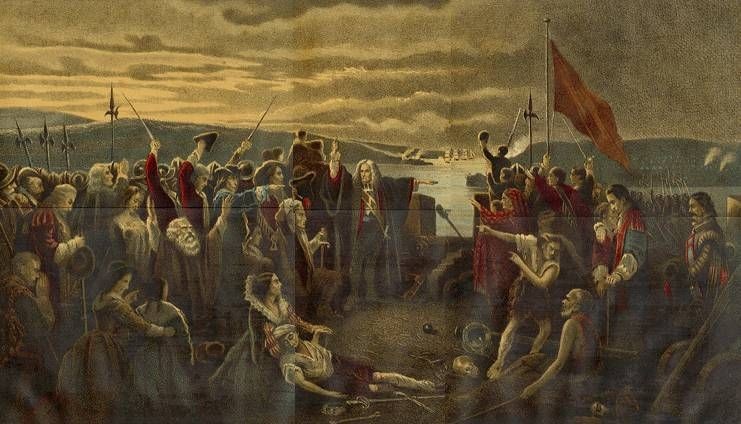
|
|
George Walker standing on the battlements
of the city of Londonderry, pointing to the relief ships sailing
up the River Foyle
|
George was joint governor of Londonderry during the siege
of
1689 in which the city was besieged for 105 days, from 18 April to
1 August 1689, by the army of James II. He is given much of the credit
for inspiring the inhabitants of Londonderry to withstand the siege, during
which about half of the town's population of about 8,000 died. George's own
first hand account of the siege (reprinted in The Siege of London-Derry, in 1689: As Set Forth in
the Literary Remains of Colonel the Rev. George Walker, D.D.
(Philip Dwyer, 1893)) was controversial and precipitated a major split
between Anglicans and Presbyterians in Londonderry. After the siege George
went to London where he was celebrated, receiving
the thanks of the House of Commons and an honorary degree of D.D. from
Oxford University. He returned to Ireland to fight with King William, losing
his life at the Battle of the Boyne in 1690.
The Life of the Most Reverend Dr. John Tillotson
vol 1 p221 (Thomas Birch, 1752)
Mr. GEORGE
WALKER, justly famous for his defence of London-Derry
in Ireland, was born of English parents in the county of Tyrone, in that kingdom, and
educated in the university of Glasgow
in Scotland. He was afterwards
Rector of Donoghmore, not many
miles from the city of London-Derry.
Upon the revolution he raised a regiment for the defence of the
Protestants, and upon intelligence of King JAMES having a
design to besiege London-Derry,
retired thither, and being at last chosen Governor of it. After the
raising of that siege he came to England,
where he was most graciously received by their Majesties, and on the
19th of November 1689,
received the thanks of the house of Commons, having just before
published an account of that siege. He was created Doctor of divinity by
the university of Oxford on
the 26th of February 1689/90, in his return to Ireland,
where he was kill'd in the beginning of July
1690 at the passage of the Boyne,
having resolved to serve that campaign before he took possession of his
Bishopric.
Ulster Journal of Archaeology vol 2 pp129-135
(1854)
BIOGRAPHICAL NOTICE OF GEORGE WALKER,
GOVERNOR OF DERRY DURING THE SIEGE IN 1688.
BY THE REV.
ABRAHAM DAWSON, A.B.
Curate of Christ's Church,
Belfast.
PART
I.
GEORGE WALKER was the son of
English parents. His father, a native of Yorkshire, appears to have
settled in the county of Tyrone, early in the seventeenth century. Like
his son he bore the name of George Walker, and was a clergyman of the
church of Ireland.
...
GEORGE WALKER, the subject of this Memoir,
son of Dr. Walker, rector of Kilmore, was born in the county of Tyrone.
The year of his birth, according to credible tradition, was 1618. Of his
early life almost nothing is recorded. The single fact which history has
preserved is, that he received his education at the university of
Glasgow.
...
We have no information when Walker was admitted into Holy Orders,
or where he spent the first part of his ministerial life. On the 16th of
July, 1669, he made the requisite subscription to the Act of Uniformity,
at Armagh, on his appointment to the parishes of Lessan (now Lissan,)
and Desertlyn, in the diocese of Armagh.
Walker was married to Isabella Maxwell, daughter to Robert
Maxwell of Finnebrogue, county Down. The exact date of this marriage is
unknown; but from a passage in Walker's “Vindication of the True Account
of the Siege of Londonderry,” it would appear to have taken place a few
years at least, prior to his appointment to Lessan and Desertlyn. Walker
was again connected with the Maxwell family by the marriage of his only
sister, Anne, to William Maxwell, of Falkland, in the county of
Monaghan, the fourth son of Dr. Maxwell, Bishop of Kilmore and Ardagh,
and nearly related to Robert Maxwell of Finnebrogue.
On the 2nd of August, 1670, Walker again made subscription at
Armagh, but without any designation appended, or any note which might
assign the reason of this additional subscription. On the 9th of
September, 1674, Walker subscribed on his appointment to the parish of
Donaghmore, in the county of Tyrone, in succession to the Rev. James
Barclay, who had been rector of that parish only from the 26th of May,
1673. Walker held Donaghmore in conjunction with his former parishes, or
certainly with Lessan, for at the Triennial Visitation, in 1679, he
appears as rector of Donaghmore and Lessan, having Bartholomew Blacke as
his curate in the latter parish.
The loss of the ancient parochial records (which would seem to be
almost universal in this country) leaves us without that information
respecting Walker, as a parish minister, which it is reasonable to
expect such documents would afford. Walker and his father, at different
times, presided over at least six parishes in Ulster; of all these the
parochial records are no longer extant. The only information of this
kind which we at present possess is furnished us by the register of the
parish of Drumglass, (Dungannon,) where Walker occasionally officiated.
The appearance of entries by Walker in this register is simply
explained. When he was appointed to Donaghmore, he found it would be
requisite to rebuild the church and glebe-house, which had been
destroyed, or very much injured, during the great rebellion of 1641.
Whilst they were being rebuilt, he resided at Dungannon, of which town
part of the suburbs are situated in the parish of Donaghmore. His
residence at Dungannon continued until a few years prior to his
retiring, with the inhabitants of the town and its vicinity, for safety,
to Derry; and during this period he frequently assisted the rector of
Drumglass, the Rev. Peter Maurice, in the several offices of the
ministry.
The earliest date in the Drumglass register is 1663. ... Walker
and his wife are noticed also as sponsors at several baptisms; and, at
page 19, the baptism of one of Walker's children is thus “stated:
Thomas, ye son of George Walker, Clerk, was baptized on
Monday, at even, ye 25 of June, (1677): Godfathers, John
Chichester, Henry Ball; Godmothers, Elizabeth Walker, Frances Nelson.”
This old register seems to tell us that Walker and his family
were on kindly terms of intimacy and friendship with the rector of
Drumglass and his parishioners.
We come now to the time when Walker's parish church and
glebe-house were rebuilt. According to the date on the sun-dial, on the
south wall of the tower, the new church of the parish of Donaghmore was
built in the year 1680, and on the 24th of September, 1681, the primate
issued a commission to William (Smith, D.D.) bishop of Killala, for its
consecration. The former church stood at the village of Donaghmore, but
the new edifice was erected at the village of Castle-Caulfield.
Tradition assigns this change of site to the influence of Lord
Charlemont, who desired that the parish church might be in the vicinity
of his mansion at the latter village. This tradition seems to be
confirmed by the prominence of Lord Charlemont's name in the primate's
commission, and by the appearance of the coronet and crest of his family
over the door of the tower.
The handsome stone windows which adorn the east and south sides
of the church were taken from the old church at Donaghmore. Over the
east window, on the exterior, there is carved in stone the figure of an
angel holding an open bible, on which are engraved the ten commandments.
The porch on the south side was added in 1685. Above the entrance there
is a piece of sculpture representing two angels, or winged figures,
holding between them an open bible, with the last four verses of the
24th psalm engraved upon it; and beneath the bible is the date of the
addition, 1685.
By the change of site the church was removed about two English
miles from the glebe-house. To obviate this disadvantage Lord
Charlemont, it is said, gave the townland of Mullamore, on which the
present glebe-house is built, for the townland of Mullagruen, on which
(adjoining to the village of Donaghmore) the old glebe-house stood. By
this alteration the residence of the rector was brought within a short
distance of his parish church at Castlecaulfield. This change however
seems to have taken effect after the death of Walker, who rebuilt the
glebe-house at Mullagruen, in the year 1683, as appears from a fragment
of this house which is still preserved. Walker's house was standing
until about twenty years ago, when it was removed to make room for the
residence of the late Alexander Mackenzie, Esq. It is well remembered by
many persons; and it has been described to the writer as a thatched
cottage, having the appearance and the accommodation of a comfortable
farm-house.
Local tradition assigns to Walker the erection of the ancient
corn mill in the village of Donaghmore, which is still standing and in
use. An apparent confirmation of this tradition is afforded by an
inscription on a stone in the wall, at the principal entrance of the
mill. The stone, which is nearly lozenge-shaped, is thus inscribed:
W
G. I.
1684.
The second initial is probably that of his wife, Isabella Walker. At
that time it was not uncommon, to inscribe the initials, or even the
names, of husband and wife together, on public buildings and works
erected by their joint munificence.
Walker appears to have maintained his parental connection with
England, by making occasional visits to that country. One of these
visits was made in March, 1685, by permission of the primate who granted
him a license for that purpose, on the 6th of this month, on his own
application as rector of Donaghmore and Lessan. A similar license was
granted to him, under the same designation on the 24th of July, 1686.
A Compendium of Irish Biography p542
(Alfred Webb, 1878)
Walker,
George, Bishop designate of Derry, Governor of Londonderry
during the siege, was born in the County of Tyrone in 1618. [His father,
George Walker, D.D., was Chancellor of Armagh Cathedral and, as such,
rector of Kilmore.] The single fact known of his early life is that he
was educated at the University of Glasgow. On 16th July 1669 he made the
requisite subscription to the Act of Uniformity at Armagh, on his
appointment as rector of the parishes of Lissan and Desertlyn. Before
this he had married Isabella Maxwell of Finnebrogue. In 1674 he received
the additional cure of the parish of Donaghmore. Pending the rebuilding
of the church and glebe-house of this parish, he resided at Dungannon.
Local tradition assigns to Walker the erection of a corn-mill in
Donaghmore, over the door of which the initials of himself and
wife—“G.W.I. 1684”— are inscribed. In the autumn and winter of 1688 the
Protestants of the north took up arms in the interest of William of
Orange, as opposed to James II. and his Viceroy Tirconnell. On 18th
(o.s.) December 1688 the apprentices of Londonderry shut the city gates
in the face of Tirconnell's army. Walker, although in his seventy-first
year, raised a regiment at his own charge, and applied “what interest he
could make towards the preservation” of Dungannon; besides immediately
opening communications with Londonderry. The garrison of Dungannon made
more than one successful sally against the bodies of Jacobites that
occupied the surrounding country, and the place would probably have been
able to hold out, but that on the 14th March, Lundy, governor of
Londonderry, directed that it should be evacuated. The order was obeyed
with reluctance, and the garrison, with many of the inhabitants, retired
towards Londonderry and Coleraine, allowing a large supply of provisions
to fall into the enemy's hands. Five companies under the command of
Walker were quartered at Rash, near Omagh, whence, a fortnight after,
they were removed to St. Johnstown, five miles from Londonderry. On 13th
April, Walker hastened into town with the news of the approach of a
large force under James II. in person. Governor Lundy advanced against
the enemy and retreated, then entered into private negotiations with
them, and also, it is said, persuaded the officers in command of a
relieving fleet in Lough Foyle, to return to England. He then declared
the defence hopeless, and the inhabitants, disgusted at his
pusillanimity, deposed him from the governorship, and permitted him to
leave the town secretly. On the 19th April, Walker and Major Baker were
appointed joint governors, a messenger was sent to London for
assistance, and the memorable siege may be said to have regularly
commenced. The fortifications were in a miserable condition; the place
was badly provisioned, and ill supplied with artillery and munitions of
war. The garrison consisted of 7,369 men, encumbered, besides the
inhabitants of the place, with numerous fugitives from the surrounding
districts. Everything was wanting but brave hearts and heroic
self-devotion. The besieging army, at first commanded by King James, and
afterwards by his most experienced generals, outnumbered the garrison by
some three to one. “It was certainly,” says Harris in his life of
William III., “a very bold undertaking in these two gentlemen to
maintain against a formidable army, commanded by a king in person, an
ill-fortified town, with a garrison composed of poor people frightened
from their habitations, and without a proportionable number of horse to
sally out, or engineers to instruct them in the necessary work. Nor had
they above twenty cannons, of which not one was well mounted, and, in
the opinion of the former governor, not above ten days' provisions.” The
defence. which lasted above a hundred days, was one of the most heroic
in history; and when the siege was raised, the garrison was reduced by
deaths in sallies and on the walls, and by disease, to 4,300, “of whom
at least a fourth part were rendered unserviceable.” Of garrison and
inhabitants 9,000 are calculated to have died within the walls during
the siege To increase their difficulties, De Rosen, James's general,
upon one occasion drove some thousands of Protestants from the
surrounding country under the walls, and kept them there for three days,
in the hope that the garrison would take them in and thereby be further
weakened. By the time they were permitted to depart Walker had cleverly
managed to draw in from amongst them the strong and hardy, and to send
away in their place some of his old and useless mouths. On 30th June
Major Baker died, and Colonel Mitchelburne was made Walker's assistant.
Without declining the post of danger and honour at the head of the
garrison, Walker always appeared willing to concede to others, where
practicable, the military functions so little suited to his cloth. He
took part in the daily service in the cathedral, as well as in the other
duties of his office, and his dress always indicated that in becoming a
soldier he had not ceased to be a priest. Towards the end of the siege,
“such a scarcity of the vilest eatables was in the city, that
horse-flesh was sold for 1s. 8d. a pound; a quarter of a dog fattened by
the dead bodies of the slain Irish, 5s. 6d; a dog's head, 2s. 6d.; a
cat, 4s. 6d.; a rat, 1s.; a mouse, 6d.; greaves by the pound, 1s.;
tallow, 4s.; salted hides, 1s.; and other things in proportion. Their
drink was water mixed with ginger and anise-seeds; and their necessity
of eating a composition of tallow and starch not only nourished and
supported them, but proved an infallible cure for the flux.” The women
shared in the labours of the men, carrying ammunition to the soldiers,
attending to the sick and wounded, and at times giving assistance in
repelling the assaults of the besiegers. Eighteen Church clergymen and
eight dissenting ministers took part in the toils of the siege, and
their turn in leading daily services in the cathedral and other places
of worship. In June an English fleet arrived in Lough Foyle; but the
banks of the lough being in the occupation of the enemy, it was unable
to throw any relief into the town, and could not even have communicated
with the inhabitants, but for the bravery of Colonel Roche. [See page
456.] At length, on the 30th of July, the Mountjoy
broke the boom that the besiegers had placed across the river, and
running the gauntlet of a furious cannonade, sailed up to the quay,
followed by two other vessels carrying supplies and provisions. All the
eatables in the place at the time are said to have been nine lean
horses, and a pint of meal to each man. A few days afterwards De Rosen
broke up camp and raised the siege, having lost, it is stated, 8,000 to
9,000 men. Walker presented the keys of the city to Major-General Kirk,
who had come with the fleet. Kirk declined to receive them, but next day
permitted Walker, who was anxious that “he might return to his own
profession,” to resign the governorship to Captain White, “a gentleman
of experienced valour and known merit.” Walker, when praised for the
part he had taken with great humility declared that the “whole conduct
of this matter must be ascribed to Providence alone. . . . God was
pleased to make us the happy instruments of preserving this place, and
to Him we give the glory. . . With his own right hand and his holy arm
getting Himself the victory.” At a meeting of the heroic inhabitants of
Londonderry, Walker was deputed to go to England to present an address
to King William and Queen Mary, expressive of their gratitude for the
relief they had received, and to assure their Majesties of their devoted
allegiance. He went by way of Scotland, and was received with great
distinction in Glasgow, where the freedom of the city was conferred upon
him. A similar honour was accorded him at Edinburgh. On the journey he
was met by a letter from King William: he was escorted into London with
great respect, and was graciously received at court. With much good
taste, Walker refused to accede to the desire of many that he should
appear before his Majesty in the semi-military apparel he had worn
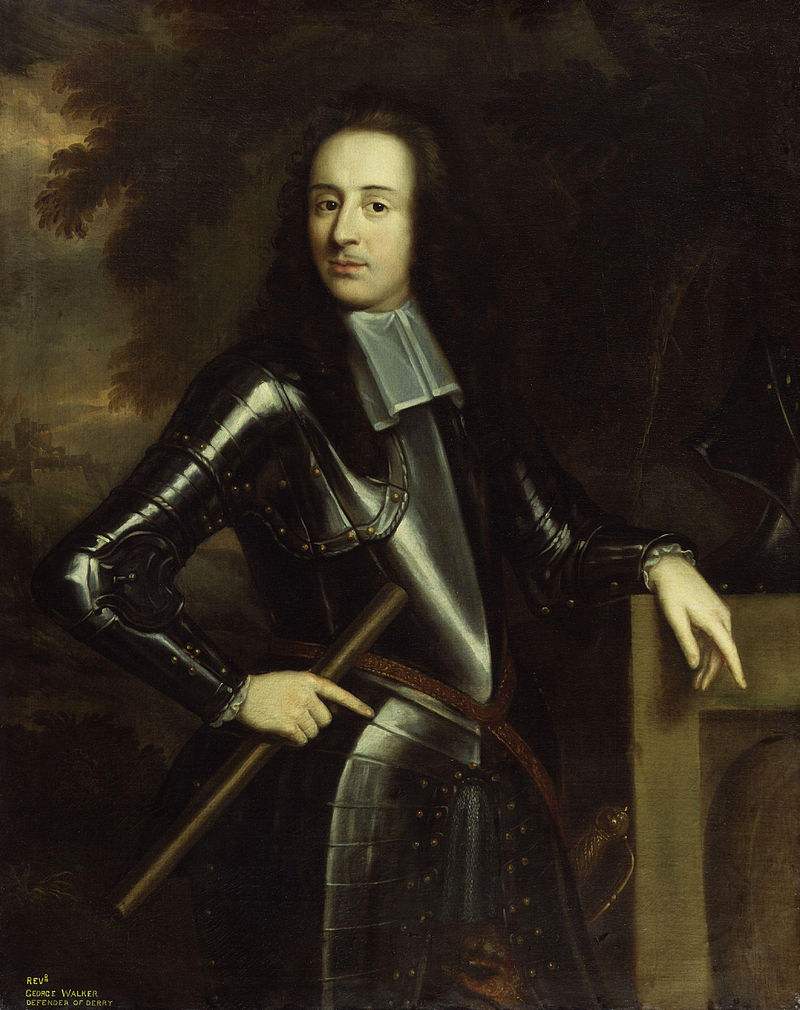
during the siege. Sir Godfrey Kneller painted his portrait for the King;
a grant of £5,000 (never paid, apparently) was made by Parliament, in
consideration of his heavy expenses and losses; he was designated to the
bishopric of Derry, was entertained by the Irish Society, and received
the thanks of the House of Commons. In September he published his famous
True Account of the Siege of
Londonderry, the statements in which were afterwards
re-asserted in the publication of his Vindication
of the True Account. There appears to have been considerable
bitterness amongst the defenders regarding the statements given to the
world of the events of the siege. Quite a number of True
Accounts and Answers
appeared, and in the end both inhabitants and leaders in the defence
considered themselves very negligently treated by Government. [See CAIRNES,
DAVID, p. 67.] Walker returned to Ireland in the
beginning of 1690, receiving at Oxford, on his way, the degree of Doctor
in Divinity. When William III. landed at Belfast in June, Walker
presented him with a congratulatory address in the name of the Ulster
clergy. He accompanied William in his march southward, on the way being
confirmed in the bishopric of Derry. On 12th July, in the early part of
the battle of the Boyne, he crossed the river with one of the
Enniskillen regiments, fell mortally wounded, and was interred on the
battle-field. After several years, and at his widow's desire, his body
was exhumed by a faithful servant who had accompanied him into the
fight, and deposited within the church at Castlecaulfield, where a
tasteful monument marks his resting-place. In 1838 his remains and those
of his wife were placed in new coffins. It was not until 1703 that his
son received a pension of £200 per annum from the Irish Parliament,
terminated in 1717 by the grant of 2,000. In 1828 the monument to his
memory on the walls of Londonderry was completed. Macaulay says: “On the
summit is the statue of Walker, such as when, in the last and most
terrible emergency, his eloquence raised the fainting courage of his
brethren. In one hand he grasps a Bible; the other pointing down the
river seems to direct the eyes of his famished audience to the English
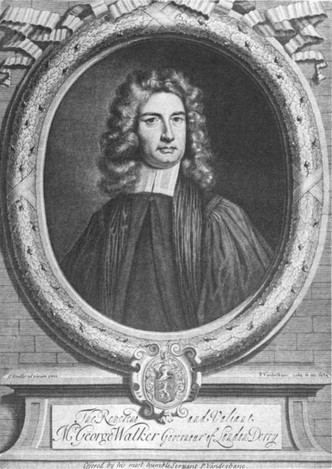
topmasts in the distant bay.” The likeness appended to a memoir in the Ulster Journal of Archaeology, vol.
ii., represents Walker as a noble looking man.
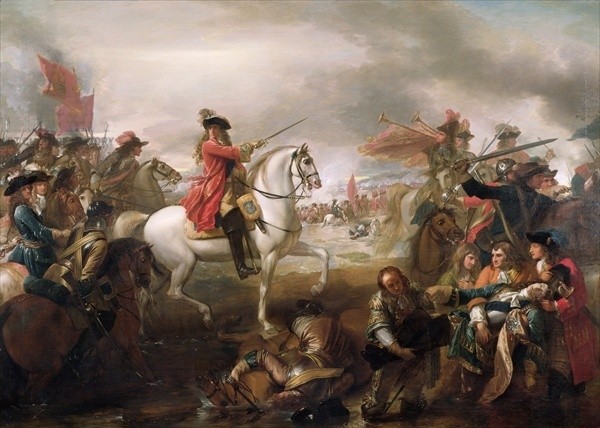
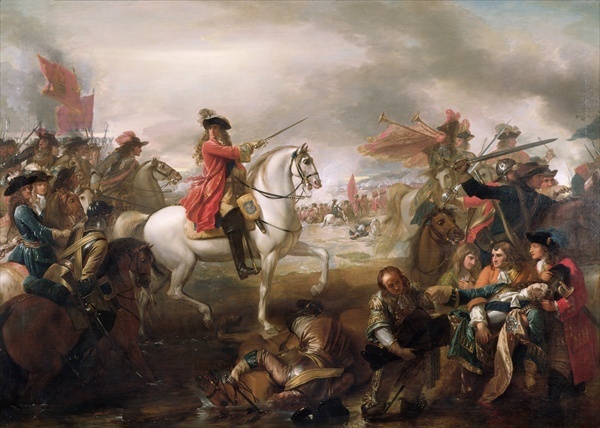
|
In this iconic painting of the Battle of
the Boyne by Benjamin West, the dying figure fallen from his horse
in the middle foreground has
been identified as Rev. George Walker.
|
1 July 1690, at the Battle of the
Boyne, Londonderry, Ireland
A History of Ireland, from the relief of Londonderry
in 1689, to the surrender of Limerick in 1691 p164 (John
Graham, 1839)
Not long
after the death of Schomberg, the renowned George Walker, who has so
highly distinguished himself in the defence of Londonderry, received a
wound in the belly, which he survived but a few minutes, dying in the
seventy-first or seventy-second year of his age, and leaving the
bishopric of Derry, to which he had been appointed by King William,
vacant.
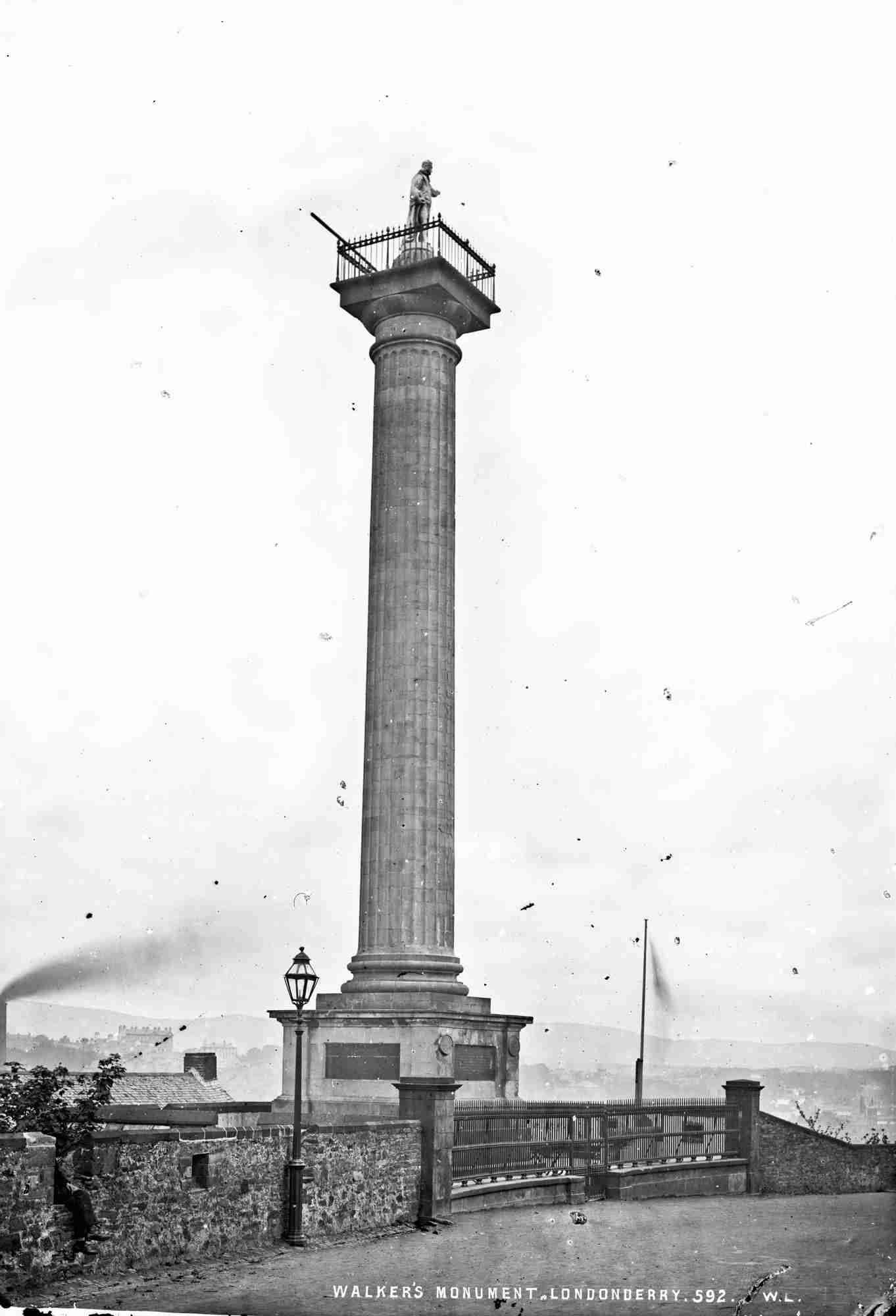
|
|
Walker's Monument on the walls of Derry,
commemorating Rev. George Walker, was erected in 1828 and
destroyed in 1973.
|
George was initially buried at the
battlefield on the banks of the Boyne, but thirteen years later, in 1703,
his bones were dug up at the direction of his widow and re-interred at the
Church of Castlecaulfield, Donaghmore in county Tyrone, Ireland. Then in
1838, during renovation of the church, these remains were found in a small
oak box next to the remains of his widow. A cast was taken of George's
skull, and the remains were then re-interred in the church in a new coffin.
Walker's Monument was erected in Londonderry in 1828. The Doric column was
96 feet in height and six feet nine inches in circumference. Inside was a
spiral staircase with 110 steps. The column was surmounted by a square
platform with a railing, and a statue of George Walker with a bible in his
right hand and his left hand pointing down river towards the Boom, the
breaking of which heralded the end of the Siege. Originally, the left hand
held a sword, but during a night of storm in the early part of the 20th
century this was blown down. The pillar was destroyed by a bomb on 27 August
1973. Claiming responsibility for the blast, the Provisional IRA said: "The
monument was built in defiance of the nationally-minded people of Derry and
served as a symbol of unionist domination."
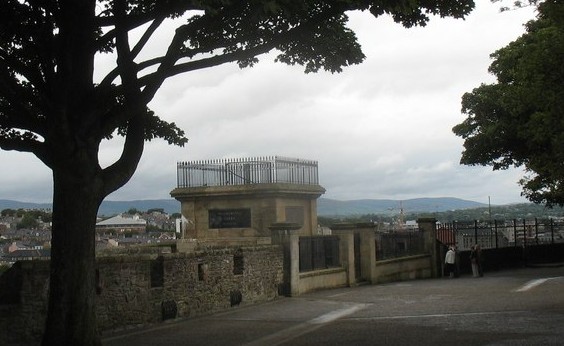
|
|
The Walker Plinth, on the walls of Derry,
is all that remains today of Walker's Monument
|
The plinth on which the tower stood, along with its antagonistic inscription
on each side, remains. This inscription reads:
This monument was erected to perpetuate the
memory of Rev. George Walker who, aided by the garrison and brave
inhabitants of this city, most gallantly defended through a protracted
siege, from the 7th December 1688 to the 1st August following, against an
arbitrary and bigoted monarch, heading an army of upwards of 20,000 men,
many of whom were foreign mercenaries, and by such valiant conduct in
numerous sorties and by patiently enduring extreme privations and
sufferings, successfully resisted the besiegers and preserved for their
posterity the blessings of civil and religious liberty.
The Derry Journal of 23 July 2010 in "Siege
hero Walker felled in midnight blast" tells an interesting history of
the use of the monument over the years by both sides of the sectarian
conflict.
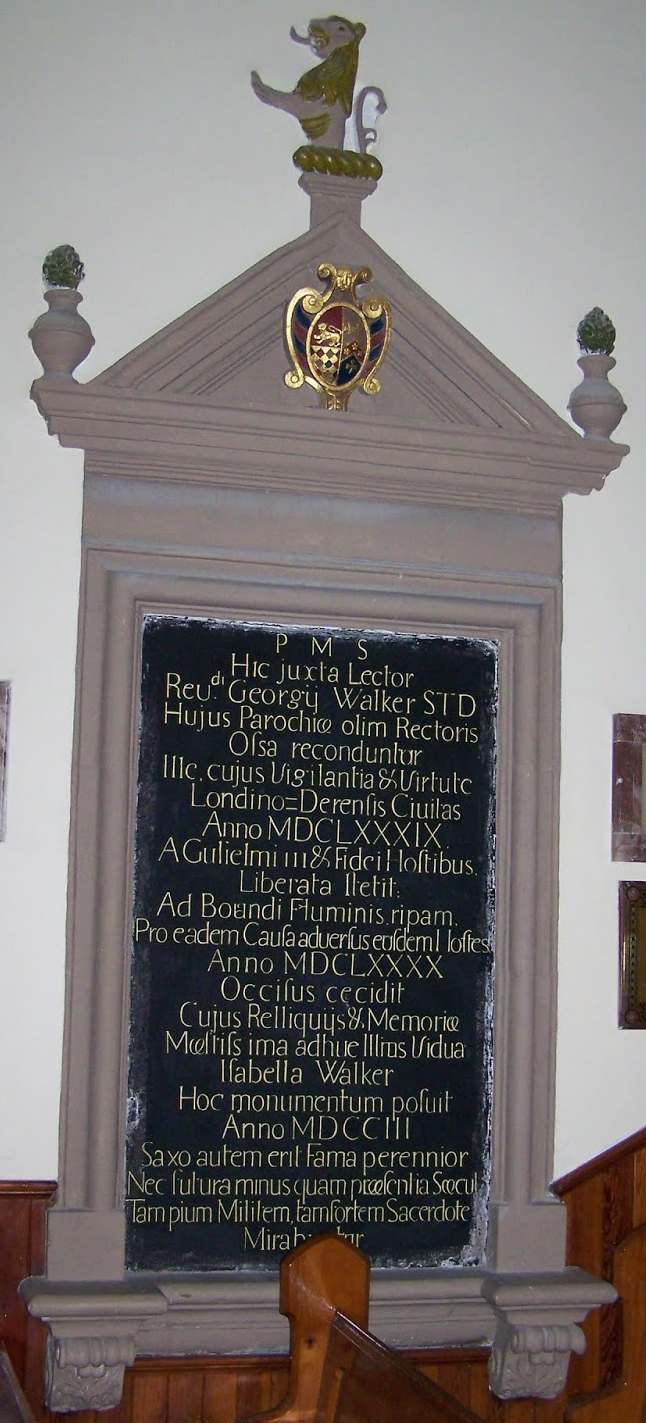
|
|
The George Walker Monument in
Castlecaulfield church, Donaghmore, county Tyrone
|
A History of Ireland, from the relief of Londonderry
in 1689, to the surrender of Limerick in 1691 p165 (John
Graham, 1839)
In the
Church of Castlecaulfield, in the county of Tyrone, of which Walker had
been Rector at the time he went to the siege of Derry, is a monument of
him in excellent preservation, on which, under his arms is the following
inscription:—
P.M.S.
Hic juxta lector
Reverendi Georgii Walker, S.T.D.
Hujus Parochiæ olim Rectoris,
Ossa Reconduntur,
Ille cujus vigilantia et virtute,
Londiniderriensis civitas,
Anno MDCLXXXIX;
Fidei hostibus
Liberata stetit.
Ad Boandi fluminis ripam,
Pro eadem causa adversus easdem hostes,
Anno MDCXC,
Occisus cecidit;
Cujus reliquiis et memoriæ,
Mœstissima adhuc vidua,
Isabella Walker,
Hoc monumentum posuit
Anno MDCCCIII.
Saxo autem Tama erit perennoir.
Nec futura minus quam præsentia sæcula
Tam purum militem, tam fortem sacerdotem
Mirabuntur.
The Siege of London-Derry, in 1689: As Set Forth in
the Literary Remains of Colonel the Rev. George Walker, D.D. p237
(Philip Dwyer, 1893)
The
following is the literal translation by Rev. Paul Walker, Vicar of
Stopsley, a descendant of Rev. G. Walker, of the Latin inscription
carved on the monument in Donoughmore Church, Castle Caulfield.
P.M.S.
“Near this, oh reader, are deposited the remains of the Rev.
George Walker, Doctor of Sacred Theology, formerly Rector of this
Parish. He, by whose vigilance and valour Londonderry, in the year 1689
was rescued from the enemies of William and the faith, fell mortally
wounded on the banks of the Boyne, for the same cause against the same
enemies in the year 1690, to whose remains and memory his still
inconsolable widow, Isabella Walker, has erected this monument, in the
year 1703.
“But his fame shall be more durable than Rock,
nor will future ages less than the present admire a Soldier so pious and
a Minister so intrepid.”
A History of Ireland, from the relief of Londonderry
in 1689, to the surrender of Limerick in 1691 pp361-5 (John
Graham, 1839)
DISCOVERY
AND RE-INTERMENT OF THE REMAINS OF THE REV. GEORGE WALKER, RECTOR OF
DONOUGHMORE, AND GOVERNOR OF LONDONDERRY.
———
“Thrice honored shade of Walker
wise,
To Derry's cause so
true,
Oh! could you from the starry skies
Our sad condition
view:—
How would your wounded spirit feel,
The dark day to behold,
When all our fathers won by steel,
Their sons betrayed for
gold.”—GRAHAM.
———
On Tuesday, the 16th of October, 1838, the Church of Donaghmore,
at Castle Caulfield, being in the process of repair by the
Ecclesiastical Commissioners, it was found necessary to lower and level
the floor of it.
In that part of the chancel, immediately under the Monument
of Governor Walker, the workmen discovered a full-sized oak coffin,
containing the remains of his widow, who, in 1703, caused his bones to
be brought there from the banks of the Boyne, where his body had been
interred and had lain for thirteen years. They were this day found in a
small oak box, in which this “widow, indeed,” full of endearing
recollections of happier days, had deposited them.
This worthy lady was the mother of four sons of the
renowned Walker, who, at his death, were serving in King William's army,
and each of whom, in justice to their immortal father's services and
their own, ought to have inherited one of the forfeited estates. John
Walker, the eldest son, on a petition to the House of Commons, obtained
a pension of two hundred pounds a year, which he enjoyed until the
beginning of the reign of George the First, when he was deprived of it
by the parsimony of the triumphant Whigs. Of the other sons there is no
record, save that the daughter of one of them was the mother of the late
Mrs. Caldbeck, of Lisburn.
The Walkers were a Yorkshire family. The father of the
Governor of Derry was the Rev. George Walker, sen., Rector of Cappagh,
County Tyrone, the friend and confidential adviser of Dr. Bramhall,
Bishop of Derry, when this Prelate was nobly using his private means and
public influence in regaining the alienated property of the Church of
Ireland, and purchasing the advowsons of the impropriated rectories,
which he added to the vicarages throughout the Diocese. He sent his son
and namesake to Glasgow College for education; and on the young man's
return, soon after the restoration of King Charles the Second, he was
presented to the rectories of Donoughmore and Errigal Keerogue, in the
county of Tyrone. Walker was in the sear and yellow leaf of life when he
went to Derry, in 1689, being then, according to credible tradition, 71
years of age. His sister Anne married William Maxwell, Esq., of
Falkland, High Sheriff of the county of Monaghan, in the year 1691, and
who was great grandfather of the present representative of his renowned
ancestor—the Rev. Thomas Carpendale, rector of Donoughmore.
Mr. Carpendale, with Edward Evans, Esq., son of the Rev.
George Evans, who had been upwards of thirty years rector of
Donoughmore, Alexander Mackenzie, Esq., and a few others, naturally
regardful of the remains of this great and good man, caused them to be
taken carefully from the decayed box in which they were found, and
putting them and those of his widow, into smaller boxes, enclosed both
with suitable inscriptions into a leaden coffin, which, being laid in
one of deal plank, was solemnly deposited in the hero's grave, by his
reverend descendant and successor, assisted by the Rev. John Graham,
Author of the History of the Siege of Derry, and also by one of the
oldest Apprentice Boys of the maiden city.
In the case with Governer Walker's remains was placed a
flint glass bottle, hermetically sealed, containing the following
writing on parchment:
“Be it recorded, that whilst this church was undergoing
repair, in the year 1838, search was made beneath the monument of the
Rev. George Walker, immediately opposite to the communion-table, at the
eastern end of the church, and south side of the aisle, to ascertain
whether his bones were deposited there, agreeable to the inscription on
the monument, erected by his widow in the year 1703.
“We, whose names are hereunto subscribed, having assembled
in said church, on Tuesday the 16th of October 1838, and having made
search immediately beneath said monument, fixed in the wall, have found,
in a full-sized oak coffin, the remains of his widow, and in a small
oaken case adjoining were deposited bones which had not the appearance
of regular interment in a coffin, but corresponding with the words on
the monument, ‘Ossa reconduntur,’ &c. &c.
“Now, to testify our veneration and respect for the memory
of the illustrious Walker, we herein carefully replace the bones, and
restore them to their former position, together with this record.
“THOMAS CARPENDALE, Rector of the Parish
of Donoughmore.
“ROBERT FRASER, Curate of said
Parish.
“EDWARD EVANS, Esq., of Dungannon,
son of the Rev. GEORGE EVANS, formerly Rector of said Parish.
“EDWARD EVANS, jun., Esq., of
Armagh, son of the said Edward.
“HENRY POLE, Esq., J.P.,
Dungannon.”
Previous to the re-interment of the bones, a cast was taken
of the skull, which was perfectly sound, and in which the organs of
intelligence and firmness were remarkably developed.
Walker afforded an instance of the value of a classical
education and habits of literary composition to a military man; proving
that the hero, capable of recording actions in which he has been
concerned, with modesty and without exaggeration, is more likely to get
full credit for his own merits, than the illiterate warrior, who
requires another man's pen to do justice to him.
The following extract from the Preface to the “History of
the Siege of Londonderry” may not be unsuitable in this place:
“The applause which immediately followed the publication of
Walker's Diary in London, was unbounded. The heroic author basked in the
sunshine of royal and popular favour, seldom beaming on the head of any
one man at the same time, however great his worth or important his
services. King William's munificent bounty to him, was a matter of
policy as well as gratitude, scarce less beneficial to the giver than to
the receiver of it. The Whigs, who were even then ready enough to be
troublesome to their deliverer, and soon afterwards made him weary of
his crown and his life together, hailed it as an act which reflected
equal honour upon both; and the celebrated Tillotson, afterwards
Archbishop of Canterbury, thus re-echoed the voice of the public upon
Walker's promotion to the See of Derry, in his letter to Lady Russell,
of the 19th of September, 1689:
“ ‘The King, besides his first bounty to Mr. Walker (£5,000), whose
modesty is equal to his merit, hath made him Bishop of Londonderry, one
of the best Bishoprics in Ireland. It is incredible how much every body
is pleased with what his Majesty hath done in this matter, and it is no
small joy to me to see that GOD directs him so wisely.’
“On the 19th of November, in the same year, he received the
thanks of the House of Commons; and on the 26th of February following,
the University of Oxford, with that regard to the Protestant interest
which still characterizes it, conferred upon him the honorary degree of
Doctor of Divinity. Sir Godfrey Kneller, at the King's command, drew his
picture; and copper-plates struck off from it were dispersed through the
three kingdoms. In some of the prints he is drawn with a Bible open, at
the 20th chapter of Exodus, in one hand, and a drawn sword in the other.
His garment of a purple colour, and a large old-fashioned band, form a
strong contrast to the military sash, appearing in crimson folds about
his waist. A copy of this curious print hung for half a century over the
parlor fire-place of a tavern in Londonderry.”
Another copy, said to be a more correct likeness, is in
possession of his descendent, William Caldbeck, Esq., of Lisburn,
Sub-Sheriff of the county of Down.
George died intestate.
The Siege of London-Derry, in 1689: As Set Forth in
the Literary Remains of Colonel the Rev. George Walker, D.D. p237
(Philip Dwyer, 1893)
Walker
died intestate. There were grants of administration taken out, one to
the Archbishop of Tuam, and two to his wife Isabella. “There is no will
or inventories preserved of Dr. Walker.”
-
Baptism records for George have not been found; an early published
source The Life of the Most Reverend Dr. John Tillotson
vol 1 p221 (Thomas Birch, 1752) states that he was born in county
Tyrone. A History of Ireland, from the relief of
Londonderry in 1689, to the surrender of Limerick in 1691
p164 (John Graham, 1839) then states that "when he went to Derry,
in 1689, being then according to credible tradition, 7l years of age"
which Ulster Journal of Archaeology vol 2
pp129-135 (1854) then repeats as "The year of his birth, according
to credible tradition, was 1618" and later published sources, including
A Compendium of Irish Biography p542
(Alfred Webb, 1878), The Siege of Londonderry, in 1689 p125
(Philip Dwyer, 1893) and Armagh Clergy and Parishes p230 (James
B. Leslie, 1911) just show George as born in 1618 in county Tyrone. I am
happy to believe George was born in county Tyrone, but I struggle to
reconcile the 1618 date with other data points - George's father only
entered T.C.D in in 1617 and did not graduate until 1621, George's first
appointment as vicar was in 1669, George's sister Anne was the mother of
infants at the time of her husband's death in 1691, his sister Margaret
was baptised in Kirk Deighton in 1650 when her father was the vicar of
Wighill, in exile from Ireland - see Nidderdale, from Nun Monkton to Whernside
p174 (Harry Speight, 1906). My best guess is that George was born
in the late 1630s in county Tyrone, some time before his parents removed
to the vicinity of his mother's family in Yorkshire to escape the
political turmoil of the Irish
Rebellion of 1641.
- Ulster Journal of Archaeology vol 2
pp129-135 (1854) (Joseph Foster, 1892); A Compendium of Irish Biography p542
(Alfred Webb, 1878); Armagh Clergy and Parishes pp230-1
(James B. Leslie, 1911)
- Alumni Oxonienses 1500-1713 vol III p1556
(Joseph Foster, 1892); Armagh Clergy and Parishes pp230-1
(James B. Leslie, 1911); Ulster Journal of Archaeology vol 2 p131
(1854)
- Ireland Preserved p320 and p381
(John Graham, 1841); Ulster Journal of Archaeology vol 2
pp129-135 (1854); A Compendium of Irish Biography p542
(Alfred Webb, 1878); Armagh Clergy and Parishes pp230-1
(James B. Leslie, 1911)
- Armagh Clergy and Parishes pp230-1
(James B. Leslie, 1911); Ulster Journal of Archaeology vol 2
pp129-135 (1854)
- A History of Ireland, from the relief of
Londonderry in 1689, to the surrender of Limerick in 1691
p164 (John Graham, 1839); The Siege of London-Derry, in 1689: As Set Forth
in the Literary Remains of Colonel the Rev. George Walker, D.D.
p237 (Philip Dwyer, 1893)
- A History of Ireland, from the relief of
Londonderry in 1689, to the surrender of Limerick in 1691
pp361-5 (John Graham, 1839); Newry
Telegraph, 30 October 1838
- The Siege of London-Derry, in 1689: As Set Forth
in the Literary Remains of Colonel the Rev. George Walker, D.D.
p237 (Philip Dwyer, 1893)
George Walker
George Walker
Isabella
(Maxwell) Walker
Elizabeth Moland
A
Great Archbishop of Dublin, William King, D.D., 1650-1729 p31
(William King, 1908)
King William
had made choice of the heroic governor of Derry, Rev. George Walker,
D.D., rector of Donaghmore, Co. Tyrone, to be the new bishop, but the
brave old man, notwithstanding his age and profession, accompanied the
colonists of Ulster to animate their zeal by exhortation and example,
and was shot dead at the Boyne; he left, by Margaret, his wife, a son,
George, of Donaghmore, who married Elizabeth Moland, and died 1699;
After George's death, Elizabeth married Thomas Richardson on 7 December 1705
in Dublin St Michan, county Dublin, Ireland. As Elizabeth Richardson, she is
mentioned in a deed concerning the will of George's brother, John, on 26
July 1728:
Transcripts
of memorials of deeds, conveyances and wills Memorial No: 38369 film
007905895 image 163
Eliz Richardson, otw Walker Relict of George Walker Esqr Deced
who was eldest son of the Reverend Doctr George Walker late
Governr of Londonderry Deced
George was the eldest son of George
Walker, Governor of Londonderry.
In his Vindication of the True Account of the Siege of Derry,
written in 1689, Governor George Walker mentions that he has four sons in
the service of King William, likely including this George, his eldest son.
This George is also likely the George Walker who co-signed the address to
King William and Queen Mary written by his father on 29 July 1689 (The Siege of London-Derry, in 1689: As Set Forth in
the Literary Remains of Colonel the Rev. George Walker, D.D. p41
(Philip Dwyer, 1893))
c1699, at which time he was of Donaghmore, county Tyrone,
Ireland
granted 1699
- Transcripts
of memorials of deeds, conveyances and wills Memorial No: 38369 film
007905895 image 163; A Great Archbishop of Dublin, William King, D.D.,
1650-1729 p31 (William King, 1908)
- A Great Archbishop of Dublin, William King, D.D.,
1650-1729 p31 (William King, 1908); Elizabeth 2nd
marriage from parish
registers of Dublin St Michan Marriages 1705 and Transcripts
of memorials of deeds, conveyances and wills Memorial No: 38369 film
007905895 image 163
- Transcripts
of memorials of deeds, conveyances and wills Memorial No: 38369 film
007905895 image 163
- Administration granted in
1699 to George Walker of Donaghmore Co Tyrone Gent. I[ntestate], from Ireland
National Archives Diocesan and Prerogative Wills W1699
- Administration
granted in 1699 to George Walker of Donaghmore Co Tyrone Gent.
I[ntestate], from Ireland
National Archives Diocesan and Prerogative Wills W1699
George Walker
1695 in Ireland
John Walker
- Walker family tree supplied by Maylon Walker
Gervase Walker
1566, in Ruddington, Nottinghamshire,
England
Thomas Walker
Mr. Smith at Nottingham School;
Caius College, Cambridge which he entered 3 January 1584/5, and obtained his
B.A. in 1588/9.
Biographical History of Gonville and Caius College
vol p123 (John Venn, 1897)
Walker, Gervase
(matriculated as James), of Ruddington, Notts.: son of Thomas Walker,
mediocris fortunæ. School, Nottingham, under Mr Smith. Age 18. Admitted
Jan. 3, 1584-5, sizar of his surety, Mr George Estey, M.A., fellow.
B.A. 1588-9. Ordained deacon (Lond.), March 29, 1591; as curate
of All SS., Steyning, London. Vicar of Gt Staughton, Hunts., 1593.
Alumni Cantabrigienses part 1 vol 4 p316
(John Venn, 1927)
WALKER,
GERVASE. Adm. sizar (age 18) at CAIUS, Jan. 3,
1584-5. S. of Thomas, of Ruddington, Notts. School, Nottingham (Mr
Smith). B.A. 1588-9. Ord. deacon (London) Mar. 29, 1591; priest, 1592.
C. of All Saints', Steyning, London. V. of Gt Staughton, Hunts.,
1594-1615. One of these names R. of Cappagh and Badony, Derry, in 1622.
(Venn, 1. 123.)
Clergyman.
Gervase was ordained deacon in London Mar. 29, 1591 and priest in 1592.
He was curate of All Saints Steyning, London and vicar of Great Staughton,
Huntingdonshire from 1594 until 1615. He was also vicar of Cappagh
from 1622-36 and rector of Badoney, county Derry also from 1622-36.
Ulster Journal of Archaeology vol 1 p245
(1894)
The Estate of
the Diocess of Derry
COMPILED BY DR. GEORGE DOWNHAM BISHOP OF THAT SEE—1616-34.
From the Original MS.—intitled
“The Ulster Visitation Book, 1622,”
...
11. The Church of Cappy is uncovered.
The Incumbent is GERVASE WALKER, Mr
of Arts, a grave man and an ancient preacher.
The valuation in the King's Books is xiiili, vis,
viii., the third part of the cleare value. The vicesima is xiii. ivd.
It hath three townelands of glebe, upon one of them, called
Rehen, the Incumbent hath built one
(? a) mansion house of timber after the English fashion.
The Incumbent is resident, and serveth the Cure himself in a
house given by Sr John Dromond (?),
Kt, to that use.
12 The Church of Bodony is ruinous.
The Incumbent is the sd GERVASE WALKER,
who by dispensation holdeth this with the former, the parish being
contiguous.
The valuation in the King's Books is xli, wch is
somewhat more than the fourth part of the cleare value. The vicesima xs.
It hath but one towneland of glebe, sett forth in the wild
mountaynes, two miles distant from the church.
The Incumbent hath bound his Tenant to build ane house after the
English manner, wch is in building.
The Cure is served partly by the Incumbent himself and partly by
an Irish Clerk, the parish consisting wholy of Irish recusants.
Ulster Journal of Archaeology vol 1 p252
(1895)
Cappy [NOW
CAPPAGH]. Sti
Eugenii.
In 1622, GERVASE WALKER, M.A. He was
also R. of Badoney
Derry Clergy and Parishes p100 (James B
Leslie, 1937)
Parish of
Badoney: Rectors
1622.- Gervase Walker appears R,. (R.V.). Probably Gervase W., son of
Thomas W. of Ruddington, Notts., ed. by Mr. Smith at Nottingham Sch.,
adm. Siz. aged 18 at Caius Coll. Cambr. Jan. 3, 1584/5, B.A. 1588/9 ;
ord. D. London Mar. 29, 1591, P. 1592, C. All SS. Steyning, London, V.
Great Staughton, Hunts. 1594-1615 (Venn's Al. Cant.). He was also V.
Cappagh 1622-36. He got a grant of a glebe here on May 24, 1626 (Morrin
III 177). He is described in the R.V. 1622 as "a Master of Arts, a grave
man and a preacher." He seems to have res. in 1636 in favour of his son.
In the Derry Cath. Reg. is the entry "Mr. Garvis Walker was buried on
1st July 1642."
Rev. Geo. Walker below, was his son: a grand dau. m. Abp. John Vesy of
Tuam.
1 July 1642, in St. Columb's
Cathedral, Londonderry, Ireland
Gervase Walker
in Ireland
George Walker
Isabella
(Maxwell) Walker
Notes and Queries vol 8 p151 (23 August
1913)
Governor Walker had a son Gervase
Isabella (Walker) Woolsey
1702 in Ireland
John Walker
William Woolsey
Rev William Woolsey was rector of Dundalk from 1709 until 1728
Jane (Walker) Read
1699 in Ireland
John Walker
James Read, of Dundalk, county
Louth, Ireland.
John Walker
1669/70, in Minimore [Moneymore],
county Derry, Ireland
George Walker
Isabella
(Maxwell) Walker
Trinity College Dublin
Alumni Dublinenses p847 (ed. G. D.
Burtchaeli and T. U. Sadlier, 1935):
WALKER, JOHN, Pen. (Mr Collier,
Armagh), Oct. 8, 1685, aged 15; s. of George, Theologus de Donoghmore in
Com. Tyronensi; b. Minimore, Co. Derry.
Collector of Customs, in Cavan,
then Armagh, then Dundalk.
The Antiquities and History of Ireland p187
(James Ware, 1705)
The Collectors
of the several Districts in Ireland.
...
Cavan, John Walker
A History of Ireland, from the relief of Londonderry
in 1689, to the surrender of Limerick in 1691 p362 (John
Graham, 1839)
John Walker,
the eldest son, on a petition to the House of Commons, obtained a
pension of two hundred pounds a year, which he enjoyed until the
beginning of the reign of George the First, when he was deprived of it
by the parsimony of the triumphant Whigs.
St Michael's
Castlecaulfield & St Patrick's Donaghmore
The Glebe House
at Mullygruen was rebuilt by George Walker in 1683-4. The old house which
he replaced must itself have been a considerable mansion, for in
Archbishop Ussher's manuscript on the state of the diocese in 1622 it was
valued at £70. This house was destroyed in the Jacobite wars and rebuilt
around 1707 by George Walker's son John, who lived there for some years.
Extracts from
an Account of the Lands of the Archbishop of Armagh for County Tyrone, By
Thomas Ashe 1703
Parishes of Donaghmore & Killeshil
Extracted from the enormous Archbishopric of
Armagh Estate, Public Record Office of Northern Ireland (PRONI), Belfast
Ref PRONI Ref: T848/1
The Archbishop of Armagh owned large tracts of land in Counties Tyrone,
Londonderry, Armagh, Monaghan and Louth. With the exception of place names
and personal names, spelling in this document has been modernised and
punctuation has been inserted where it has been judged useful and
relevant. Acreages are in Irish Plantation Measure [IPM]. One Irish acre
equals 1.62 statute acres.
...
Mullagrewan
Mr. Robert Walker and under him Mr. Thomas Carr are tenants. This is very
good land well enclosed with quicksetts. Note: - in Survey this is called
Cleggan and in the country called Donoghmore - Here it was that the famous
Dr. Walker dwelt, I say famous because of his great services at Derry in
the last Rebellion. The rebels burnt his house here and his son Mr. John
Walker is now rebuilding of it. And the present Lord Primate for his
Encouragement gave him what timber he desired for that use. This contains
116 acres 1 rood 24 perches IPM. There is a great deal of good meadow
belonging to this and on this farm is a very good corn-mill built with
lime and stone.
This
memorial, dated 1 February 1722, concerns a judgement of £2000 awarded
to John from Audley Mervyn, related to lands in the Omagh, county Tyrone.
10 October 1726
Ireland
National Archives Diocesan and Prerogative Wills 1726
In the Name of
God Amen, I John Walker of the County of Louth Esqr.
being in perfect Sence and memory but weak in body thanks be to God do
make this my last Will and Testament in maner following First I bequeath
my Soul to the great god heaven trusting that he will graciously be
pleased through the meritts and intercession of my blessed redeemer
receive me into Glory my will is that I be interd in the nigh time in the
Church yeard of Newry by my Son John Walker in the most private manner
possible my will also is that my debts be discharged out of my reall and
personall estate and that the remainder be equally divided between my
daughter Jane Walker and my Son George Walker I likewise bequeath to my
son Robert Walker one shilling and to my daughter Isabella Woolsey alias
Walker one shilling in full of any claim or right they may have to my
fortune or any part thereof I also knowing my concerns to be very
unsettled and confused make it my last and earnest request to my dearly
beloved Cousin Robert Maxwell of Faulkland in the County of Monaghan Esqr
that he will become Executor of this my last Will Joynt with my dearly
beloved Sister Charity Dyneley als Walker Lastly I do declare all former
Wills made by me to be utterly void and of none effect in law or equity
and do publish and declare this to be my last Will and Testament this
twenty Seventh of August One thousand Seven hundred twenty and Six 1726 —
J:Walker Signed Seaed and published in presence of us — George Taafte, Tho
Skelton John Page
Whereas I John Walker of Dundalk
in the County of Louth Esqr did on the 26th or 27th of Augt
last publish and declare my last Will and Testament in presence of Doctr
George Taafte the Reverend Mr Thomas Skelton and John Page who
were sunbscribing Witnesses thereto I declare the said Will to continue as
my last Will and Testament in which Robt Maxwell my dearly
beloved Cousin of Faulkand in the County of Monaghan Esq and my dearly
beloved Sister Charity Dyneley Widow are appointed Executors but not being
named admrs I do now declare the said Robert Maxwell and
Charity Dyneley to be Exrs and admrs of my said last
Will and Testament and whatever money they or each of them shall or do
from time to time expend in Execution of my said last Will and Testament
that they deduct the same out of what receipts shall come into their
hands this I declare (George Taafte and Thos Skelton aforesd
not being present) in presence of John Page aforesaid the Revd
Mr James Cuningham Curit of Dundalk and Mary Houston Relict of
Mr Willm Houston late of Morn in the County of Down
Signed Sealed and Published in presence of the aforesd.
Witnesses this twelveth day of Sepbr one thousand and seven
hundred twenty & six 1726 - J. Walker Signd Seald and published in
presence of us Ja: Cuningham Mary Houston
John Page
Probate was granted to Charity Dyneley on 15 December 1726.
- Aged 15 at TCD entry on 1
October 1685 from Alumni Dublinenses p847 (ed. G. D.
Burtchaeli and T. U. Sadlier, 1935); place from Alumni Dublinenses p847 (ed. G. D.
Burtchaeli and T. U. Sadlier, 1935)
- Mentioned in will of
his mother, Isabella at The Siege of London-Derry, in 1689: As Set Forth
in the Literary Remains of Colonel the Rev. George Walker, D.D.
pp237-9 (Philip Dwyer, 1893); Alumni Dublinenses p847 (ed. G. D.
Burtchaeli and T. U. Sadlier, 1935); will at Ireland
National Archives Diocesan and Prerogative Wills 1726 shows sister
Charity Dynely
- Alumni Dublinenses p847 (ed. G. D.
Burtchaeli and T. U. Sadlier, 1935)
- Mentioned in John's
will at Ireland
National Archives Diocesan and Prerogative Wills 1726
- Codicil dated 12
September 1726 and probate granted on 15 December 1726 from will at Ireland
National Archives Diocesan and Prerogative Wills 1726; specific
date of 10 October 1726 from Genealogy of John Walker from Ireland, 1720
p13 (Robert Walton Walker, 1934)
- Ireland
National Archives Diocesan and Prerogative Wills 1726
John Walker
Colonel
1697 in Derry, Ireland
John Walker
- Thomas Walker (1722 - ? )
- _____ Walker (1723 - ? )
- _____ Walker (1725 - ? )
- _____ Walker (1727 - ? )
- John Walker (1728 - 1796)
1742
in Back Creek Church on the Bohemia
River in Delaware, United States
- Walker family tree supplied by Maylon Walker
Margarett Walker
26 September 1650 in All Saints, Kirk Deighton, Yorkshire, England
George Walker
Ursula
(Stanhope) Walker
Maria Walker
17 October 1713, in Great
Staughton, Huntingdonshire, England
Gervase Walker
Mary (Walker) Wilkinson
George Walker
Isabella
(Maxwell) Walker
Joseph Wilkinson
From her mother's will, we know that Mary married a Wilkinson, and that
Mary's Wilkinson husband was Rev. Joseph Wilkinson, Predendary of
Castleknock in St. Patrick's Cathedral, Dublin is shown by this official
notice of a license to engrave George Walker's picture:
Calendar of State Papers: Of the Reign of William and
Mary. Domestic series vol 1 p157 (1895)
1689 June 18.
Hampton Court. Licence to the Rev. Joseph Wilkinson,
prebendary of St Patrick's, Dublin, son-in-law to George Walker,
commander of Londonderry, to engrave on copper the picture of Mr.
Walker, and to restrain all others from publishing it.
Rev. Joseph Wilkinson was born in 1650/1 in Dublin, Ireland, the son of
Thomas Wilkinson, a priest. He was educated at Trinity College Dublin,
graduating M.A. in 1672. Joseph was Prebendary of Castleknock in St.
Patrick's Cathedral, Dublin from 1679 until 1691, then rector of Wigginton,
Yorkshire and vicar of Halifax, Yorkshire, from 1691 until his death on 28
December 1711. John Crabtree notes that "he is said to have been
necessitous, and to have lived, for a considerable time, in the library of
the church [at Halifax], in order to secure himself from arrests", which
dovetails with the £100 debt he had to his mother-in-law at her death in
1705. Joseph was buried in the chancel of Halifax chuch on 31 December 1711.
His will, dated 20 December 1711 and proved at York on 26 July 1712 names
his executors as his wife Mary and his brother-in-law, John Dyneley.
Alumni Dublinenses p880 (ed. G. D.
Burtchaeli and T. U. Sadlier, 1935)
WILKINSON, JOSEPH, Pen. (Mr Scott,
Dublin), Apr. 6, 1665, aged about 14; s. of Thomas, Presbiter; b. Dublin.
Sch. 1665. B.A. unrecorded. M.A. Æst. 1672.
Fasti Ecclesiae Hibernicae: The Province of Leinster
p86 (Henry Cotton, 1848)
VICARS CHORAL OF
CHRIST CHURCH DUBLIN
N.B.— (*) prefixed to their names
were Vicars Choral of St. Patrick's also.
1700. *REV. JOSEPH WILKINSON, M.A. (v. Le Jan resigned); admitted
September 24th
p157
PREBENDARIES OF
ST. PATRICK'S DUBLIN
10. CASTLEKNOCK.
1679. JOSEPH WILKINSON, M.A. presented by the Crown, by patent dated April
12th; admitted May 9th (or 16th); installed May 20th. He resigned in 1691.
The Diary of Ralph Thoresby... (1677-1724) vol
1 p361 (Ralph Thoresby, Joseph Hunter, 1830)
1702 April 29.
Rode to Halifax, ... went to the Vicarage to visit Mr. Wilkinson; took
some extracts from the registers, &c. Was to see the church and new
library, which he has exceedingly beautified.
30. Taking extracts of the chantries at Leeds, &c. from Mr.
Nalson's MS. collections, lent me by Mr. Wilkinson.
A Concise History of the Parish and Vicarage of
Halifax, in the County of York p130 (John Crabtree, 1836)
24 JOSEPH
WILKINSON, A.M. instituted Sept. 7th, or 17th, and
inducted Oct. 26, 1691, having been presented by King William III. He
was first vicar of Chapel-Izod, near Dublin, and Prebendary of
Casternock, in the Cathedral of St Patrick's, Dublin, afterwards rector
of Widdington, Yorkshire. Notwithstanding these preferments, he is said
to have been necessitous, and to have lived, for a considerable time, in
the library of the church, in order to secure himself from arrests. He
died Dec. 28, 1711, and was buried in the Chancel at Halifax.
Biographia Halifaxiensis vol 1 p176 (John
Watson, 1883)
WILKINSON.
On a grave-stone in the Chancel: “JOSEPH WILKINSON,
A.M. quondam Vicarius de Chapel-Izod, juxta Dublin, in Hibernia, et
Prebendarius de Castroknock, Ecclesiæ Cathedralis Sancti Patricii
Dublin, postea Rector de Wigginton comitatu Ebor. et tandem huic
Ecclesiæ par viginti annos præfuit Vicarius. Obiit 28 die Decembris,
Anno Dom. 1711. Ætatis suæ 60.”
JOSEPH WILKINSON, M.A., formerly
Vicar of Chapel-Izod, near Dublin, Prebend of Castroknock, the Cathedral
Church of St Patrick, Dublin; afterwards Rector of Wigginton, in the
County of York, and lastly, Vicar of this Church for near 20 years.
The monumental and other inscriptions in Halifax
parish church p127 (E. W. Crossley, 1909)
Vicar
1691-1711. Will dated 20 December, 1711, proved at York 26 July, 1712.
Bequeaths to each of his children, Joseph, Mary, Isabella, Elizabeth,
Lydia, George, and Sarah, three pounds to buy a mourning suit. Exors.,
his wife Mary and his brother-in-law John Dyneley (Reg.
Sharp, fo. 232).
- Eleanor Wilkinson ( ? - 1694)
- Joseph Wilkinson
- Mary Wilkinson
- Isabella Wilkinson
- Elizabeth Wilkinson (1704/5 - 1769)
- Lydia Wilkinson
- George Wilkinson
- Sarah Wilkinson
Mary and her husband Mr. Wilkinson
are mentioned in the will of Mary's mother, Isabella, in 1705, at which time
they appear to be living in London.
The Siege of London-Derry, in 1689: As Set Forth in
the Literary Remains of Colonel the Rev. George Walker, D.D.
pp238 (Philip Dwyer, 1893)
“Item, I give and
bequeath to my daughter Wilkinson the yearly sum of eight pounds stg., to
be paid to her, or her order, in London by equal parts half-yearly during
the whole time she shall live after the death of her husband, Mr. Joseph
Wilkinson.
“Item, I give to my
grand-daughter Isabella Wilkinson £10 stg., the money to be paid out at
interest, and so to continue till she be disposed of in marriage, or
disposed of in any other way out of her father's house, and then the £10,
with the interest of it, to be paid to her on her order in London.
“Item, I give and bequeath
to my daughter Wilkinson the sum of £100 stg., to be paid by my exoor
two years after my decease, and not before, the said £100 to be equally
divided among my sd grand-daughters, Isabella Wilkinson
included. And it is my will that this sd money be put out to
interest, and so to continue till they, or any of them, be married, or
otherwise disposed of out of their father's house, on which occasion they
shall be paid in London the proportion of the sd £100, and the
interest of the same. And if any of the sd child or children dy
(sic) before they are so disposed
of, then the part of the sd money wh belonged to him
or her shall be equally divided among the children that survive.
“Item, Whereas my
son-in-law, per Joseph Wilkinson, perfected a bond to me for the payment
of £100, my will is that my sd exors shall demand and receive
from him the sd £100, but no interest for the same to the time
of my decease.
- Mentioned in will of
her mother, Isabella at The Siege of London-Derry, in 1689: As Set Forth
in the Literary Remains of Colonel the Rev. George Walker, D.D.
pp237-9 (Philip Dwyer, 1893)
- Wilkinson mentioned in
Mary's mother's will at The Siege of London-Derry, in 1689: As Set Forth
in the Literary Remains of Colonel the Rev. George Walker, D.D.
pp237-9 (Philip Dwyer, 1893) and Calendar of State Papers: Of the Reign of William
and Mary. Domestic series vol 1 p157 (1895) shows that
this was Rev. Joseph Wilkinson, prebendary at St. Patrick's. In
addition, Joseph's will summarized at The monumental and other inscriptions in Halifax
parish church p127 (E. W. Crossley, 1909) names an
executor as his brother-in-law, John Dyneley, who was the husband of
Mary's sister, Charity; Joseph birth
from age 60 at death on 28 December 1711 from gravestone transcribed at
Biographia Halifaxiensis vol 1 p176
(John Watson, 1883) and aged about 14 at TCD entry in 1665 from Alumni Dublinenses p880 (ed. G. D.
Burtchaeli and T. U. Sadlier, 1935); Joseph father, education from
Alumni Dublinenses p880 (ed. G. D.
Burtchaeli and T. U. Sadlier, 1935) (Note that Alumni Cantabrigienses p411 (John Venn,
1927) claims a Joseph Wilkinson who studied at St John's College,
Cambridge, from 1688 to 1696 was the Joseph Wilkinson who was vicar of
Halifax from 1691 to 1711, but this must be in error - his age and the
the timing of his studies is way off.); Joseph death from gravestone
transcribed at Biographia Halifaxiensis vol 1 p176
(John Watson, 1883); Joseph burial from The Nonconformist Register, of Baptisms,
Marriages, and Deaths p257 (Joseph Horsfall Turner, 1881)
- Eleanor from The monumental and other inscriptions in Halifax
parish church p137 (E. W. Crossley, 1909); Isabella
mentioned in Mary's mother's will at The Siege of London-Derry, in 1689: As Set Forth
in the Literary Remains of Colonel the Rev. George Walker, D.D.
pp237-9 (Philip Dwyer, 1893); Elizabeth from The monumental and other inscriptions in Halifax
parish church p87 (E. W. Crossley, 1909); other children
from Joseph's will summarized at The monumental and other inscriptions in Halifax
parish church p127 (E. W. Crossley, 1909)
Richard Walker
30 May 1596 in Great Staughton,
Huntingdonshire, England
Gervase Walker
Richard is likely the Richard Walker
who graduated from Trinity College Dublin B.A. in 1617 and M.A. in 1620. He
was appointed rector of Drumrugh (Derry) on 14 May 1619, rector and vicar of
Templebogan (Derry) on 2 November 1625, rector and vicar of Clonleigh in
1626 and Prebendary of Killimard (Raphoe) on 20 March 1629/30. This Richard
died at Lifford in 1641 of "pestilential fever".
Alumni Dublinenses p848 (ed. G. D.
Burtchaeli and T. U. Sadlier, 1935)
*WALKER, RICHARD. Sch. B.A. Æst. 1617. M.A. Æst.
1620. [Rector of Drumragh (Derry) May 14, 1619. Rector and Vicar of
Templebogan (Derry) Nov. 2, 1625. Rector and Vicar of Clonleigh 1626.
Prebendary of Killimard (Raphoe) Mar. 20, 1629-30.]
Ulster Journal of Archaeology vol 1 p245
(1894)
The Estate of
the Diocess of Derry
COMPILED BY DR. GEORGE DOWNHAM BISHOP OF THAT SEE—1616-34.
From the Original MS.—intitled
“The Ulster Visitation Book, 1622,”
...
10. The Church of Drumrah is ruined, but there is good hope and meanes
made, that a new church may be built in the towne of Omagh, and new land
exchanged for the old, fitt for the Minister to build upon.
The Incumbent is RICHARD WALKER, Mr
of Arts, a toward young man and a preacher.
The valuacon in the King's Books is xli, the thirde
part of the cleare value. The vicesima is x.
There be two townes of new glebe, and a gort, or old glebe, of 9
acres.
The Incumbent is resident, and serveth the Cure himself.
p248
Clonley
[NOW CLONLEIGH]. Sti
Doughi.
1625, 2 November, RICHARD WALKER,
B.A. (Dub.) Æst. 1617, M.A. Æst. 1620. Formerly R Drumragh. He was also
Prebendary of Killymard (Raphoe). He died at Lifford during the
Rebellion of 1641. He may have been for a very short time, Archdeacon of
Derry.
p251
Drumrab
[NOW DRUMRAGH OR OMAGH].
Sti Colombœ.
1619, 14 May, RICHARD WALKER, M.A.
The history of the Presbyterian church in Ireland
vol 1 pp328-331 (James Seaton Reid, 1834)
An authentic
statement of the sufferings of the protestant clergy at this dreadful
crisis, taken by authority, has been preserved. The writer, one of the
commissioners appointed for the examination of protestant grievances,
relates that about thirty ministers were massacred in a small part of
Ulster alone, while a still larger number died in circumstances of
extreme wretchedness.
...
“Besides these thus massacred, there died of the pestilential
fever, ... Mr Richard Walker, minister of Lifford, at Lifford.
Robert Walker
1674, in Donaghmore, county Tyrone,
Ireland
George Walker
Isabella
(Maxwell) Walker
Robert is likely the Robert Walker
who co-signed the address to King William and Queen Mary written by his
father on 29 July 1689 (The Siege of London-Derry, in 1689: As Set Forth in
the Literary Remains of Colonel the Rev. George Walker, D.D. p41
(Philip Dwyer, 1893))
Robert is not mentioned in the will
of his mother, Isabella, dated 18 February 1705 which does mention his
brother John and three sisters, so perhaps he was deceased before then.
Robert Walker
1692/3 in Lisson, county Tyrone,
Ireland
John Walker
Trinity College Dublin,
graduating B.A. in 1714.
Alumni Dublinenses p848 (ed. G. D.
Burtchaeli and T. U. Sadlier, 1935):
WALKER, ROBERT, Pen. (Mr Carver,
Carrickmacross), Sept. 2, 1709, aged 16; s. of John, Generosus; b. Lisson,
Co. Tyrone. B.A. Vern. 1714.
Thomas Walker
Thomas was of Ruddington, Nottinghamshire (entry in Alumni Cantabrigienses part 1 vol 4 p316
for his son Gervase). Thomas is described in another record from Cambridge
as "mediocris fortunæ" or having an average fortune.
Biographical History of Gonville and Caius College
vol p123 (John Venn, 1897)
Walker, Gervase
(matriculated as James), of Ruddington, Notts.: son of Thomas Walker,
mediocris fortunæ. School, Nottingham, under Mr Smith. Age 18. Admitted
Jan. 3, 1584-5, sizar of his surety, Mr George Estey, M.A., fellow.
B.A. 1588-9. Ordained deacon (Lond.), March 29, 1591; as curate
of All SS., Steyning, London. Vicar of Gt Staughton, Hunts., 1593.
Alumni Cantabrigienses part 1 vol 4 p316
(John Venn, 1927)
WALKER, GERVASE.
Adm. sizar (age 18) at CAIUS, Jan. 3, 1584-5. S. of Thomas,
of Ruddington, Notts. School, Nottingham (Mr Smith). B.A. 1588-9. Ord.
deacon (London) Mar. 29, 1591; priest, 1592. C. of All Saints', Steyning,
London. V. of Gt Staughton, Hunts., 1594-1615. One of these names R. of
Cappagh and Badony, Derry, in 1622. (Venn,
1. 123.)
Thomas Walker
25 June 1677 in Drumglass, county
Tyrone, Ireland
Godfathers were John Chichester and Henry Ball, Godmothers were Elizabeth
Walker and Frances Nelson.
Ulster Journal of Archaeology vol 2 p133
(1854)
The earliest date in the Drumglass register is 1663. ... at page
19, the baptism of one of Walker's children is thus stated: “Thomas, ye
son of George Walker, Clerk, was baptized on Monday, at even, ye
25 of June, (1677): Godfathers, John Chichester, Henry Ball; Godmothers,
Elizabeth Walker, Frances Nelson.”
George Walker
Isabella
(Maxwell) Walker
Thomas is not mentioned in the will
of his mother, Isabella, dated 18 February 1705 which does mention his
brother John and three sisters, so perhaps he was deceased before then.
William Walker
7 January 1604 or 2 April
1604, in Great Staughton, Huntingdonshire, England
Gervase Walker
Two baptism transcriptions exist for
William (recorded under his Latin name Gulielmius), one on 7 January 1604
and another on 2
April 1604. I note that 2 April would have been the 7th day of 1604
which under the calendar of the time, started
on 25 March, and I wonder if the 7 January record involves some sort
of date conversion. If 2 April 1604 is correct, then this is the same baptism
date as William's brother, George, so they may have been twins, or
possibly a mis-transcription of Gulielmius rendered as Georgius.
Return to Chris Gosnell's Home Page
If you have any comments, additions or modifications to the information on this page, please feel free to email me.
Created and maintained by: chris@ocotilloroad.com