The Tillett Family
Anne Cynthia Mabel (Tillett) Northcott
1904, in Hampstead
district, London, England
Pedro
Juan
Tillett
Mabel
Gertrude
(Plumbe) Tillett
John H. Northcott in 1932, in Willesden
district, Middlesex, England
1911: Willesden, Middlesex: Anne Cynthia Mabel Tillett is aged 6
- England Birth
Index (4Q1904 Hampstead vol 1a p619)
- 1911 census
- England Marriage
Index (1Q1932 Willsden vol 3a p590)
Desmond Jackson Tillett
1903, in Hampstead
district, London, England
Pedro
Juan
Tillett
Mabel
Gertrude
(Plumbe) Tillett
1911: Blean, Kent: Desmond Jackson Tillett is aged 8
- England Birth
Index (1Q1903 Hampstead vol 1a p609)
- 1911 census in the same
household as his brothers
Juan Hammett Tillett
April/May 1900, in Hampstead, London, England
Pedro
Juan
Tillett
Mabel
Gertrude
(Plumbe) Tillett
Juan was a midshipman in the Royal Naval Reserve. He is recorded arriving in
New York aboard the Mauretania on 7 April 1919
with a group of R.N.R. midshipmen in transit to San Francisco to join the L'Avenir there to return her to
England.
1901: Hampstead, London: Ivan H. Tillett is aged 0, born in London
Hampstead
1911: Blean, Kent: Juan Hammett Tillett is aged 10
Pedro Juan Tillett
1872, in St Pancras, Middlesex, England
John Hudson Tillett
Henrietta Jeanetta Theresa
(Vert) Tillett
Mabel Gertrude Plumbe on 22 July 1896 in
St Andrew, Wells Street, St. Marylebone, London, England
Musical Courier 6 August 1896 p12
A
Brilliant Wedding.
THE genial and
highly-esteemed Mr. Pedro J. Tillett, a partner with Mr. N. Vert in the
well-known Cork Street firm, must be a happy man. Not only has he won
the affections of a beautiful and accomplished young lady, Miss Mabel
Gertrude Plumbe, but the large number of people who gathered at the
wedding to bid the young couple God-speed was certainly representative,
and showed how many friends Mr. Tillett has already made. Nor did these
friends come empty-handed. They brought upwards of 200 gifts, embracing
such a wide variety of useful and ornamental presents that these young
people will have plenty of souvenirs of this happy occasion through
life.
We are unable for want of space to give a complete, list of the
presents, but take pleasure in recording here a few of the names of the
donors. The marriage ceremony took place at St. Andrew's, Wells Street,
on July 22nd, at 2 o'clock. The service was fully choral, and very
impressive. Afterwards a reception was held at Queen's (small) Hall,
when several hundred people proffered their congratulations and best
wishes.
Most of the presents were arranged on the stage of the hall in
such a manner as to make an effective display. We noticed a complete set
of table-glass and decanters by Mr. and Mrs. Edward Lloyd; a case of
silver spoons and sugar-tongs by Mr. and Mrs. Watkin Mills; a brass lamp
and shade by Mr. and Mrs. Bantock Pierpoint; an inlaid writing-table by
Miss Ella Russell; a corner cabinet and Japanese cabinet by Mr. N. Vert;
an ivory silver mounted paper knife by Mr. C. A. E. Harris, of Montreal;
dining-room and bedroom suites by Mr. Rowland Plumbe, father of the
bride; a full service of cutlery by Mrs. Plumbe; inlaid table by Sir
John and Lady Hutton; silver muffineer by Mr. Frank Dicksee, R.A.; two
cloisonné vases by Mr. T. H. Watson, F.R.I.B.A.; bas relief by Mr.
Frampton, A.R.A.; silver dessert spoons by Mr. W. Cutler, F.R.I.B.A.;
plated fruit dish by Dr. Percy Down; case of silver spoons by Professor
and Mrs. Bannister Fletcher; a pair of silver vases by Mr. and Mrs. J.
Hunter Donaldson; a Satsuma vase by Dr. and Mrs. Gwynn; photo screen by
Dr. Gollum; oak salad bowl, various dishes, and a chair by Miss Russell;
piece of old china by Professor and Mrs. A. H. Church; pair of brass
candlesticks and afternoon tea stand by Mrs. Tillett; wrought iron and
copper flower stand by Mr. J. H. Tillett; Limoges china tea service and
picnic tea basket by Mr. R. Leigh Ibbs.
Among other musicians who contributed to the handsome array of
presents were :—
Mr. and Mrs. Franklin Clive, Mr. and Mrs. W. S. Hoyte, Mr. G. B.
J. Aitken, Mr. Charles Copland, Miss Louise Nanney, Mr. Arthur Barlow,
Mr. and Mrs. W. Kuhe, Mr. Dan Price, Miss Meredyth Elliott, Mr. and Mrs.
Archibald Ramsden, Mr. and Mrs. Maybrick, Mr. and Mrs. Douglas Powell,
Mr. and Mrs. Rose (Mme. Clara Samuell), Mr. George Bell, Mr. George
Holmes, Meister Glee Singers, Miss Carlotta Desvignes, Miss Florence
Hoskins, Mr. F. Lewis Thomas, Mr. and Mrs. Basil Tree, Mr. and Mrs.
Ambrose Austin, Mr. and Mrs. Norman Salmond, Mr. Turner Lloyd, Miss
Greta Williams, Mr. Ernest Meads, Mr. and Mrs. Fred Walker, The Misses
Conway, Mr. George Clutsam, Mons. Jonannes Wolff, Miss Macintyre, Miss
Hilda Wilson, Messrs. Réne and F. Payne, Mr. and Mrs. Fischel (Mme.
Zippora Monteith), Mr. Kennerley Rumford, Miss Mabel Berrey, Mr. Braxton
Smith, Mr. Douglas Beaufort, Mr. J. Berren (manager, Pleyel Wolff's),
Queen's Hall staff, Mr. Barton McGuckin, Mme. Belle Cole, Mme. Alice
Gomez, Mr. John Gill, and Mons. Joseph Hollman.
Mr. and Mrs. Tillett have gone to Cornwall to spend their
honeymoon, and will return about the first of September.
Musical Agent.
In 1887, aged 15, Pedro joined the musical agency founded by his uncle,
Narciso Vert and including Narciso's brothers, Fernando, Honorato and
Pedro Vert, at 6 Cork Street, Burlington Gardens, London. Pedro
reminisces in an article about him entitled "The Man who knows 2,000
Musicians" (Radio Times 20 April 1934
p178):
I entered the office of my uncle, the late N. Vert, for many years the
leading impresario and concert manager. Here I learnt the business in
all its aspects and came into contact with the foremost artists of the
day - Adelina Patti, Trebelli, Albani, Melba, Marie Toast, Lillian
Nordica, Antoinette Sterling, Emma Eames, Calvé, Sims Reeves, Edward
Lloyd, Santley, and Foli the famous bass, Sarasate, World-renowned
violinist, Vladimir de Pachmann, Hans van Bülow, Carreño, Saint-Saëns,
Bottesini, the famous double bass player, Sir Arthur Sullivan, Sir
Charles Hallé,
Augustus Manns of the Crystal Palace Concerts.
Life then was full of interest.
Pedro was
made a partner in the agency on 14 January 1896 and in 1902 the
agency entered into an agreement with Pedro's younger brother, John
Hudson Tillett, to establish and manage a branch of the agency in New
York. N. Vert died in June 1905, and despite the fact that two of his
brothers still worked for the agency, control of the firm fell to Pedro
Tillett, in practice when N. Vert fell ill and formally when he died.
The company kept the name "Vert's Agency"
Pedro was interviewed for the obituary to N. Vert in the Musical
Herald 1 July 1905:
If he did not create the profession of concert agent, he was
certainly a pioneer, and became foremost in that line... A business so
well managed can scarcely lose its position. Mr. Vert, in fact, when
his health began to fail, put it into the capable hands of his nephew
Mr Pedro J. Tillett...
We ask Mr. Tillett whether the public run after prodigies as
much as ever. He says that too many prodigies have been brought forward
and business has not been great in that line since Hofmann's highly
successful appearances under Mr Vert in 1887.
It is curious how orchestral concerts have come to the fore
without injuring the best vocal concerts. An orchestral concert used to
be quite an event, musically but not financially. Now everybody goes to
them, even people who did not go before to the ordinary concert.
'Do the public prefer foreign artists?', we ask. 'It is true',
says Mr Tillett, 'that the public still seem to be drawn by a foreign
name more than an English one, especially in the instrumental line. But
it must be remembered that the foreign names represent the whole of
Europe. Isolated cases of specially successful artists can be given in
any country, English or foreign. Great artists who are English are
perhaps not as plentiful as they might be, but they still create a
position for themselves. Leonard Borwick and others might be named as
examples, but the fact remains that violinists, cellists, and pianists
bearing foreign names and having a Continental reputation are preferred
to English artists with an English reputation'.
There was a dispute between the estate of N. Vert and John
Tillett over debts and losses incurred by the office in New York.
Whether it was this dispute or other reasons is unclear, but in March
1906 John and another Vert employee, Robert Leigh Ibbs, left the firm
and formed a new agency, Ibbs
and Tillett
which was to dominate the British musical agency scene for the next 50
years. Despite losing a number of clients to the new rival, Vert's
continued on under Pedro's management, and the two brothers were in
direct competition for a number of years. It was a battle that Pedro
lost. In 1910 the agency was recapitalised as N. Vert Ltd, of which
Pedro was the profit-sharing managing director, but without an
ownership stake. This did not solve the problems, Pedro resigned on
24 May 1911 and it was decided to wind up the company in November 1912,
a process completed on 10 March 1914.
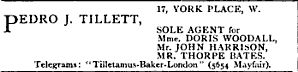 |
|
Advertisement for Pedro Juan Tillett
(1914)
|
Pedro continued as an agent on his own, operating out of 17 York Place
and an advertisement in The Musical Times
in 1914 shows him as sole
agent for Doris Woodall, John Harrison and Thorpe Bates. Pedro then
became the manager for various performers. The Radio
Times 20 April 1934 p178, in an article
about Pedro entitled "The Man who knows 2,000 Musicians", Pedro
remembers that:
I was drawn into the theatrical world and toured with Violet
Vanbrugh,
and in 1921 I managed Sir Harry Lauder's season at the Palace Theatre.
In August of this year I went to America as General Manager for
Marie Löhr and her company, returning the following March to manage
another London season for Harry Lauder, whose success was so phenomenal
at the Palace Theatre. On this occasion we were obliged to split the
season between the Princes Theatre and the London Pavilion. Following
this I became manager to Robert Loraine, who had a season at St James's
Theatre followed by a tour. In December 1923I was asked to undertake
the management of the first series of Symphony Concerts to be given
under the auspices of the British Broadcasting Company. These concerts
took place at the Central Hall, Westminster, in February, March, April
and May 1924. They were six in number, conducted by Percy Pitt, Sir
Landon Ronald, Eugene Goosens, Sir Hamilton Harry, Stanton Jeffries,
and Sir Edward Elgar. In July 1924 I joined the Staff of the Company
Pedro Tillett became the booking manager at the BBC in 1924, a post he
held
until his retirement in 1934. On his retirement he received this letter
from Adelina de
Lara:
I have read with sorrow and surprise
that you have retired from the BBC. In this case may I once again thank
you for all you have done for me in connection with BBC engagements and
for all your courtesy and patience. Whatever your future plans may be,
I wish you the greatest luck and happiness.
Ibbs
and Tillett: the rise and fall of a musical
empire (Christopher Fifield, 2005) contains some examples of
the impression made by Pedro Tillett on his acquaintances.
Percy Grainger
writes to his mother from Wakefield on 20 February 1908 (p58):
Tillett & I are going to see a
Melodrama tonight. It ought to be fun. He's such a nice little chap;
nothing coarse about him, I think. Nice & human & kind-thinking
and later that same day, to Karen Holten he wrote:
What do you think I have just done? I
and our agent (Tillett; he is a kind man - poor chap, I believe he has
had an unhappy life) have been together to theatre in this little town.
1881:
35
Fitzroy Rd, London, Middlesex
1901: Hampstead, London: Pedro J. Tillett is aged 28, born in London St
Pancras. He is a Musical Agent.
1911: Willesden, Middlesex: Pedro Juan Tillett is aged 38
1918: 62 Cranhurst Road, Willesden Green, London (Commonwealth
War
Graves Commission)
1919: 62 Cranhurst Road, Willesden, London (manifest
of the Mauretania 7 April 1919)
- England Birth
Index (3Q1872 Pancras vol 1b p45); exact place from 1901 census
- 1881 census,
England Marriage Index (2Q1870 Pancras vol 1b p207); Henrietta's full
name from England Birth Index (2Q1847 St Pancras vol 1 p354)
- England Marriage
Index (3Q1896 Marylebone vol 1a p1229)
- England Marriage Index
(3Q1896 Marylebone vol 1a p1229); exact date and place from Musical Courier 6 August 1896 p12
- 1901
census; Ibbs and Tillett: the rise and fall of a musical
empire (Christopher Fifield, 2005)
Ramon Pedro Rowland Tillett
1899, in Hampstead, London, England
Pedro Juan
Tillett
Mabel
Gertrude
(Plumbe) Tillett
22 September 1918, in action,
aged 19. Ramon was a gunner in A Batallion, 79th Brigade of the Royal
Field Artillery.
 |
|
St Sever Cemetery Extension, Rouen,
France, where Ramon Tillett is buried
|
St Sever Cemetery Extension,
Rouen, France. Most of the servicemen buried here died in military
hospitals in Rouen.
The birth registration lists his
name as Pedro Ramon R. Tillett, but the 1901 census has Ramon P. R.
Tillett and the casualty details at the Commonweath War Graves
Commission also lists him as Ramon Pedro Rowland Tillett.
1901: Hampstead, London: Ramon P. R. Tillett is aged 2, born in London
Hampstead
1911: Blean, Kent: Raymart Pedro Roland Tillets is aged 12
Return to Chris Gosnell's Home Page
If you have any comments, additions or modifications to the information on this page, please feel free to email me.
Created and maintained by: chris@ocotilloroad.com