The Evans Family
Ann Evans
27
October 1773
23 November 1773, in St
Mary-le-Bow, City of London, London, England
Maurice
Evans
Charlotte
(Lloyd) Evans
Ann was the recipient of some of the letters that Samuel Taylor Coleridge
wrote to the Evans family during his time at Cambrisge. Two of these letters
have survived:
Letters of Samuel Taylor Coleridge vol 1 pp37-8:
February 19,
1792.
DEAR ANNE, -
To be sure I felt myself rather disappointed at my not receiving a few
lines from you; but I am nevertheless greatly rejoiced at your amicable
dispositions towards me. Please to accept two kisses, as the seals of
reconciliation - you will find them on the word "Anne" at the beginning of
the letter - at least there I left them. I must, however, give you
warning, that the next time you are affronted with Brother Coly, and show
your resentment by that most cruel of all punishments, silence, I shall
address a letter to you as long and as sorrowful as Jeremiah's
Lamentations, and somewhat in the style of your sister's favourite lover,
beginning with, -
TO THE
IRASCIBLE MISS
DEAR MISS, &c.
My dear Anne, you are my Valentine. I dreamt of you this morning,
and I have seen no female in the whole course of the day, except an old
bedmaker belonging to the College, and I don't count her one, as the
bristle of her beard makes me suspect her to be of the masculine gender.
Some one of the genii must have conveyed your image to me so opportunely,
nor will you think this impossible, if you will read the little volumes
which contain their exploits, and crave the honour of your acceptance.
If I could draw, I would have sent a pretty heart stuck through
with arrows, with some such sweet posy underneath it as this:-
"The rose
is red, the violet blue;
The pink is sweet, and so are you."
But as the Gods have not made me a drawer (of
anything but corks), you must accept the will for the deed.
You never wrote or desired your sister to write concerning the
bodily health of the Barlowites, though you know my affection for that
family. Do not forget this in your next.
Is Mr. Caleb Barlow recovered of the rheumatism? The quiet ugliness
of Cambridge supplies me with very few communicables in the news way. The
most important is, that Mr. Tim Grubskin, of this town, citizen, is dead.
Poor man! he loved fish too well. A violent commotion in his bowels
carried him off. They say he made a very good end. There is his epitaph:-
"A loving
friend and tender parent dear,
Just in all actions, and he the Lord did fear,
Hoping, that, when the day of Resurrection come,
He shall arise in glory like the Sun."
It was composed by a Mr. Thistlewait, the
town crier, and is much admired. We are all mortal!!
His wife carries on the business. It is whispered about the town
that a match between her and Mr. Coe, the shoemaker, is not improbable. He
certainly seems very assiduous in consoling
her, but as to anything matrimonial I do not write it as a well
authenticated fact.
I went the other evening to the concert, and spent the time there
much to my heart's content in cursing Mr. Hague, who played on the violin
most piggishly, and a Miss (I forget her name) - Miss Humstrum, who
sung most sowishly. O the Billington! That I should be absent during the
oratorios! The prince unable to conceal his pain! Oh! oh! oh! oh! oh! oh!
oh! oh! oh!
To which house is Mrs B. engaged this season?
The mutton and winter cabbage are confoundedly tough here, though
very venerable for their old age. Were you ever at Cambridge, Anne? The
river Cam is a handsome stream of a muddy complexion, somewhat like Miss
Yates, to whom you will present my love (if you like).
In Cambridge there are sixteen colleges, that look like workhouses,
and fourteen churches that look like little houses. The town is very
fertile in alleys, and mud, and cats, and dogs, besides men, women,
ravens, clergy, proctors, tutors, owls, and other two-legged cattle. It
likewise - but here I must interrupt my description to hurry to Mr.
Costobadie's lectures on Euclid, who is as mathematical an author, my dear
Anne, as you would wish to read on a long summer's day. Addio! God bless
you, ma chère soeur, and your affectionate frère,
S.T.
COLERIDGE.
P.S. I add a postscript on purpose to communicate a joke to you. A
party of us had been drinking wine together, and three or four freshmen
were most deplorably intoxicated. (I have too great a respect for delicacy
to say drunk.) As we were returning homewards, two of them fell into the
gutter (or kennel). We ran to assist one of them, who very generously
stuttered out, as he lay sprawling in the mud: "N-n-n-no - n-n-no! save my
f-fr-fr-friend there; n-never mind me, I can swim."
Won't you write me a long letter now, Anne?
P.S. Give my respectful compliments to Betty, and say that I
enquired after her health with the most emphatic energy of impassioned
avidity.
Letters of Samuel Taylor Coleridge vol 1 pp52-3:
JESUS
COLLEGE, CAMBRIDGE, February 10, 1793.
MY DEAR ANNE, - A
little before I had received your mamma's letter, a bird of the air had
informed me of your illness - and sure never did owl or night-raven
("those mournful messengers of heavy things") pipe a more loathsome song.
But I flatter myself that ere you have received this scrawl of mine, by
care and attention you will have lured back the rosy-lipped fugitive,
Health. I know of no misfortune so little susceptible of consolation as
sickness: it is indeed easy to offer comfort, when we ourselves are well;
then we can be full of grave saws
upon the duty of resignation, etc.; but alas! when the sore visitations of
pain come home, all our
philosophy vanishes, and nothing remains to be seen. I speak of myself,
but a mere sensitive animal, with little wisdom and no patience. Yet if
anything can throw a melancholy smile over the pale, wan face of illness,
it must be the sight and attentions of those we love. There are one or two
beings, in this planet of ours, whom God has formed in so kindly a mould
that I could almost consent to be ill in order to be nursed by them.
O
turtle-eyed affection!
If thou be present - who can be distrest?
Pain seems to smile, and sorrow is at rest:
No more the thoughts in wild repinings roll,
And tender murmurs hush the soften'd soul.
But I will not proceed at this
rate, for I am writing and thinking myself fast into the spleen, and feel
very obligingly disposed to communicate the same doleful fit to you, my
dear sister. Yet permit me to say, it is almost your own fault. You were
half angry at my writing laughing
nonsense to you, and see what you have got in exchange -
pale-faced, solemn, stiff-starched stupidity. I must confess, indeed, that
the latter is rather more in unison with my present feelings, which from
one untoward freak of fortune or other are not of the most comfortable
kind. Within this last month I have lost a brother and a friend! But I
struggle for cheerfulness - and sometimes, when the sun shines out, I
succeed in the effort. This at least I endeavour, not to infect the
cheerfulness of others, and not to write my vexations upon my forehead. I
read a story lately of an old Greek philosopher, who once harangued so
movingly on the miseries of life, that his audience went home and hanged
themselves; but he himself (my author adds) lived many years afterwards in
very sleek condition.
God love you, my dear Anne! and receive as from a brother the
warmest affections of your
S.T.
COLERIDGE.
Charlotte Evans
16
July 1771, in St Mary-le-Bow, City of London, London, England
Maurice Evans
Charlotte
(Lloyd) Evans
Charlotte Massie (Evans) Kensington
14
February 1815
17 February 1815, in St Mary, St
Marylebone, Middlesex, England
Maurice Evans
Maria
Benedicta
(Massie) Evans
Charles
Kensington on 3 July 1841, at Midnapore, Bengal, India.
Asiatic Journal for September-December 1841
p221
MARRIAGES.
July 3.
At Midnapore, Charles Kensington, Esq. lieut. M.N.I., to Charlotte Massie,
daughter of the late Maurice Evans, Esq.,
25 February 1879, in Bangalore,
Mysore, India
Times of India 3 March 1879
DEATHS:
Feb 25 at Bangalore Charlotte Massie widow of Lieut C Kensington 14th MNI
Christopher Evans
Maurice Evans
Charlotte
(Lloyd) Evans
28 April 1771, in St Mary-le-Bow,
City of London, London, England
Elizabeth Evans
7
August 1772, in St Mary-le-Bow, City of London, London, England
Maurice
Evans
Charlotte
(Lloyd) Evans
Elizabeth is referred to a number of times in letters written by Samuel
Taylor Coleridge to her mother and sisters. In earlier letters she is called
Bessie and in later ones Eliza. The most notable reference is in 1794
when Coleridge, evidently after a break with the family, encounters
Elizabeth leaving a church in Wrexham, where Eliza lived with her
grandmother. Samuel Coleridge wrote to his friend Robert Southey from
Wrexham on 15 July 1794.
Letters of Samuel Taylor Coleridge vol 1
pp77-78:
I saw a face in Wrexham Church this
morning, which recalled "Thoughts full of bitterness and images" too
dearly loved! now past and but "Remembered like sweet sounds of
yesterday!" ...
Monday, 11 o'clock. Well, praised be God! here I am. Videlicet,
Ruthin, sixteen miles from Wrexham. At Wrexham Church I glanced upon the
face of a Miss E. Evans, a young lady with [whom] I had been in habits of
fraternal correspondence. She turned excessively pale; she thought it my
ghost, I suppose. I retreated with all possible speed to our inn. There,
as I was standing at the window, passed by Eliza Evans, and with her to my
utter surprise her sister, Mary Evans, quam
efflictim et perdite amabam. I apprehend she is come from London
on a visit to her grandmother, with whom Eliza lives. I turned sick, and
all but fainted away! The two sisters, as H. informs me, passed by the
window anxiously several times afterwards; but I had retired.
Elizabeth Benedicta Evans
22
May 1816, in London, England
13 June 1816, in St Mary, St
Marylebone, Middlesex, England
Maurice
Evans
Maria
Benedicta
(Massie) Evans
25
June
1899, in Ramsey, Isle of Man, aged 83
1881:
18
Lezaryre Road, Lezayre, Isle of Man
Laura (Evans) Ferris
1
July 1825
8 January 1826, in Portchester,
Hampshire, England
Maurice
Evans
Maria
Benedicta
(Massie) Evans
Edward
Fiott Ferris on 19 November 1846, in Chunar, Bengal, India. Edward is listed as the son
of Thomas Ferris. Laura is listed as the daughter of Morison Evans.
Simmond's Colonial Magazine Jan-Apr 1847 p364
MARRIAGES.
At Chunar, on the 19th Nov. Edward Fiott, son of the Rev. Thomas Ferris,
Vicar of Darlington, Sussex, to Laura, youngest daughter of the late
Maurice Evans, Esq., Army and Navy Agency, Strand, London.
Maria Isabella (Evans) Rolston
1817,
in Wrexham, Denbighshire, Wales
7 June 1817, in Wrexham,
Denbighshire, Wales
Maurice
Evans
Maria
Benedicta
(Massie) Evans
William
Thomas
Kidman Rolston
13 September 1893, in Ramsey, Isle of
Man, aged 76
1863: Albion Terrace, Ramsey, Isle of Man (Thwaites Directory 1863)
1881:
18
Lezaryre Road, Lezayre, Isle of Man
1883: 18 Albion Terrace, Ramsey, Isle of Man (Smiths Directory 1883)
1889: 18 Albion Terrace, Ramsey, Isle of Man (Porters Directory 1889)
Maria Benedicta Evans
Maurice
Evans
Maria
Benedicta
(Massie) Evans
- Maria is named as the
daughter of Maurice Evans in proceeedings of the estate of her uncle,
William Evans (London Gazette 10 July 1860 p2600). At
that time she is listed as a spinster.
Mary (Evans) Todd
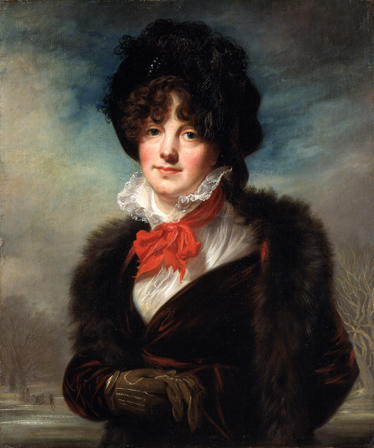 |
|
Painting of Mary (Evans) Todd
by Jospeh Allen
|
1770
Maurice
Evans
Charlotte
(Lloyd) Evans
Fryer
Todd on 13 October 1795
1843
History most remembers Mary as the
first love of Samuel Taylor Coleridge. The two met around 1790, when Samuel
was at boarding school in London with Mary's younger brother, Tom. Samuel
was very close to the whole Evans family, visiting their London home while
at schol and later when he was at Cambridge. He treated Mary as a beloved
sister, not disclosing his love for her until, after a period apart, he saw
her by chance in Wrexham in 1894 and, gearing of her engagement, he wrote to
her declaring his love which she firmly rejected. Both Samuel and Mary
married other people in October 1795.
Coleridge's "The Sigh" (1794) mentions Mary by name.
The poetical and dramatic works of Samuel Taylor
Coleridge p20 (1836)
THE
SIGH.
When Youth his fairy reign began
Ere Sorrow had proclaimed me man;
While Peace the present hour beguil'd
And all the lovely Prospect smil'd:
Then, Mary! 'mid my lightsome glee
I heav'd the painless Sigh for thee.
And when, along the wilds of woe,
My harass'd Heart was doom'd to know,
The frantic Burst of Outrage keen,
And the slow Pang that gnaws unseen;
Then shipwreck'd on Life's stormy sea
I heav'd an anguish'd Sigh for thee!
But soon Reflection's hand imprest
A stiller sadness on my breast;
And sickly Hope with waning eye
Was well content to droop and die:
I yielded to the stern decree,
Yet heav'd the languid Sigh for thee!
And tho' in distant climes to roam,
A wanderer from my native home,
I fain would sooth the sense of Care
And lull to sleep the Joys, that were!
Thy Image may not banish'd be-
Still, Mary! still I sigh for thee.
Samuel's relationship with Mary started with all the innocence of youth. In
a letter to Thomas Allsop in 1822, printed in Letters, conversations and recollections of S. T.
Coleridge p170 (by Thomas Allsop, 1836), Coleridge remembers:
And, oh, from sixteen to nineteen what hours of
Paradise had Allen and I, in escorting the Miss Evanses home on a
Saturday, who were then at a milliner's whom we used to think, and who I
believe really was, such a nice lady;- and we used to carry thither, of a
summer morning, the pillage of the flower gardens within six miles of
town, with Sonnet or Love Rhyme wrapped round the nose-gay.
Some of Coleridge's letters to Mary have been preserved in Letters of Samuel Taylor Coleridge (ed.
Ernest Hartley Coleridge, 1895) but unfortunately, by his own admission,
Samuel burnt all he had received from her when she got engaged, and the only
fragment that remains is a portion of a single letter from this period that
he had transcribed in another letter.
Letters of Samuel Taylor Coleridge vol 1
pp30-37:
February 13,
[1792] 11 o'clock.
Ten of
the most talkative young ladies now in London!
Now by the most accurate calculation of the specific quantities of
sounds, a female tongue, when it exerts
itself to the utmost, equals the noise of eighteen sign-posts,
which the wind swings backwards and forwards in full creak. If then one
equals eighteen, ten must equal one hundred and eighty; consequently, the
circle at Jermyn Street unitedly must have produced a noise equal to that
of one hundred and eighty old crazy sign-posts, inharmoniously agitated as
aforesaid. Well! to be sure, there are few disagreeables for which the
pleasure of Mary and Anne Evans' company would not amply compensate; but
faith! I feel myself half inclined to thank God that I was fifty-two miles
off during this clattering clapperation
of tongues. Do you keep ale at Jermyn Street? If so, I hope it is not soured.
Such, my dear Mary, were the reflections that instantly suggested
themselves to me on reading the former part of your letter. Believe me,
however, that my gratitude keeps pace with my sense of your exertions, as
I can most feelingly conceive the difficulty of writing amid that second
edition of Babel with additions. That your health is restored gives me
sincere delight. May the giver of all pleasure and pain preserve it so! I
am likewise glad to hear that your hand is re-whiten'd, though I cannot
help smiling at a certain young lady's effrontery
in having boxed a young gentleman's ears till her own hand became black
and blue, and attributing those unseemly marks to the poor unfortunate
object of her resentment. You are at
liberty, certainly, to say what you please.
It has been confidently affirmed by most excellent judges (tho' the
best may be mistaken) that I have grown very handsome lately. Pray that I
may have grace not to be vain. Yet, ah! who can read the stories of
Pamela, or Joseph Andrews, or Susannah and the three Elders, and not
perceive what a dangerous snare beauty is? Beauty is like the grass, that
groweth up in the morning and is withered before night. Mary! Anne! Do not
be vain of your beauty!!!!!
I keep a cat. Amid the strange collection of strange animals with
which I am surrounded, I think it necessary to have some meek well-looking
being, that I may keep my social affections alive. Puss, like her master,
is a very gentle brute, and I behave to her with all possible politeness.
Indeed, a cat is a very worthy animal. To be sure, I have known some very
malicious cats in my lifetime, but then they were old - and besides, they
had not nearly so many legs as you, my sweet Pussy. I wish, Puss! I could
break you of that indecorous habit of turning your back front to the fire.
It is not frosty weather now.
N.B. If ever, Mary, you should feel yourself inclined to visit me
at Cambridge, pray do not suffer the consideration of my having a cat to
deter you. Indeed, I will keep
her chained up all the while you
stay.
I was in company the other day with a very dashing literary lady.
After my departure, a friend of mine asked her her opinion of me. She
answered: "The best I can say of him is, that he is a very gentle bear."
What think you of this character?
What a lovely anticipation of spring the last three or four days
have afforded! Nature has not been very profuse of her ornaments to the
country about Cambridge; yet the clear rivulet that runs through the grove
adjacent to our College, and the numberless little birds (particularly
robins) that are singing away, and above all, the little lambs, each by
the side of its mother, recall the most pleasing ideas of pastoral
simplicity, and almost soothe one's soul into congenial innocence. Amid
these delightful scenes, of which the uncommon flow of health I at present
possess permits me the full enjoyment, I should not deign to think of
London, were it not for a little family, whom I trust I need not name.
What bird of the air whispers me that you too will soon enjoy the same and
more delightful pleasures in a much more delightful country? What we
strongly wish we are very apt to believe. At present, my presentiments on
that head amount to confidence.
Last Sunday, Middleton and I set off at one o'clock on a ramble. We
sauntered on, chatting and contemplating, till to our great surprise we
came to a village seven miles from Cambridge. And here at a farmhouse we
drank tea. The rusticity of the habitation and the inhabitants was
charming; we had cream to our tea, which though not brought in a lordly
dish, Sisera would have jumped at. Being here informed that we
could return to Cambridge another way, over a common, for the sake of
diversifying our walk, we chose this road, "if road it might be called,
where road was none," though we were not unapprized of its difficulties.
The fine weather deceived us. We forgot that it was a summer day in warmth
only, and not in length; but we were soon reminded of it. For on the
pathless solitude of this common, the night overtook us - we must have
been four miles distant from Cambridge - the night, though calm, was as
dark as the place was dreary: here steering our course by our imperfect
conceptions of the point in which we
conjectured Cambridge to lie, we wandered on "with cautious steps
and slow." We feared the bog, the stump, and the fen: we feared the ghosts
of the night - at least, those material and knock-me-down ghosts, the
apprehension of which causes you, Mary (valorous girl that you are!),
always to peep under your bed of a night. As we were thus creeping forward
like the two children in the wood, we spy'd something white moving across
the common. This we made up to, though contrary to our supposed
destination. It proved to be a man with a white bundle. We enquired our
way, and luckily he was going to Cambridge. He informed us that we had
gone half a mile out of our way, and that in five minutes more we must
have arrived at a deep quagmire grassed over. What an escape! The man was
as glad of our company as we of his - for, it seemed the poor fellow was
afraid of Jack o' Lanthorns - the superstition of this county attributing
a kind of fascination to those wandering vapours, so that whoever fixes
his eyes on them is forced by some irresistible impulse to follow them. He
entertained us with many a dreadful tale. By nine o'clock we arrived at
Cambridge, betired and bemudded. I never recollect to have been so much
fatigued.
Do you spell the word scarsely?
When Momus, the fault-finding God, endeavoured to discover some
imperfection in Venus, he could only censure the creaking of her slipper.
I, too, Momuslike, can only fall foul on a single s.
Yet will not my dear Mary be angry with me, or think the remark trivial,
when she considers that half a grain is of consequence in the weight of a
diamond.
I had entertained hopes that you would really
have sent me a piece of sticking
plaister, which would have been very convenient at that time, I having cut
my finger. I had to buy sticking plaister, etc. What is the use of a man's
knowing you girls, if he cannot chouse
you out of such little things as that? Do not your fingers, Mary, feel an
odd kind of titillation to be about my ears for my impudence?
On Saturday night, as I was sitting by myself all alone, I heard a
creaking sound, something like the noise which a crazy chair would make,
if pressed by the tremendous weight of Mr. Barlow's extremities. I cast my
eyes around, and what should I behold but a Ghost
rising out of the floor! A deadly paleness instantly overspread my body,
which retained no other symptom of life but
its violent trembling. My hair (as is usual in frights of this nature)
stood upright by many degrees stiffer than the oaks of the mountains, yea,
stiffer than Mr. ---; yet was it rendered oily-pliant by the profuse
perspiration that burst from every pore. This spirit advanced with a book
in his hand, and having first dissipated my terrors, said as follows: "I
am the Ghost of Gray. There
lives a young lady" (then he mentioned your
name), "of whose judgment I entertain so high an opinion, that her
approbation of my works would make the turf lie lighter on me; present her
with this book, and transmit it to her as soon as possible, adding my love
to her. And, as for you, O young man!" (now he addressed himself to me)
"write no more verses. In the first place your poetry is vile stuff; and
secondly" (here he sighed almost to bursting), "all poets go to --ll; we
are so intolerably addicted to the vice of lying!" He vanished, and
convinced me of the truth of his last dismal account by the sulphurous
stink which he left behind him.
His first mandate I have obeyed, and I hope you will receive safe your ghostly admirer's present.
But so far have I been from obeying his second injunction, that I never
had the scribble-mania stronger on me than for these last three or four
days: nay, not content with suffering it myself, I must pester those I
love best with the blessed effects of my disorder.
Besides two things, which
you will find in the next sheet, I cannot forbear filling the remainder of
this sheet with an Odeling, though I know and approve your aversion to mere prettiness, and though my tiny
love ode possesses no other property in the world. Let then its shortness
recommend it to your perusal - by the
by, the only thing in
which it resembles you, for wit, sense, elegance, or beauty it has none.
AN ODE IN THE
MANNER OF ANACREON.
As late in wreaths gay flowers I bound,
Beneath some roses Love I found,
And by his little frolic pinion
As quick as thought I seiz'd the minion,
Then in my cup the prisoner threw,
And drank him in its sparkling dew:
And sure I feel my angry guest
Fluttering his wings within my
breast!
Are you quite asleep, dear Mary? Sleep on; but when you awake, read the
following productions, and then, I'll be bound, you will sleep again
sounder than ever.
A WISH WRITTEN IN JESUS WOOD, FEBRUARY 10, 1792.
Lo! through the dusky silence of the groves,
Thro' vales irriguous, and thro' green retreats,
With languid murmur creeps the placid stream
And works its secret way.
Awhile meand'ring round its native fields,
It rolls the playful wave and winds its flight:
Then downward flowing with awaken'd speed
Embosoms in the Deep!
Thus thro' its silent tenor may my Life
Smooth its meek stream by sordid wealth unclogg'd,
Alike unconscious of forensic storms,
And Glory's blood-stain'd palm!
And when dark Age shall close Life's little day,
Satiate of sport, and weary of its toils,
E'en thus may slumb'rous Death my decent limbs
Compose with icy hand!
A LOVER'S COMPLAINT TO HIS MISTRESS
WHO DESERTED HIM IN QUEST OF A MORE WEALTHY HUSBAND IN THE EAST
INDIES.
The dubious light sad glimmers o'er the sky:
'T is silence all. By lonely anguish torn,
With wandering feet to gloomy groves I fly.
And wakeful Love still tracks my course forlorn.
And will you, cruel Julia? will you go?
And trust you to the Ocean's dark dismay?
Shall the wide, wat'ry world between us flow?
And winds unpitying snatch my Hopes away?
Thus could you sport with my too easy heart?
Yet tremble, lest not unaveng'd I grieve!
The winds may learn your own delusive art,
And faithless Ocean smile - but to deceive!
I have written too long a letter. Give me a hint, and I will avoid
a repetition of the offence. It's a compensation for the above-written
rhymes (which if you ever condescend to read a second time, pray let it be
by the light of their own flames) in my next letter I will send some
delicious poetry lately published by the exquisite Bowles.
To-morrow morning I fill the rest of this sheet with a letter to
Anne. And now, good night, dear sister! and peaceful slumbers await us
both!
S.T. COLERIDGE
Letters of Samuel Taylor Coleridge vol 1
pp41-42:
JESUS
COLLEGE, CAMBRIDGE, February 22, [1792].
DEAR MARY, - Writing
long letters is not the fault into which I am most apt to fall,
but whenever I do, by some inexplicable ill luck, my prolixity is always
directed to those whom I would yet least of all wish to torment. You
think, and think rightly, that I had no occasion to increase
the preceding accumulations of wearisomeness, but I wished to inform you
that I have sent the poem of Bowles, which I mentioned in a former sheet;
though I dare say you would have discovered this without my information.
If the pleasure which you receive from the perusal of it prove equal to
that which I have received, it will make you some small return for the
exertions of friendship, which you must have found necessary in order to
travel through my long, long, long letter.
Though it may be a little effrontery to point out beauties,
which would be obvious to a far less sensible heart than yours, yet I
cannot forbear the self-indulgence of remarking to you the exquisite
description of Hope in the third page and of Fortitude in the sixth; but
the poem "On leaving a place of residence" appears to me to be almost
superior to any of Bowles's compositions.
I hope that the Jermyn Street ledgers are well. How can they be
otherwise in such lovely keeping?
Your Jessamine Pomatum, I trust, is as strong and as odorous as
ever, and the roasted turkeys at Villiers Street honoured, as usual, with
a thick crust of your Mille (what do you call it?) powder.
I had a variety of other interesting inquiries to make, but time
and memory fail me.
Without a swanskin waistcoat, what is man? I have got a swanskin
waistcoat, - a most attractive external.
Yours with sincerity of friendship,
SAMUEL
TAYLOR C.
Letters of Samuel Taylor Coleridge vol 1
pp47-52:
JESUS
COLLEGE, CAMBRIDGE, February 7, 1793.
I would to Heaven, my dear Miss
Evans, that the god of wit, or news, or politics would whisper in my ear
something that might be worth sending fifty-four miles - but alas! I am so
closely blocked by an army of misfortunes that really there is no passage
left open for mirth or anything else. Now, just to give you a few articles
in the large inventory of my calamities. Imprimis, a gloomy, uncomfortable
morning. Item, my head aches. Item, the Dean has set me a swinging
imposition for missing morning chapel. Item, of the two only coats which I
am worth in the world, both have holes in the elbows. Item, Mr. Newton,
our mathematical lecturer, has recovered from an illness. But the story is
rather a laughable one, so I must tell it you. Mr. Newton (a tall, thin
man with a little, tiny blushing face) is a great botanist. Last Sunday,
as he was strolling out with a friend of his, some curious plant suddenly
caught his eye. He turned round his head with great eagerness to call his
companion to a participation of discovery, and unfortunately continuing to
walk forward he fell into a pool, deep, muddy, and full of chickweed. I
was lucky enough to meet him as he was entering the college gates on his
return (a sight I would not have lost for the Indies), his best black
clothes all green with duckweed, he shivering and dripping, in short a
perfect river god. I went up to him (you must understand we hate each
other most cordially) and sympathized with him in all the tenderness of
condolence. The consequence of his misadventure was a violent cold
attended with fever, which confined him to his room, prevented him from
giving lectures, and freed me from the necessity of attending them; but
this misfortune I supported with truly Christian fortitude. However, I
constantly asked after his health with filial anxiety, and this morning,
making my usual inquiries, I was informed, to my infinite astonishment and
vexation, that he was perfectly recovered and intended to give lectures
this very day!!! Verily, I swear that six of his duteous pupils - myself
as their general - sallied forth to the apothecary's house with a fixed
determination to thrash him for having performed so speedy a cure, but,
luckily for himself, the rascal was not at home. But here comes my
fiddling master, for (but this is a secret) I am learning to play on the
violin. Twit, twat, twat, twit! "Pray, M. de la Penche, do you think I
shall ever make anything of this violin? Do you think I have an ear for
music?" "Un magnifique! Un superbe! Par honneur, sir, you be a ver great
genius in de music. Good morning, monsieur!" This M. de la Penche is a
better judge than I thought for.
This new whim of mine is partly a scheme of self-defence. Three
neighbours have run music-mad lately - two of them fiddle-scrapers, the
third a flute-tooter - and are perpetually annoying me with their vile
performances, compared with which the gruntings of a whole herd of sows
would be seraphic melody. Now I hope, by frequently playing myself, to
render my ear callous. Besides, the evils of life are crowding upon me,
and music is "the sweetest assuager of cares." It helps to relieve and
soothe the mind, and is a sort of refuge from calamity, from slights and
neglects and censures and insults and disappointments; from the warmth of
real enemies and the coldness of pretended friends; from your well
wishers (as they are justly called, in opposition, I suppose, to
well doers), men whose
inclinations to serve you always decrease in a most mathematical
proportion as their opportunities to do it increase; from the
"Proud man's
contumely, and the spurns
Which patient merit of th' unworthy takes;"
from grievances that are the growth of all times
and places and not peculiar to this age,
which authors call this critical
age, and divines this sinful age,
and politicians this age of revolutions.
An acquaintance of mine calls it this learned
age in due reverence to his own abilities, and like Monsieur
Whatd'yecallhim, who used to pull off his hat when he spoke of himself.
The poet laureate calls it "this golden
age," and with good reason, -
For him
the fountains with Canary flow,
And, best of fruit, spontaneous guineas grow.
Pope, in his
"Dunciad," makes it this leaden age,
but I choose to call it without an epithet, this
age. Many things we must expect to meet with which it would be hard to
bear, if a compensation were not found in honest endeavours to do well, in
virtuous affections and connections, and in harmless and reasonable
amusements. And why should not a
man amuse himself sometimes? Vive la
bagatelle!
I received a letter this morning from my friend Allen. He is up to
his ears in business, and I sincerely congratulate him upon it -
occupation, I am convinced, being the great secret of happiness. "Nothing
makes the temper so fretful as indolence," said a young lady who, beneath
the soft surface of feminine delicacy, possesses a mind acute by nature,
and strengthened by habits of reflection. 'Pon my word, Miss Evans, I beg
your pardon a thousand times for bepraising you to your face, but, really,
I have written so long that I had forgot to whom I was writing.
Have you read Mr Fox's letter to the Westminster electors? It is
quite the political go at
Cambridge, and has converted many souls to the Foxite faith.
Have you seen the Siddons this season? or the Jordan? An
acquaintance of mine has a tragedy coming out early in the next season,
the principal character of which Mrs. Siddons will act. He has importuned
me to write the prologue and epilogue, but, conscious of my inability, I
have excused myself with a jest, and told him I was too good a Christian
to be accessory to the damnation of anything.
There is an old proverb of a river of words and a spoonful of
sense, and I think this letter has been a pretty good proof of it. But as
nonsense is better than blank paper, I will fill this side with a song I
wrote lately. My friend, Charles Hague, the composer, will set it to wild
music. I shall sing it, and accompany myself on the violin. Ça
ira!
Cathloma, who reigned in the Highlands of Scotland about two
hundred years after the birth of our Saviour, was defeated and killed in a
war with a neighbouring prince, and Nina Thoma his daughter (according to
the custom of those times and that country) was imprisoned in a cave by
the seaside. This is supposed to be her complaint:-
How long will ye
round me be swelling,
O ye blue-tumbling waves of the sea?
Not always in caves was my dwelling,
Nor beneath the cold blast of the Tree;
Thro' the high sounding Hall of Cathloma
In the steps of my beauty I strayed,
The warriors beheld Nina Thoma,
And they blessed the dark-tressed Maid!
By my Friends, by my Lovers discarded,
Like the Flower of the Rock now I waste,
That lifts its fair head unregarded,
And scatters its leaves on the blast.
A Ghost! by my cavern it darted!
In moonbeams the spirit was drest -
For lovely appear the Departed,
When they visit the dreams of my rest!
But dispersed by the tempest's commotion,
Fleet the shadowy forms of Delight;
Ah! cease, thou shrill blast of the Ocean!
To howl thro' my Cavern by night.
Are you asleep, my dear Mary? I have administered rather a strong
dose of opium; however, if in the course of your nap you should chance to
dream that I am, with ardor of eternal friendship, your affectionate
S.T. COLERIDGE,
you will never have dreamt a truer dream in
all your days.
The next preserved letter from Samuel Coleridge concerning Mary is one he
wrote to his friend Robert Southey from Wrexham on 15 July 1794, describing
his feelings on seeing Mary by chance in the town where she was visiting her
grandmother.
Letters of Samuel Taylor Coleridge vol 1
pp77-78:
I saw a face in Wrexham Church this
morning, which recalled "Thoughts full of bitterness and images" too
dearly loved! now past and but "Remembered like sweet sounds of
yesterday!" ...
Monday, 11 o'clock. Well, praised be God! here I am. Videlicet,
Ruthin, sixteen miles from Wrexham. At Wrexham Church I glanced upon the
face of a Miss E. Evans, a young lady with [whom] I had been in habits of
fraternal correspondence. She turned excessively pale; she thought it my
ghost, I suppose. I retreated with all possible speed to our inn. There,
as I was standing at the window, passed by Eliza Evans, and with her to my
utter surprise her sister, Mary Evans, quam
efflictim et perdite amabam. I apprehend she is come from London
on a visit to her grandmother, with whom Eliza lives. I turned sick, and
all but fainted away! The two sisters, as H. informs me, passed by the
window anxiously several times afterwards; but I had retired.
Vivit,
sed mihi non vivit - nova forte marita,
Ah dolor! alterius carâ a cervice pependit.
Vos, malefida valete accensœ insomnia mentis,
Littora amata valete! Vale, ah! formosa Maria!
My fortitude would not have supported me,
had I recognized her - I mean appeared to do it! I neither ate nor
slept yesterday. But love is a local anguish; I am sixteen miles distant,
and am not half so miserable. I must endeavour to forget it amid the
terrible graces of the wild wood scenery that surround me. I never durst
even in a whisper avow my passion, though I knew she loved me. Where were
my fortunes? and why should I make her miserable! Almighty God bless her!
Her image is in the sanctuary of my heart, and never can it be torn away
but with the strings that grapple it to life.
The Latin lines above are translated in Poetical Works p122 (ed J.C.C. Mays, 2001)
as:
She lives, but for me
lives not; perchance, newly wed,
Ah woe! she hangs upon the dear neck of another.
Farewell deceptive dreams of an inflamed mind.
Farewell, beloved shores! Farewell, ah! beautiful Mary!
At this time, Coleridge and Robert Southey had planned a strange scheme of
emigrating to America to establish a society on the lines of a utopian
society they had devised - the pantisocracy. Mary wrote to Samuel to counsel
him against the idea and Coleridge quotes part of Mary's letter in a letter
to Southey in October 1794:
Letters of Samuel Taylor Coleridge vol 1
pp87-89:
October 21, 1794.
To you alone, Southey, I write the first
part of this letter. To yourself confine it.
"Is this handwriting altogether erased from your memory? To whom am
I addressing myself? For whom am I now violating the rules of female
delicacy? Is it for the same Coleridge, whom I once regarded as a sister
her best-beloved Brother? Or for one who will ridicule
that advice from me, which he has rejected
as offered by his family? I will hazard the attempt. I have no right, nor
do I feel myself inclined to reproach you for the Past. God forbid! You
have already suffered too much from self-accusation. But I conjure you,
Coleridge, earnestly and solemnly conjure you to consider long and deeply,
before you enter into any rash schemes. There is an Eagerness in your
Nature, which is ever hurrying you in the sad Extreme. I have heard that
you mean to leave England, and on a Plan so absurd and extravagant that
were I for a moment to imagine it true,
I should be obliged to listen with a more patient Ear to suggestions,
which I have rejected a thousand times with scorn and anger. Yes! whatever
Pain I might suffer, I should be forced to exclaim, 'O what a noble mind
is here o'erthrown, Blasted with
ecstacy.' You have a country, does it demand nothing of you? You have
doting Friends! Will you break their Hearts! There is a God - Coleridge!
Though I have been told (indeed I
do not believe it) that you doubt of his existence and disbelieve a
hereafter. No! you have too much sensibility to be an Infidel. You know I
never was rigid in my opinions concerning Religion - and have always
thought Faith to be only Reason
applied to a particular subject. In short, I am the same Being as when you
used to say, 'We thought in all things alike.' I often reflect on the
happy hours we spent together and regret the Loss of your Society. I
cannot easily forget those whom I once loved - nor can I easily form new
Friendships. I find women in general vain - all of the same Trifle, and
therefore little and envious, and (I am afraid) without sincerity; and of
the other sex those who are offered and held up to my esteem are very
prudent, and very worldly. If you value my peace of mind, you must on no account answer this letter, or
take the least notice of it. I would
not for the world any part of my
Family should suspect that I have written to you. My mind is sadly
tempered by being perpetually obliged to resist the solicitations of those
whom I love. I need not explain myself. Farewell, Coleridge! I shall
always feel that I have been your Sister."
No name was signed,- it was from Mary Evans. I received it about
three weeks ago. I loved her, Southey, almost to madness. Her image was
never absent from me for three years, for more
than three years.
In this letter in December 1794, Samuel, having heard of Mary's engagement
to Fryer Todd, finally reveals to Mary his long hidden love.
Letters of Samuel Taylor Coleridge vol 1
pp122-4:
December, 1794.
Too long has my heart been the
torture house of suspense. After infinite struggles of irresolution, I
will at last dare to request of you, Mary, that you will communicate to me
whether or no you are engaged to Mr. ---. I conjure you not to consider
this request as presumptuous indelicacy. Upon mine honour, I have made it
with no other design or expectation than that of arming my fortitude by
total hopelessness. Read this letter with benevolence - and consign it to
oblivion.
For four years I have endeavoured
to smother a very ardent attachment; in what degree I have succeeded you
must know better than I can. With quick perceptions of moral beauty, it
was impossible for me not to admire in you your sensibility regulated by
judgment, your gaiety proceeding from a cheerful heart acting on the
stores of a strong understanding. At first I voluntarily invited the
recollection of these qualities into my mind. I made them the perpetual
object of my reveries, yet I entertained no one sentiment beyond that of
the immediate pleasure annexed to the thinking of you. At length it became
a habit. I awoke from the delusion, and found that I had unwittingly
harboured a passion which I felt neither the power nor the courage to
subdue. My associations were irrevocably formed, and your image was
blended with every idea. I thought of you incessantly; yet that spirit (if
spirit there be that condescends to record the lonely beatings of my
heart), that spirit knows that I thought of you with the purity of a
brother. Happy were I, had it been with no more than a brother's ardour!
The man of dependent fortunes, while he fosters an attachment,
commits an act of suicide on his happiness. I possessed no establishment.
My views were very distant; I saw that you regarded me merely with the
kindness of a sister. What expectations could I form? I formed no
expectations. I was ever resolving to subdue the disquieting passion;
still some inexplicable suggestion palsied my efforts, and I clung with
desperate fondness to this phantom of love, its mysterious attractions and
hopeless prospects. It was a faint and rayless hope! Yet it soothed my
solitude with many a delightful day-dream. It was a faint and rayless
hope! Yet I nursed it in my bosom with an agony of affection, even as a
mother her sickly infant. But these are the poisoned luxuries of a
diseased fancy. Indulge, Mary, this my first, my last request, and restore
me to reality, however gloomy.
Sad and full of heaviness will the intelligence be; my heart will die
within me. I shall, however, receive it with steadier resignation from
yourself, than were it announced to me (haply on your marriage day!) by a
stranger. Indulge my request; I will not disturb your peace by even a look of discontent, still less will I
offend your ear by the whine of selfish sensibility. In a few months I
shall enter at the Temple and there seek forgetful calmness, where only it
can be found, in incessant and useful activity.
Were you not possessed of a mind and of a heart above the usual lot
of women, I should not have written you sentiments that would be
unintelligible to three fourths of your sex. But our feelings are
congenial, though our attachment is doomed not to be reciprocal. You will
not deem so meanly of me as to believe that I shall regard Mr. --- with
the jaundiced eye of disappointed passion. God forbid! He whom you honour
with your affections becomes sacred to me. I shall love him for your
sake; the time may perhaps come when I shall be philosopher enough not to
envy him for his own.
S.T.
COLERIDGE.
I return to Cambridge to-morrow morning.
MISS EVANS No. 17 Sackville Street,
Piccadilly
Coleridge's feelings for Mary at this time undoubtably formed the base of
his sonnet "On a Discovery Made too Late", in which he repeats many of the
phrases and themes from the letter.
The poetical and dramatic works of Samuel Taylor
Coleridge pp30-1 (1836)
ON
A DISCOVERY MADE TOO LATE
THOU bleedest, my poor Heart! and thy distress
Reas'ning I ponder with a scornful smile
And probe thy sore wound sternly, tho' the while
Swoln be mine eye and dim with heaviness.
Why didst thou listen to Hope's whisper bland?
Or list'ning why forget the healing tale,
When Jealousy with fev'rish fancies pale
Jarr'd thy fine fibres with a maniac's hand?
Faint was that Hope, and rayless!- Yet twas fair
And sooth'd with many a dream the hour of rest;
Thou should'st have loved it most, when most oppress'd.
And nurs'd it with an agony of Care,
Ev'n as a Mother her sweet infant heir,
That wan and sickly droops upon her breast!
Letters of Samuel Taylor Coleridge vol 1
pp124-5:
December 24,
1794.
I have this moment received your letter,
Mary Evans. Its firmness does honour to your understanding, its gentleness
to your humanity. You condescend to accuse yourself - most unjustly! You
have been altogether blameless. In my wildest day-dream of vanity, I never
supposed that you entertained for me any other than a common friendship.
To love you habit has made unalterable. This passion, however,
divested as it now is of all shadow of hope, will lose its disquieting
power. Far distant from you I shall journey through the vale of men in
calmness. He cannot long be wretched, who dares be actively virtuous.
I have burnt your letters - forget mine; and that I have pained
you, forgive me!
May God infinitely love you!
S.T. COLERIDGE.
and shortly thereafter, Coleridge writes to Southey describing his feelings
at receiving Mary's rejection.
Letters of Samuel Taylor Coleridge vol 1
pp125-6:
December, 1794.
I am calm, dear Southey! as an autumnal
day, when the sky is covered with gray moveless clouds. To love
her, habit has made unalterable. I had placed her in the
sanctuary of my heart, nor can she be torn from thence but with the
strings that grapple it to life. This passion, however, divested as it now
is of all shadow of hope, seems to lose its disquieting power. Far
distant, and never more to behold or hear of her, I shall sojourn in the
vale of men, sad and in loneliness, yet not unhappy. He cannot be long
wretched who dares be actively virtuous. I am well assured that she loves
me as a favourite brother. When she was present, she was to me only as a
very dear sister; it was in absence that I felt those gnawings of
suspense, and that dreaminess of mind, which evidence an affection more
restless, yet scarcely less pure than the fraternal. The struggle has been
well nigh too much for me; but, praised be the All-Merciful! the
feebleness of exhausted feelings has produced a calm, and my heart
stagnates into peace.
Southey! my ideal standard of female excellence rises not above
that woman. But all things work together for good. Had I been united to
her, the excess of my affection would have effeminated my intellect. I
should have fed on her looks as she entered into the room, I should have
gazed on her footsteps when she went out from me.
To lose her! I can rise above that selfish pang. But to marry
another. O Southey! bear with my weakness. Love makes all things pure and
heavenly like itself,- but to marry a woman whom I do not
love, to degrade her whom I call my wife by making her the instrument of
low desire, and on the removal of a desultory appetite to be perhaps not
displeased with her absence! Enough! These refinements are the wildering
fires that lead me into vice. Mark you, Southey! I
will do my duty.
It seems that Mary and samuel did not see each other or communicate for more
than 13 years, until Mary saw and met Coleridge, then a successfuly poet, at
The Royal Institute and the following exchange of plaesant notes occurred.
They were orinally published in the Athenæum,
18 May 1895 p643, and reprinted in Collected Letters of Samuel Taylor Coleridge:
1807-1814 pp690-1 (ed. Earl Leslie Griggs, 2002)
April 6th, 1808.
No 31 - Bury Street, St. James's -
My dear Sir,
On hearing your name announced at the Royal Institution I felt so
great a desire to once more behold an old and esteemed friend that I could
not resist the opportunity that presented itself - The pleasure however
that I experienced was greatly diminished by seeing you in so indifferent
a state of health - making myself known to you at such a moment was
perhaps ill-timed and i now write to offer an apology - In truth it was
the effect of a momentary impulse and not a premideditated act - If i
erred I can only say it was an error of judgement - but not intended to
give pain - I hope I shall be able to explain myself better when I have
the pleasure of seeing you here which I shall expect in the course of a
day or two -
In the meantime | Believe me | still your sincere friend
Mary
Todd.
Thursday. [7
April 1808]
Dear Madam,
Undoubtedly the first moment of the feeling was an awful one to me.
The second of time previous to
my full recognition of you, the Mary Evans of 14 years ago, flashed across
my eyes with a truth and vividness as great as its rapidity. But the
confusion of mind occasioned by this sort of double
presence was amply and more than balanced by the after pleasure and
satisfaction. Truly happy does it make me to have seen you once more, and
seen you well, prosperous, and cheerful - all that your goodness gives you
a title to.
I shall, as soon as I am at liberty, call on you and Mr. Todd, and
believe me to be with most sincere regard and never extinguished esteem
Your friend
S. T. Coleridge
Coleridge evidently called on the Todds. He presented Mary with a signed
copy of his poetical works which is now in the Lawrence Special Collection
of the University of Kansas, but he was shocked at the circumstances of Mary
Todd. The next day he wrote to Daniel Stuart that
Collected Letters of Samuel Taylor Coleridge:
1807-1814 pp695 (ed. Earl Leslie Griggs, 2002)
I saw yesterday, which I will explain when I see you, such a counterpart
of the very worst parts of my own Fate, in an exaggerated Form, in the
Fate of the Being, who was my first attachment, and who with her family
gave me the first Idea of an Home,
& inspired my best and most permanent Feelings
The last known letter between Mary and Samuel was in 1820. Coleridge replies
to a letter from Mary evidently requesting help in a plan she had of
establishing a school. Samuel offers some advice, but declines to assist her
financially, an ironic end to a relationship that never got off the ground
because Coleridge felt he could not declare his love for her because he
lacked a fortune.
Collected Letters of Samuel Taylor Coleridge:
1820-1825 pp101-2
Highgate-
Tuesday 26th Septr. 1820.
Dear Mrs. Todd
I inclose Lady C. L. 's letter together with the
Answer, which I have this morning received from Mrs. Cootes. I would I
could accompany it with some 'compensating counterbalance'! But I have
done my best - and at a time when I know not which way to turn, first in
encountering perplexities & embarrassments that are pressing in on me,
partly on my own account, & yet more, or more urgently at least, on
account of my sons - one of whom will leave me for Cambridge in a few
days, while I am going to Oxford on behalf of the other - I had a note
from Mrs. Prickett, acquainting me with the terms of the house in Hornsey
Lane - the rent 60£, the premium for the Lease 200£.
They
are considered here as very reasonable, the House being an excellent one.
You blame me for not having written a plan. How can I, when you are
yourself wholly undecided? Advertisements of any kind, merely to satisfy
yourself whether you are likely to succeed, will but exhaust your
interest, and convey the impression that you are trifling with the
Applicants who answer them. A plan for a school will not answer for a
scheme of a family Home for ladies, or for single gentlemen. I am
incompentant to advise; but of this I am sure that what is begun in haste
ends in disappointment. Were you fixed on a School and felt yourself
adequate to the undertaking, the wisest way, as it appears to me, would be
to settle on a house first, the rent of which should commence a month or
so afterwards, so that you would announce the day on which you would be
prepared to receive the Scholars & then
to circulate the plan, and send the advertisements, i.e. the plan in its
most abridged form. I said the wisest
way, meaning of course to imply, if
practicable. How very little the chance is of your procuring any sum from
uninterested persons by subscription, for the purpose of enabling you to
commence the attempt, any sum at all proportionate either to your object,
or to your own toil & solicitation, but you have had, I fear, more
than sufficient grounds of presuming - But I feel that my own horizon is
too thicj with clouds for me to be a fair judge - and better be sanguine
to no purpose, than despondent to no purpose: and if my present mood
incline to the latter, I can most sincerely assure you that my own
inability to befriend you, combined with the earnest wish that I could
supercede the necessity of your applying to any other friend, has no small
share in the depression of
My dear Mrs.
T. | Your faithful friend
S.T.
Coleridge
1794: 17 Sackville Street, Picadilly, London (Letters of Samuel Taylor Coleridge vol 1
pp122-4)
1808: 31 Bury Street, St James, London (Collected Letters of Samuel Taylor Coleridge:
1807-1814 pp690-1)
1817: Curzon Street, Mayfair, Westminster, Middlesex (Old
Bailey
Proceedings 9 April 1823 p239)
Maurice Evans
of West Cheap, Cheapside, London
1730/1
Charlotte Lloyd on 2 November 1767,
in Wrexham, Denbighshire, Wales
Maurice Evans is recorded as a batchelor, of West Cheap, London. Charlotte
Lloyd is recorded as a spinster of the parish of Wrexham. The marriage, by
licence, was officiated by T. Edwards, vicar, and witnessed by Thos. Lloyd
and John Edwards.
24 November 1781 at St
Mary-le-Bow, City of London, London, England, aged 50
Maurice Evans
18
June 1770, in St Mary-le-Bow, City of London, London, England
Maurice
Evans
Charlotte
(Lloyd) Evans
Maurice Evans
18
September 1778
13 October 1778, in St Mary-le-Bow,
City of London, London, England
Maurice
Evans
Charlotte
(Lloyd) Evans
Maria
Benedicta Massie on 8 September 1813, in Wrexham, Denbighshire, Wales
Army and Navy Agent, with
premises in the Strand, London.
In 1815, Maurice was involved in the lawsuit Smith vs. Mercer, a complex
financial case involving the level of care required by banks to detect
fraud. The document in question was one in which Maurice's signature had
been forged. The case gives some insight into the navy agent world of
Maurice Evans.
Maurice was the author of The Ægis of England or the Triumphs of the Late War
(1817), a collection of the thanks of Parliament to officers of the navy and
army, with biographical and miltary notes.
5 February 1827, in Emsworth, Hampshire, England, aged 49
The Gentleman's Magazine February 1827 p188
OBITUARY.
HANTS.- Feb. 5.
At Emsworth, aged 49, Maurice Evans, esq. Navy Agent
10 February 1827, in Warblington,
Hampshire, England
1817: Bryn y ffynnon Lodge, Wrexham, Denbighshire (A History of the Town and Parish of Wrexham
vol 4 p144)
Maurice Evans
1818/9, in London, England
9 March 1819, in St Clement Danes,
Westminster, Middlesex, England
Maurice
Evans
Maria
Benedicta
(Massie) Evans
Jane
Baker Sweetten on 29 April 1857, in St James, Paddington, Middlesex,
England. Maurice is recorded as the son of Maurice Evans. Jane is recorded
as the daughter of John Baker Sweetten.
Wine Merchant. Maurice was also,
at times, a Beer Exporter, Soap Manufacturer and Commission Merchant.
Maurice had complex financial arrangements, not all of them very stable and
was involved in many partnerships and also bankruptcy proceedings against
him and his partners. As part of his marriage settlement, dated 28 April
1857, Maurice transferred a number of shares to J. W. Hoare, D. H. Young and
H. G. Hoare. This transfer was faultily recorded leading to a lawsuit (The English Reports vol 70 p1041). Earlier
that year, Edward Duke Moore, a "Merchant and Dealer in Concentrated Milkand
Cocoa, trading in copartnership with Maurice Evans and William John Hoare,
under the firm of E. D. Moore and Co." was declared bankrupt (London Gazette 7 April 1857 p1281). This
was followed by bankruptcy proceedings against Maurice and William Hoare,
"Export Wine and Bottled Beer Merchants", on 9 July 1857. (London Gazette 10 July 1857 p2428). Their
business address is listed as 29 Great Saint Helens in the city of London
and Trinity wharf in Rotherhithe, Surrey. This did not seem to deter
Maurice. We read that on 4 August 1860 that a partnership between Maurice
and Horatio Thomas Wibrow, soap manufacturers in Southerhampton street,
Camberwell, Surrey doing business as Wibrow and Company, was dissolved and
all debts would be paid and received by Maurice Evans "by whom the business
will in future be carried on" (London Gazette 14 August 1860 p3027).
Maurice then partnered with a Walter Strickland as Wine Merchants at 31
Throgmorton Street in the city of London doing busienss as Evans and
Strickland and the Gladstone Wine Company. This partnership was dissolved in
1867 (London Gazette 27 August 1867 p4838). The
bankruptcy proceedings dragged on and in 1868 we read that Maurice
executed a deed assigning all his "estate and effects" to a trustee for the
benefit of his creditors "and release by them to him" (London Gazette 21 January 1868 p311). This
seems to have resolved his own bankruptcy and Maurice then went on the
offensive. On 14 January 1869 he petitioned for the winding up of the London
Cooperative Commissariat Limited, of which he was a creditor (London Gazette 15 January 1869 p247). On 5
March 1877, the partnership between Maurice and Henry Hart, named the
Foreign Wine Association at 17 Philpot Lane in the city of London, was
dissolved (London Gazette 9 March 1877 p1991).
1891,
in Fulham
district, London, England, aged 73
1857: 13 Victoria Terrace, Westbourne Grove, Middlesex (London Gazette 25 December 1857 p1281)
1868: 19 Garway Road, Bayswater, Middlesex (London Gazette 21 January 1868 p311)
1869: 2 Old Swan Lane, City of London (London Gazette 15 January 1869 p247)
1881:
6
Melrose Gardens, London, Middlesex
Thomas Evans
11
October 1776
6 November 1776, in St Mary-le-Bow,
City of London, London, England
Maurice
Evans
Charlotte
(Lloyd) Evans
Christ's
Hospital school. Thomas entered Christ's Hospital on 7 May 1784. While
at the school he befriended Samuel
Coleridge. Samuel's father had died and his mother lived in Devon, and
Samuel spent a lot of time at the Evans's London home from about 1788 where
he fell deeply in love with Tom's sister, Mary.
1814
Thomas Lloyd Money Evans
Maurice
Evans
Maria
Benedicta
(Massie) Evans
William Evans
27
January 1781
1 March 1781, in St Mary-le-Bow,
City of London, London, England
Maurice
Evans
Charlotte
(Lloyd) Evans
Ana Johanna Pellet on 19 February
1807, in the Abbey, St Albans, Hertfordshire, England
The gentleman's magazine (1807) p178
MARRIAGES.
Feb 19. Mr. William Evans, of the
East India-house, to the daughter of Dr. Pallet, of St. Alban's, Herts.
Ana was the daughter of Dr. Stephen Pellett. He evidently provided her an
education at home, as described below. It is not certain that the daughter
referred to is Ana, but in Sussex Archælogical Collections p92 (1894),
Stephen is shown as having only one daughter.
The countess and Gertrude; or, Modes of discipline pp182-3
(Lætitia Matilda Hawkins, 1811):
Our erudite friend, Dr. Pellet, of St. Albans, to whose hiinted wish this
work owes its existence, also in the midst of the complex cares of a
medical profession, and in a track 6f it that might have excused neglect,
took into his own charge the mind and intellect of a daughter. - For
the sake of our readers, we have tried to learn his system;
but system he had none, save that of acting as occasion made fit. We will
give what we got from him: he will forgive being made useful.
'I followed no system,' said he: 'I led nature, but it was by a
silken thread; and I never lost my temper. I did not wish to make her a
prodigy. I never pushed her faculties beyond their powers; but I gave them
fair encouragement. I found it, for a long while, indeed till she was near
twenty years of age, not at all agreeable to her to read books of mere
amusement; but when once prevailed on to read a few of the best, she
relished them extremely. I happened to have Jortin's life of Erasmus on my
table: she took to it of herself, and hunted out in Bayle all the
references; she has read few books; but I have taken care they should be
good. I made her read Prideaux's Connection, to accustom her organs to
difficult pronunciation. She has turned out all I could wish: she is a
nice little notable wife, knows all that is necessary to be done in a
family, sets out her table well, and does the honors elegantly; she is
expert in all feminine works, and not deficient in any female attainment
or accomplishment.'
In 1811, William and Ana took in his three year old nephew, Elliot D'Arcy
Todd, whose home had been broken up in financial distress.
The Dictionary of national biography (1909)
p906
TODD, ELLIOTT D'ARCY (1808-1845),
...His mother was Mary Evans, the 'Mary' of Samuel Taylor Coleridge [q.v.]
His father lost his fortune by speculation, the home was broken up, and
Elliott D'Arcy Todd, when three years old, was consigned to the care of
his maternal uncle, William Evans, of the East India Company's home
establishment. He was educated at Ware and in London, and entered the
military college of the East India Company at Addiscombe in 1822.
Addresses:
1838: Baker Street, Marylebone, Middlesex (The gentleman's magazine (1838) p106)
Baggage agent and baggage
warehouse keeper for the East India Company.
William joined the company at East India House in May 1796. He was a baggage
agent in 1804 and became assistant baggage warehouse keeper in 1808, and
baggage warehouse keeper in 1812, a post he still
held
in 1819. William was also a proprietor of The
Pamphleteer.
22 May 1826, in Bayswater, Middlesex,
England
The gentleman's magazine (1826) p646
DEATHS.
LONDON AND ITS ENVIRONS.
June 22. At Bayswater, in his
46th year, W. Evans, esq. of Baker-street, Portman-square, and
Superintendant of the Baggags Department, East India-house
(Presumably the June 22 is an error for May 22, since the burial occured on
May 27)
27 May 1826, in St Mary-le-Bow,
City of London, London, England, aged 45. The ceremony was performed by A.
W. Trollope, curate.
William was a "particular friend" of Charles Lamb, a noted poet and essayist
of the time. Both men worked at the East India Company, and Charles had
attended Christ's Hospital school with William's elder brother, Tom. Another
classmate, and friend of both Charles and Tom, was Samuel Coleridge who fell
deeply and famously in love with Mary Evans, Willam and Tom's elder sister.
Charles Lamb wrote to Samuel Coleridge on 10 June 1796:
The complete works of Charles Lamb: Containing his
letters, essays, poems, etc pp107-8
Young Evans (W. Evans, a branch of a family you
were once so intimate with) is come into our office, and sends his love to
you!
In 1806, Charles Lamb again wrote of William Evans, this time in a letter to
William Wordsworth, describing an amusing incident in which William mixed up
poets:
The works of Charles and Mary Lamb, vol 6
pp334-5 (ed. E.V. Lucas, 1905)
A propos of Spencer (you will find him mentioned
a page or two before, near enough for an a propos), I was discoursing on
Poetry (as one's apt to deceive onesself, and when a person is willing to
talk of what one likes, to
believe that he also likes the same: as Lovers do) with a Young Gentleman
of my office who is deep read in Anacreon Moore, Lord Strangford, and the
principal Modern Poets, and I happen'd to mention Epithalamiums and that I
could shew him a very fine one of Spencer's. At the mention of this, my
Gentleman who is a very fine Gentleman, and is brother to the Miss Evans
who Coleridge so narrowly escaped marrying, pricked up his ears and
exprest great pleasure, and begged that I would give him leave to copy it:
he did not care how long it was (for I objected the length), he should be
very happy to see any thing by him.
Then pausing, and looking sad, he ejaculated POOR SPENCER!
I begged to know the reason of his ejaculation, thinking that Time had by
this time softened down any calamities which the Bard might have endured -
"Why, poor fellow!" said he "he has lost his Wife!" "Lost his Wife?" said
I, "Who are you talking of?" "Why, Spencer," said he. "I've read the
Monody he wrote on the occasion, and a
very pretty thing it is." This led to an explanation (it could be
delay'd no longer) that the sound Spencer, which when Poetry is talk'd of
generally excites an image of an old Bard in a Ruff, and sometimes with it
dim notions of Sir P. Sydney and perhaps Lord Burleigh, had raised in my
Gentleman a quite contrary image of The Honourable William Spencer, who
has translated some things from the German very prettily, which are
publish'd with Lady Di. Beauclerk's Designs.
Nothing like defining of Terms when we talk. What blunders might I
have fallen into of quite inapplicable Criticism, but for this timely
explanation.
William introduced Charles and Thomas Noon Talfourd, who was to become
Charles's biographer and published a complete collection of his work, at a
dinner at William's house in Weymouth Street, in 1815. Talfourd writes, in
The complete works of Charles Lamb: Containing his
letters, essays, poems, etc pp107-8
(Talfourd, 1879)
I was invited to meet Lamb at dinner, at the house of Mr. William Evans, a
gentleman holding an office in the India House, who then lived in
Weymouth-street, and who was a proprietor of the "Pamphleteer," to which I
had contributed some idle scribblings. My duties at the office did not
allow me to avail myself of this invitation to dinner, but I went up at
ten o'clock, through a deep snow, palpably congealing into ice, and was
amply repaid when I reached the hospitable abode of my friend. There was
Lamb, preparing to depart, but he staid half an hour in kindness to me,
and then accompanied me to our common home - the Temple.
In 1819 William embarked on a project that
was to eventually land up in the British Museum. Lord Byron had recently
published a satire entitled English bards, and Scotch reviewers and
William created a version of the satire illustrated with engravings and
drawings of the literary characters in the satire. His friend Charles Lamb
was one of the poets satirised and Charles contributed an original protrait
of himself to the project as well as writing to Joseph Cottle to request
a portrait of him. The letter refers obliquley to the project of "a
particular friend" and an "illustrated volume" and only much later Lamb's
biographer, Alfred Ainger, uncovered the full story, related in The Athenæum 9 October 1886:
CHARLES LAMB AND JOSEPH COTTLE.
October
4 1886
A VOLUME of much interest, for more reasons than
one, to lovers of "Elia" has just come to light, and I venture to think
that some account of it is worth preserving.
Joseph Cottle, the Bristol publisher and poet, tells us in his
'Recollections of S.T. Coleridge' that in the year 1819 he resumed a
correspondence with Charles Lamb that had been interrupted for some years.
In that year, he says, he received from him the following letter:-
DEAR SIR,- It is so long since I have seen or heard
from you, that I fear you will consider a request I have to make as
impertinent. About three years since, when I was one day at Bristol, I
made an effort to see you, but you were from home. The request I have to
make is, that you would very much oblige me, if you have any small
portrait of yourself, by allowing me to have it copied to accompany a
selection of 'Likenesses of Living Bards,' which a most particular
friend of mine is making. If you have no objections, and could oblige me
by transmitting such portrait to me at No. 20, Russell Street, Covent
Garden, I will answer for taking the greatest care of it, and returning
it safely the instant the copier has done with it. I hope you will
pardon the liberty, from an old friend and well wisher.
CHAS.
LAMB.
In answer to this request Cottle forwarded to Lamb a portrait of
himself by Branwhite, the Bristol miniature painter. In another part of
his book Cottle gives a list of original portraits in his possession, and
includes this one of himself, dating it as having been painted in this
very year, so it looks as if he might have had it taken on purpose to
appear worthily in the gallery thus being formed by Lamb's friend. However
that may have been, Lamb received the portrait, and duly acknowledged it
in the following terms:-
DEAR SIR,- My friend whom you have obliged by the
loan of your picture, having had it very exactly copied (and a very
spirited drawing it is, as every one thinks that has seen it - the copy
is not much inferior, done by a daughter of Joseph, R.A.) - he purposes
sending you back the original, which I must accompany with my warm
thanks, both for that and for your better favour the 'Messiah' which I
assure you I have read through with great pleasure; the verses have
great sweetness, and a New Testament plainness about them which affected
me very much.
While arranging Lamb's letters with a view to my forthcoming
edition, I was naturally curious to ascertain something more about this
illustrated volume, or gallery of portraits. But no trace of it seemed
discoverable until about a month ago, when the very volume came by
purchase into the hands of my friend Mr. Bain, of the Haymarket. It proves
to be a very handsome "grangerized" copy of Byron's 'English Bards and
Scotch Reviewers,' the pages mounted on large paper, and profusely
interspersed with water-colour drawings or engraved portraits of the poets
and others mentioned by Byron in the famous satire. On a specially printed
title page appears the name of the compiler "William Evans," and the date,
1819. Among the water-colour drawings is a copy of Branwhite's miniature
of Cottle, and - what is, of course, a far more valuable and important
treasure - an original portrait of Lamb by Jospeh - not, as Lamb calls
him, the R.A., but an Associate of the Academy. The name of Mr. Joseph's
daughter is appended to several of the drawings in the volume, though by
some inadvertance, not to the head of Joseph Cottle.
The Mr. William Evans who put this interesting volume was a
colleague of Lamb in the India House, and a man who cultivated literature
and literary persons in various ways. He was the editor of the Pamphleteer, and was the means of first
introducing Lamb to Talfourd. After Evans's death his widow parted with it
to another friend of Lamb's, the late Mr. Samuel Ball, who died only a few
years ago at a very advanced age. He, too, had been in the India House,
but left it to reside for many years in China, in connexion with the tea
trade. "My friend in Canton is Inspector of Teas," Lamb writes in a well
known letter to Bernard Barton; "his name is Ball."
The chief interest of the book lies, of course, in the portrait of
Charles Lamb, which is a most welcome addition to the limited and not
altogether satisfactory collection of likenesses by Hazlitt, Hancock,
Pulham, and others. It is a most interesting and pleasing portrait. As to
the expression one can form no opinion, but the hair and the brow and the
contour of the face are unmistakable.
But setting aside this most welcome discovery, there is something
exquisitely humorous in the first of these two letters to Cottle. now read
for the first time in the light supplied by Mr Evans's volume. When Lamb
informed his old bookseller friend that his portrait was to "accompany a
selection of Likenesses of Living Bards," we can imagine the flutter of
innocent vanity that the poet of 'Malvern Hills' and the 'Messiah' must
have experienced. He little suspected, and we may be sure that he never
came to know, that his portrait was to illustrate the now too-familiar
lines:-
Bœotian Cottle, rich Bristowa's boast,
Imports old stories from the Cambrian coast,
And sends his goods to market - all alive!
Lines forty thousand - Cantos twenty five.
Oh pen perverted! paper misapplied!
Had Cottle still adorned the counter's side,
Bent o'er the desk, or, born to useful toils,
Been taught to make the paper which he soils.
Ploughed, delved, or plied the oar with lusty limb,
He had not sung of Wales, nor I of him.
ALFRED AINGER
In The Life and Works of Charles Lamb p233 by
Alfred Ainger (1900), he notes that "Since I made known these facts in the
columns of the Athenæum, Mr.
Evans's volume has passed into the keeping of the British Museum."
William's estate was the subject of legal proceedings in 1860, 34 years
after his death. It seems the proceedings concerned the sale of his two
houses, 34 Baker Street and 49 Weymouth Street, which seemed to be in a
trust established by William's will. Nonetheless, the notice in the London Gazette provides a nice list of William's
siblings, nieces and nephews.
London
Gazette 10 July 1860 p2600
Estate of WILLIAM EVANS, late of the East India
House, London, Deceased.
PURSUANT to an Order of the High
Court of Chancery, made on the 4th day of May, 1860, in the cause Macbean
v. Babington, and in the matter of the Trustee Act, 1850, all persons
having charges or incumbrances upon the interest of Frederick William
Todd; Mary Ann Timins, Widow; Catherine Helen Denny, Wife of George Denny;
William James Rind; Burnett Rind, Spinster; Charlotte Rind, Spinster;
George Smith; Mary Blair, Widow; Maurice Evans; Thomas Lloyd Money Evans;
Charlotte Massey Kensington, Widow; Elizabeth Benedicta Evans, Spinster;
Maria Benedicta Evans, Spinster; and Laura Ferris, Wife of Edward Fiott
Ferris; in the legacies and shares in the residue of the estate of William
Evans, who died in or about the month of May, 1826, being nephews and
nieces of the said William Evans, and being respectively children of Mary
Todd, Ann Rind, Maurice Evans, and Elizabeth Smith, are, by their
Solicitors, on or before the 12th day of November, 1860, to come in and
prove their claims at the chambers of the Vice-Chancellor Sir Richard
Torin Kindersley, No. 3, Stone-buildings, Lincoln's-inn, Middlesex, or in
default thereof they will be peremptorily excluded from the benefit of the
said Order. Friday the 16th day of November, 1860, at one o'clock in the
afternoon, at the said chambers, is appointed for hearing and adjudicating
upon the claims.-
Dated this 30th day of June, 1860.
1815: Weymouth Street, London1826: 34
Baker Street, Marylebone, Middlesex (burial record)
Return to Chris Gosnell's Home Page
If you have any comments, additions or modifications to the information on this page, please feel free to email me.
Created and maintained by: chris@ocotilloroad.com
