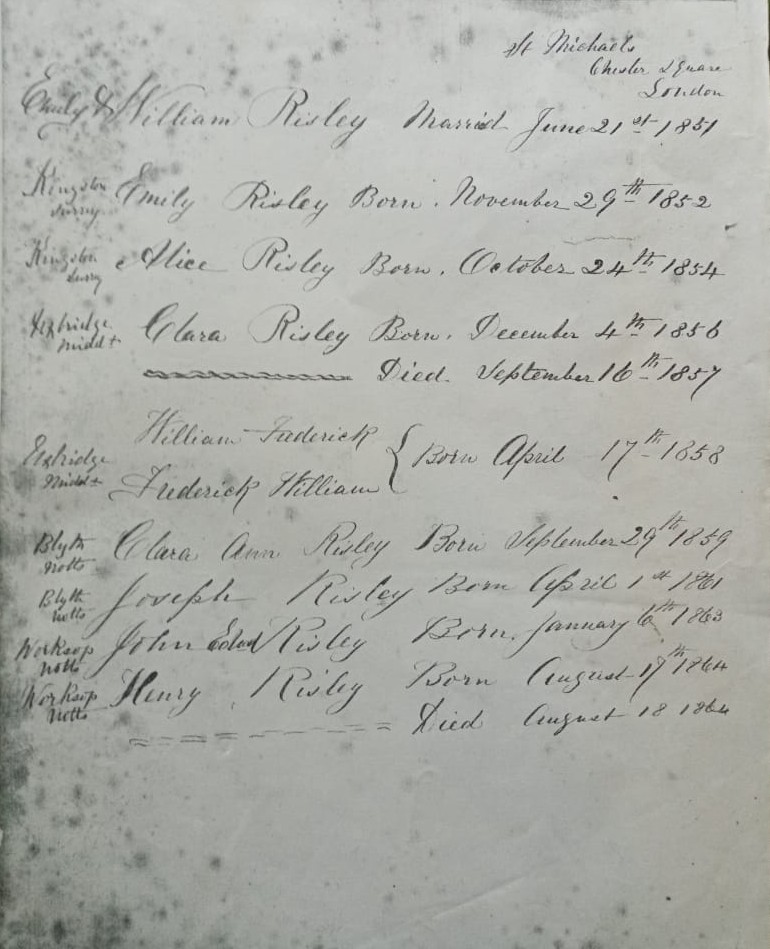
The Risley Family
Abigail (Risley) Dunkling
1832/3 in Edmonton, Middlesex,
England
John Risley
Sarah (Page) Risley
Edward L. Dunkling on 4 August 1866
in St Mary le Strand, Westminster, Middlesex, England
Edward was born in 1831/2, in Enfield, Middlesex. There were two Edward
Dunklings baptised in Enfield in this period - on 8 May 1831 an Edward
Dunkling was baptised, the son of William Dunkling and Maria, and on 8 April
1832, an Edward Dunkling was baptised the son of John Dunkling and Sarah. We
find both Edwards in later records - one married Louisa and the other
married Abigail Risley. Edward was a shoemaker (1871) and bootmaker (1881,
1891, 1901). He married, secondly, Elizabeth Cavill in 1876 in Strand
district. Elizabeth died in 1883. Edward died in 1917 in Edmonton
district, aged 86.
Census & Addresses:
1871: 9
Church Lane, Edmonton, Middlesex
1881: The
Shoe Shop, The Green, Edmonton, Middlesex
1882: The Green, Winchmore Hill N, Middlesex (London
Electoral Register). Edward is listed as "occupier as tenant of house"
1891: The
Green, Edmonton, Middlesex
1901: The
Green, Southgate, Middlesex
1911:
Enfield, Middlesex
- Edward Ernest John Dunkling (1866 - 1941)
- Henry William Dunkling (1867 - 1870)
- Annie Matilda Ada Dunkling (1868 - 1916)
1870, in Edmonton
district, England, aged 37
1841: Bury
Street, Edmonton, Middlesex
1851: Bury
Street, Edmonton, Middlesex
1861: Bury
Street, Edmonton, Middlesex
Alfred Risley
12 September 1838, in Edmonton
district, Middlesex, England
7 October 1838, in St Mary,
Hornsey, Middlesex, England
Alfred is recorded as born on September 12, the son of Joseph Risley,
gardener resident at Fortis Green, and his wife Alice
Joseph Risley
Alice
(Simmons) Risley
1842, in Edmonton
district, Middlesex, England
9 February 1842, in St Mary,
Hornsey, Middlesex, England
Alfred Risley is recorded as 3 years old, resident at Fortis Green. He is
immediately preceded in the burial register by his 10 year old brother,
James.
1841:
Felix Place, Hornsey, Middlesex
Alice (Risley, Barker) White
24 October 1854, in Kingston upon
Thames, Surrey, England
26 November 1854, in Kingston upon
Thames, Surrey, England
Alice is recorded as the daughter of William and Emily Risley, born on Oct
24. William is listed as a gardener, of Kingston.
William Risley
Emily
(Ward) Risley
Richard
Donthorn Barker on 26 February 1879 in St Peters Cathedral,
Pietermaritzburg, Natal
Richard Donthorn Barker is recorded as a bachelor, aged 33. He is a
merchant, resident in Maritzburg. Alice Risley is recorded as a spinster,
aged 24, resident in Maritzburg. The marriage was performed by Bishop John
William Colenso ("Jno. Natal") and witnessed by William Risley and Jno. ?.
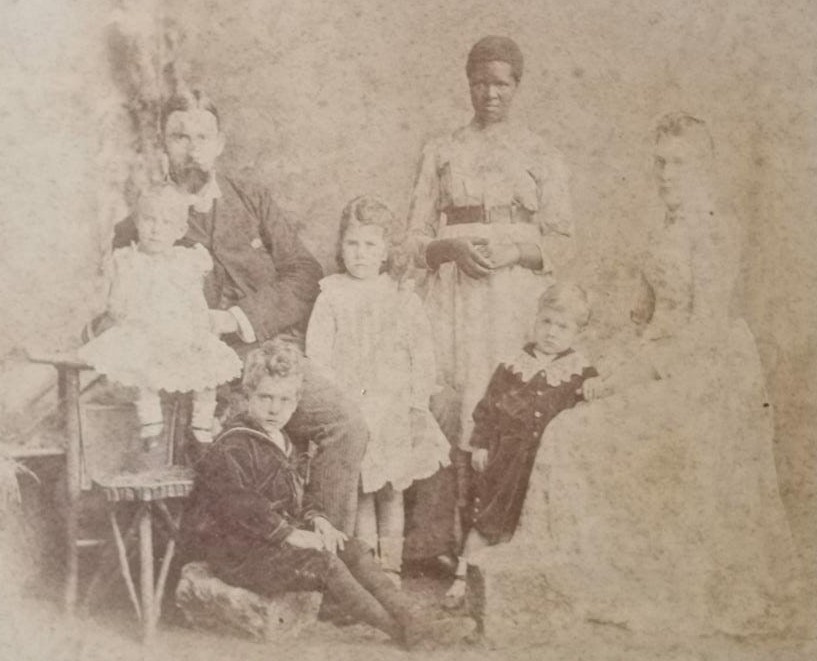
|
|
Harry White, Alice (Risley) White and
children, from left to right, Noel, Harry, Alice and Kenneth
photograph courtesy of Robert King
|
Harry
White on 30 April 1883 at St Peter's Cathedral, Pietermaritzburg,
Natal
Harry White is recorded as a bachelor, of full age. He is a merchant,
resident in Pietermaritzburg. Alice Donthorn Barker is recorded as a widow,
of full age, resident in Pietermaritzburg. The wedding was performed by
Thomas Colley and witnessed by Jos. Risley, W. A. Hadock and Clara Risley.
The Natal Witness 2 May 1883
MARRIAGE:- White - Barker, - On the 30th April,
at St. Peter's Cathedral, PMBurg, by the Venerable Archdeacon Colley, -
Harry White, eldest son of C. F. H.White Esq. of College House, Edmonton,
Middlesex, to Alice Douthora, widow of the late R.D.Barker Esq. of PMBurg,
and daughter of W. Risley Esq. of PMBurg.
Entry in
the front of large prayer book entitled Fletchers
Family Devotion
MARRIAGES.
On the 30th April 1883
at St Peters Cathedral, Maritzburg, Natal, S. A. Harry White and
Alice Donthorn Barker were united in Holy Matrimony by the Revd.
Archdeacon Colley.
"Harry White Son (eldest) of Cornelius Francis Hundley White, College
House, Upper Edmonton, nr London."
"Alice Donthorn Barker, second Daughter of William Risley of
Pietermaritzburg, Natal and widow of the late Richard Donthorn Barker, who
died in Pietermaritzburg on the 14 August 1880.
Issue from first marriage. One Son. Reginald Donthorn Barker born on the
2nd December 1879.
Alice
emigrated to Natal aboard
the Natal Star, arriving in
Durban on 1 February 1867. She is recorded as aged 12, and surety was
stood by her father, William Risley, who had emigrated earlier, and her
uncle, Joseph Risley, both of Pietermaritzburg. Accompanying Alice on the Natal Star were her mother, Emily, and
siblings Emily, Arthur, William J., Fred H., John E., Clara and Joseph.
Later in life, Alice took on lodgers to help make ends meet, and one of her
boarders was the author Harry
Camp Lugg.
28 January 1909 at 390 Longmarket
Street, Pietermaritzburg, Natal, aged 54
The cause of death is listed as burns and shock.
South Africa 27 February 1909 p485
NATAL LADY'S
TRAGIC DEATH.
MRS. H. WHITE, a resident of Longmarket
Street, Maritzburg, died recently under very painful circumstances. She
had taken a ricksha from the Market Hall to her residence, and upon
stepping out of the vehicle her dress, composed of light silk material,
suddenly broke into flames. She screamed for help and rushed into the
house, where the neighbours rendered her every assistance, but she died
a few hours afterwards. It is supposed that the ricksha puller had been
smoking and left something alight which caught the dress and when Mrs.
White stepped on to the pavement the wind caused the flames to break
out. The deceased lady, who was 54 years of age, was well known in
Natal, and had lived in Maritzburg for several years. She was the
daughter of the late Mr. William Risley, of Maritzburg, and had been
twice married, being at the time of her death a widow. She left four
sons and a daughter, besides brothers and sisters. Her eldest son is Mr.
R. D. Barker in the Natal Public Works Department. Her other sons are
Mr. H. N. H. White (of the Attorney-General's Department), Mr. K. V.
White (of the Natal Bank), and Mr. N. M. White. Mrs. E. F. Ford and Mrs.
Edmondson, of Maritzburg, are sisters of the late Mrs. White, and her
brothers are Mr. J. E. Risley, of Durban, Mr. H. F. Risley, of
Harrismith, Mr. F. W. Risley, of Zululand, and Mr. Joseph Risley, of
Maritzburg, all well-known Colonists. Great sympathy is felt for the
bereaved relatives.
Alice was returning from the wedding of her niece,
Mary
Gladys Edmondson to Alfred Potterill at the time of her tragic
accident.
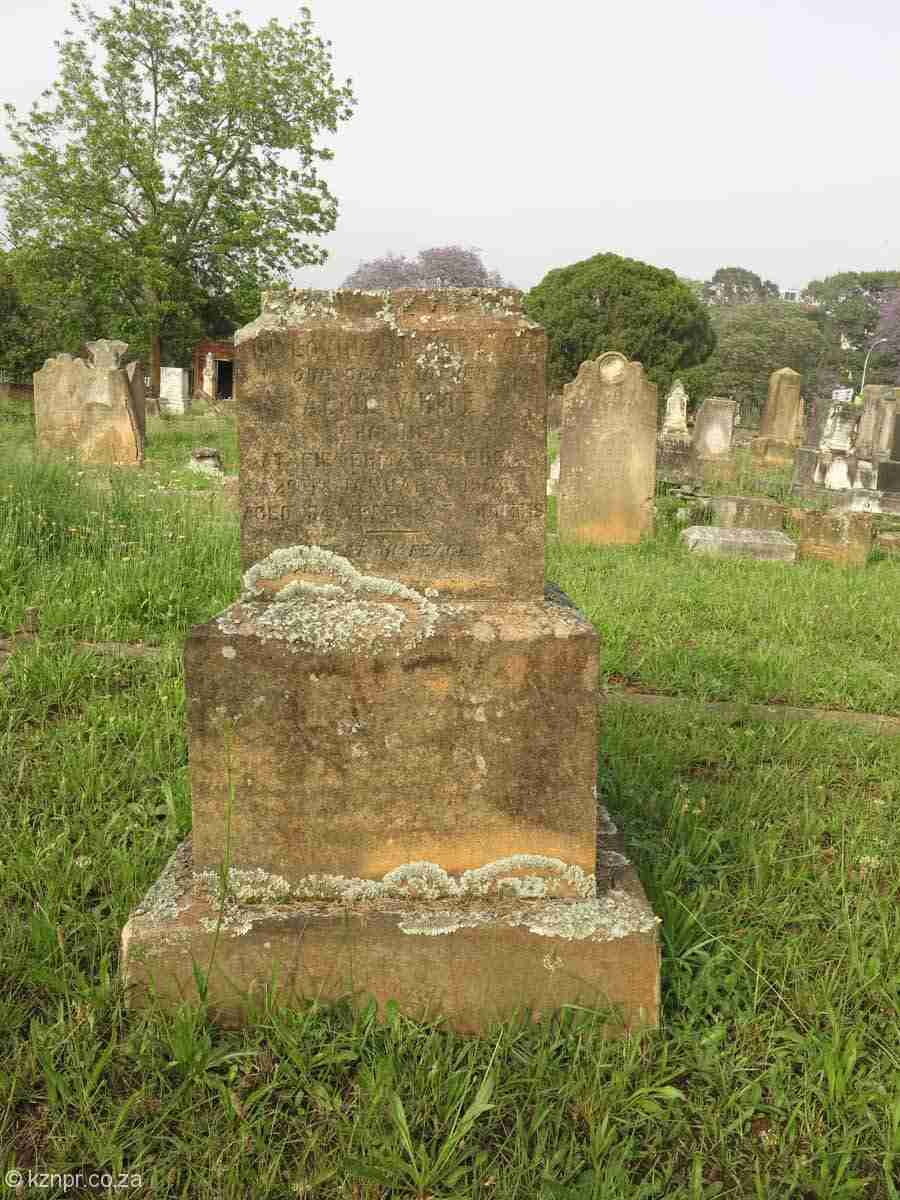 |
|
Grave of of Alice (Risley, Barker) White
in Commercial Road cemetery, Pietermaritzburg, Natal
|
Commercial Road cemetery,
Pietermaritzburg, Natal
The inscription reads:
In Loving Memory of our dear mother
ALICE WHITE
who died at Pietermaritzburg
29th January 1909
Aged 54 years and three months
Rest in Peace
dated 26 June 1905
Pietermaritzburg
Estate Files 1909 vol 34 #212 film 007866827 images 461-8
THIS IS THE LAST WILL AND TESTAMENT OF ME,
ALICE WHITE (born Risley) formerly the wife of the late RICHARD DONTHORNE
BARKER, and now the wife of HARRY WHITE of Pietermaritzburg, Natal Clerk
I declare that my domicile is Natal, and that community of property
was excluded from my marriage with the said Harry White by Ante Nuptial
Contract.
I hereby revoke, cancel and make void all wills, or other
Testamentary Acts which I may heretofore have made or executed whether
jointly with my husband or not and desire that the same may be of no force
or effect whatever.
I give and bequeath all my Estate and Effects movable and immovable
in possession, reversion, remainder or expectancy wheresoever situated,
and nothing whatever excepted to James King of Lynedoch, Nottingham Road,
Natal, Farmer, John Edward Risley of Durban, Agent, and Reginald Donthorne
Barker, my son (hereinafter with their successors called the Trustees)
upon trust to hold and deal with my Estate and Effects, with power to
convert the same, and that whether consisting of movable or immovable
property, into money by public auction or privately, and to deal with and
apply the Estate and income thereof as follows:-
1. To pay and apply the income arising from my Estate towards the
maintenance, education and support of my minor children until such time as
the youngest of such children attains majority, and on the happening of
such event I direct my Trustees to divide my Estate and Effects equally
amongst all my children who may have survived me including my said son by
my said first husband the said Reginald Donthorne Barker the lawful issue
of any child or children who may have pre-deceased me to take the share to
which their deceased parent would have been entitled if in life per
stirpes, that is, although the period of payment to the beneficiaries of
their shares under this Will is postponed until the youngest of my
children attains majority, it is my intention that such shares shall vest
in them immediately on my decease.
2. The shares of any of my said grandchildren who may take any
benefit under this Will on account of any of my said children
pre-deceasing me shall be retained by my Trustees until they respectively
attain the age of twenty one years complete but such shares shall vest in
them on my death. This condition however, shall not affect the paying out
to my children of their vested shares in my Estate on the youngest of my
children attaining majority as before provided for.
3. Although the income from my Estate is directed by me to be paid
towards the maintenance, education and support of my minor children until
the youngest attains majority, it is my intention that should there in any
one year be any surplus after providing for the said minor childrens'
maintenance education and support, in such manner as may, in the sole
discretion of my Trustees be sufficient and proper taking into account
their position in life, that such surplus be divided equally amongst the
major children, and the children of any pre-deceasing major child per
stirpes, and if the income on the vested shares of my minor children in
the Estate is sufficient to provide in the discretion of my said Trustees
for their proper education, maintenance and support, my desire is that the
income of my Estate should be divided amongst all my children and
grandchildren in the proportion to their vested interests in the capital
of my Estate, but that always only after the proper education, maintenance
and support of my said minor children has been properly provided for out
of the whole income of my Estate as aforesaid and in such application of
the income hereunder I desire my Trustees' to have and use the fullest
discretionary powers and the beneficiaries in my Estate must leave the
matter of the application of such income entirely to my Trustees
discretion and decision.
4. As a direction to my Trustees I would suggest if it can be
arranged and worked amicably that my said children, minors and majors, in
so far as they have not married or acquired homes of their own, should
reside in family and keep house together, and in providing for the
support, maintenance and education of my minor children from the income of
my Estate, and in the application of any income that may be available
after the proper maintenance, education and support of such children is
provided for my Trustees should keep this suggestion in view, and if need
be the whole of the income of my Estate can be employed in the up keep of
such home, keeping in view of course the proper education and upbringing
of my minor children and that notwithstanding any other direction to my
Trustees herein contained as to the disposal of such income and in order
that they may give the better effect thereto, if they consider it
advisable to adopt said suggestion I authorize them to dispose of the
property in Longmarket Street presently belonging to and occupied by me
together with such furniture belonging to me as shall not be required for
the purposes of furnishing the hereinafter mentioned cheaper house
property and in place thereof to hire a smaller and cheaper house property
for the occupation of my said children, or so many of them as agree to
stay in family together, until the youngest of said children attains
majority.
5. In the event of my daughter ALICE MILDRED WHITE surviving me and
being at the date of my death still unmarried, I direct my Trustees to pay
to her on her attaining the age of twenty one years the proceeds of the
sale of the surplus or balance of the furniture or other household
effects, which, in their opinion are not required for the furnishing of
any smaller house they may hire in giving effect to the suggestion or
direction contained in the preceding condition hereof, which surplus
furniture I direct them to sell in such manner as they deem advisable. As
to the quantity and class of furniture or household effects if any, so to
be sold, my Trustees shall be the sole judges. The remainder of my
household furniture and effects shall belong to and form part of my
Estate. Notwithstanding this special bequest to my said daughter, she
shall nevertheless share equally with my other children in the vesting and
division of the remainder of my Estate. In the event of my said daughter
predeceasing me, or being at the date of my decease married, or in the
further event of her dying before attaining the age of 21 years, when the
proceeds of the said surplus are directed to be paid to her, or in the
event of the family or portion of them not agreeing to reside in family
together or should the Trustees for any reason consider it not advisable
to keep together a home for my said children or any of them, or should
they consider that the whole furniture should forthwith be sold, or should
all of my furniture in the opinion of my Trustees be required for the said
home, and they resolve for this or any other reason as might appear to
them proper that the furniture should be retained by them, in the Estate
in whole, then and in any such event this special bequest to my said
daughter of the surplus furniture or household effects or the proceeds
thereof before referred to, shall at once become in-operative, and have no
force or effect whatever. I recognize possible difficulties in the way of
my Trustees administering and dealing with my Estate as directed in this
and the preceding condition, namely conditions 4 and 5 hereof, especially
in the event of any dissensions occurring amongst the members of my
family, and I therefore make my said Trustees the sole judges as to
whether the said conditions 4 and 5 hereof shall be acted upon or
partially acted upon by them, or completely ignored, and my Estate dealt
with as provided in the remainder of my Will, and in the event of their
deciding to give effect to the said conditions 4 and 5 or any part thereof
in the administration of my Estate by them, it is my desire that they
shall have the fullest discretionary powers and their actions in
administering the Estate according to the suggestions or directions
contained in the said conditions 4 and 5 hereof shall in no wise be open
to question by any of the beneficiaries under this Will.
6. My Trustees shall further have power if they consider it
advisable in the interest of any of my children major or minor, or any
grandchild who may have become interested in the Estate to advance the
whole or any part of any such child or grandchild's vested share in the
Estate for the maintenance, education or advancement in life of any such
child or grandchild, and the decision of my Trustees as to whether or not
it is advisable to advance the whole or any part of any child or
grandchild's share as aforesaid shall not be open to question by any
person in any way interested in the Will or otherwise.
7. My said Trustees are authorized to invest all moneys belonging
to my Estate in any sort of public stocks, or funds or Government
securities of Great Britain or of any British Colony or Dependency, or of
any State or Country in South Africa, or upon first mortgage of immovable
property in South Africa or elsewhere, or in the purchase of any such
immovable property or in or upon the public securities, stocks, mortgages,
debentures or securities of any Corporation, public body or Company,
Municipal Corporation or otherwise in South Africa, and to vary from time
to time or to transfer such stocks, funds or securities into or for others
of a like nature, hereby authorized, all in the discretion of my said
Trustees.
8. The receipt of my Trustees shall effectually discharge any
person making any payment or transferring any security or properties to my
Estate or to the Trustees and any such person shall not be bound to see
the application thereof, and if any Trustee hereby appointed shall die in
my lifetime or if any of them shall after my death die or resign or refuse
to act, or be incapable of acting, then and in every such case, it shall
be lawful for the surviving or continuing Trustee or Trustees to appoint a
new trustee or trustees in place of the Trustee or Trustees dying or
ceasing to act, and upon every such appointment the number of Trustees may
be augmented or reduced, but so that there shall always be at least two
Trustees.
9. I appoint the said James King, John Edward Risley and Reginald
Donthorne Barker, Executors of this my Will and Guardians of any minors
who shall become in any way interested in my Estate, and I authorise and
empower the Executors for the time being to pay or compromise or compound
any debts owing by or to me or my Estate, or to accept any composition or
any real or personal security for any debts due to me or my Estate, and to
allow such time for the payment or composition either with or without
security, as the Executors may deem reasonable to to refer to arbitration,
and to settle all accounts, questions or things which shall be owing or
claimed to be owing to me or my Estate and generally to in realising my
Estate in such manner as they shall think fit or expedient without being
liable for any loss occasioned thereby, and I give my Executors and
Guardians the same powers of making appointments of any person or persons
to act as Executor or Executors or Guardian or Guardians on the ceasing to
act of any of my said Executors and Guardians, as I have hereinbefore
conferred on my Trustees.
10. I intend that my Trustees and Executors shall possess all the
powers and authorities as are required and allowed in Law and I declare
that the powers conferred on my Trustees and Executors herein are not to
be considered as in any way restrictive, as it is my desire that in all
things concerning the administration and realisation of my Estate and the
investment of the Trust Funds thereof, they shall have the widest possible
discretion, including power to borrow money for any of the purposes
hereof, or the better to give effect to my expressed or apparent
intentions, and that on the security of any part of my Estate movable or
immovable, and on such conditions as they may consider advisable, and I
further declare that they shall have fullest power of assumption,
substitution and surrogation.
11. Any share of my Estate which shall under this Will fall to be
paid to any female shall not be affected by or subject to the jus mariti
or right of administration of any husband she may have married prior to or
may marry subsequent to the vesting of any such share in her and such
share shall not fall into or form any part of the community of goods or
property that may exist between her and the husband she has married or may
marry but shall form part of her own separate Estate and shall be quite
distinct from any such community and shall not be affected by the debts or
deeds of her husband. I also empower my Trustees if from any cause they
deem it advisable to place the share of the Estate falling to any female
in Trust to be held for her behoof and benefit and that subject to such
terms and conditions as they think necessary and advisable to impose.
I reserve to myself the power from time to time and at all times to
alter or add to this my Will either by a separate Act or at the foot
hereof, desiring that all such alterations or additions shall be as valid
and effectual as if inserted herein, and that although not executed
according to the requirements of the law.
All of which I declare to be my last Will and Testament desiring
that it may have effect as such or as a Codicil or other wise as may be
found to consist with Law.
IN WITNESS WHEREOF I execute these presents at Pietermaritzburg in
the Colony of Natal this the Twety sixth day of June 1905.
"Alice White".
SIGNED by Alice White (born Risley) the Testratrix of this Will in the
presence of us then present both together and affixing our signatures
hereto as witnesses to the said Will in the presence of the said Testatrix
and of each other.
"Robert Fuller".
"A.C.Klapka".
1861: Blyth (West Side), Blyth,
Nottinghamshire
1909: 390 Longmarket Street, Pietermaritzburg, Natal (Pietermaritzburg
Estate Files 1909 vol 34 #212 film 007866827 image 460)
Ann Risley
22 September 1811
20 October 1811, in All Saints,
Edmonton, Middlesex, England
Ann is recorded as born on Septr 22, the d. of William, labr
of Winchmore Hill, and Ann, his wife
William Risley
Ann
(Hopes) Risley
- Parish registers of All
Saints, Edmonton, Middlesex (Baptisms 1811 p63)
- Parish registers of All
Saints, Edmonton, Middlesex (Baptisms 1811 p63)
- Parish registers of All
Saints, Edmonton, Middlesex (Baptisms 1811 p63)
Annie Josephine Risley
19 June 1862
Joseph Risley
Annie (Cox) Risley
8 July 1880 at Ivy Cottage,
Pietermaritz Street, Pietermaritzburg, Natal, aged 18, of tuberculosis
Annie Josephine Risley died on July 8 1880 at Pietermaritz St, P.M.Burg. She
is recorded as 18 years old, the daughter of Jos. Risley. The cause of death
is listed as pulmonary consumption.
Natal Witness 10 July 1880 transcribed at Mole Genealogy
(Name, Gender, Age, Date of Event, Date of
Advert, Details)
Risley, Annie Josephine f 18yrs 21 days, 8-July-1880,
10-July-1880
at Ivy Cottage PMBurg, the beloved daughter of Mr and Mrs Jno Risley
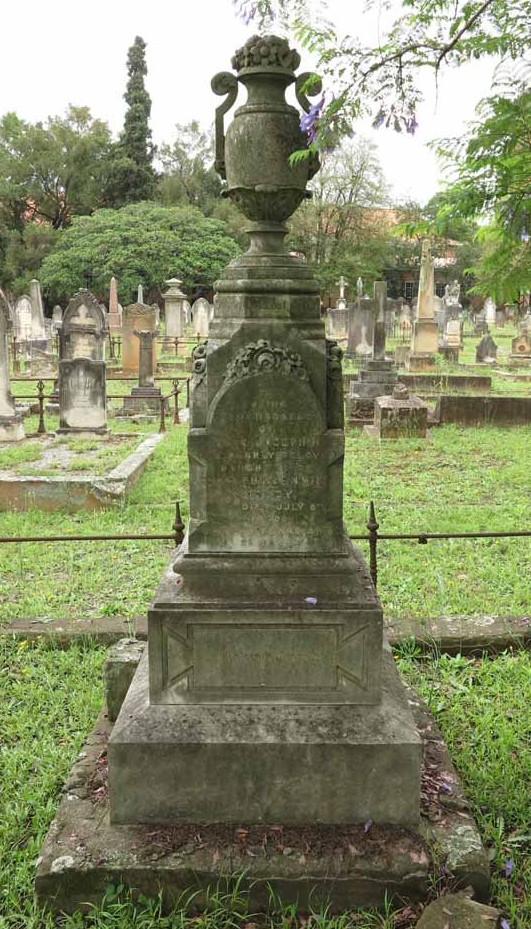 |
|
Grave of Annie Josephine Risley in DRC and
Presbyterian cemetery, Pietermaritzburg, Natal
|
DRC and Presbyterian cemetery,
Pietermaritzburg, Natal. The grave is located in Old Lot No 1I (New Lot No
1B) Area 5.
Arthur Risley
1853/4, in Kingston, Surrey, England
William Risley
Emily
(Ward) Risley
Arthur emigrated to Natal aboard
the Natal Star, arriving in
Durban on 1 February 1867. He is recorded as aged 12, and surety was
stood by his father, William Risley, who had emigrated earlier, and his
uncle, Joseph Risley, both of Pietermaritzburg. Accompanying Arthur on the Natal Star were his mother, Emily, and
siblings Emily, Alice, William J., Fred H., John E., Clara and Joseph.
1861: Blyth (West Side), Blyth,
Nottinghamshire
- 1861 census; curiously,
Arthur is not listed in the family
bible of William and Emily Risley that
includes the births of all his siblings. The 1861 census does, however,
clearly state him as a son of William and Emily.
- Immigration: passenger
lists transcribed at eGGSA from NAB Pietermaritzburg Archives,
Land and Immigration Board, Natal, Register of Immigrants Arrived, vol
65, p88
Arthur Jack Charles Risley
2 April 1893, at Desart,
Pietermaritzburg, Natal
28 February 1894, in St Peter,
Pietermaritzburg, Natal
Arthur Jack Charles is recorded as born on 2nd April 1893, the son of Joseph
Charles and Harriette Risley. Joseph is a trader, resident in Desart,
P.M.Burg. The baptism sponsors are Charles B. Goodwill, John Welch and Maria
E. Doig.
Joseph Charles
Risley
Harriet (Ellis) Risley
Durban High School and Maritzburg
College, Pietermaritzburg.
Arthur played cricket for Natal in
1921/2. He played in only one match, scoring 4 runs in his two innings.
20 January 1969 in Durban, Natal,
South Africa
22 January 1969 in Addington,
Durban, Natal, South Africa
Caroline Risley
1833/4, in Middlesex, England
23 March 1834, in St Mary, Hornsey,
Middlesex, England
Caroline is recorded as the daughter of Joseph Risley, gardener of Fortis
Green, and his wife Alice.
Joseph Risley
Alice
(Simmons) Risley
1842, in Edmonton
district, Middlesex, England
10 March 1842, in St Mary, Hornsey,
Middlesex, England, aged 8
Caroline Risley is recorded as 8 years old, resident at Fortis Green
1841:
Felix Place, Hornsey, Middlesex
- Aged 7 in 1841 census;
place from 1841 census
- Parish registers of St
Mary, Hornsey, Middlesex (Baptisms 1834 p126 #1005)
- Parish registers of St
Mary, Hornsey, Middlesex (Baptisms 1834 p126 #1005)
- England
Death Index (1Q1842 Edmonton vol 3 p110)
- Parish registers of St
Mary, Hornsey, Middlesex (Burials 1842 p72 #574)
- Caroline Risley
Catharine Risley
7 December 1794, in All Saints,
Edmonton, Middlesex, England
Catharine is recorded as the daughter of Randall and Elizabeth Risley
Randall Risley
Elizabeth
(Hutchinson) Risley
- Parish registers of All
Saints, Edmonton (Baptisms 1794)
- Parish registers of All
Saints, Edmonton (Baptisms 1794)
Charles Risley
6 May 1791, in All Saints,
Edmonton, Middlesex, England
Charles is recorded as the son of Randall and Eliz.th Risley
Randall Risley
Elizabeth
(Hutchinson) Risley
- Parish registers of All
Saints, Edmonton (Baptisms 1791)
- Parish registers of All
Saints, Edmonton (Baptisms 1791)
Clara Risley
4 December 1856, in Uxbridge,
Middlesex, England
22 March 1857 in St John the
Baptist, Hillingdon, Middlesex
Clara is recorded as the daughter of William and Emily Risley. William is a
gardener, of Hillingdon.
William Risley
Emily
(Ward) Risley
16 September 1857, in Uxbridge
district, Middlesex, England
Clara Ann (Risley) Edmondson
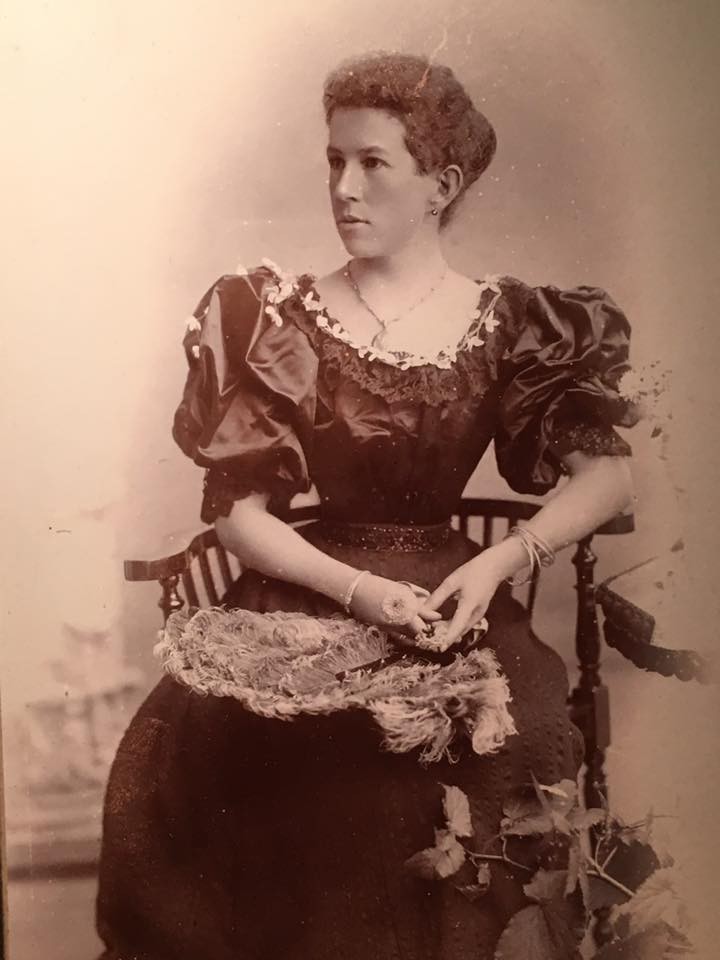 |
|
Clara Ann (Risley) Edmondson
photo from Joy Pieret
|
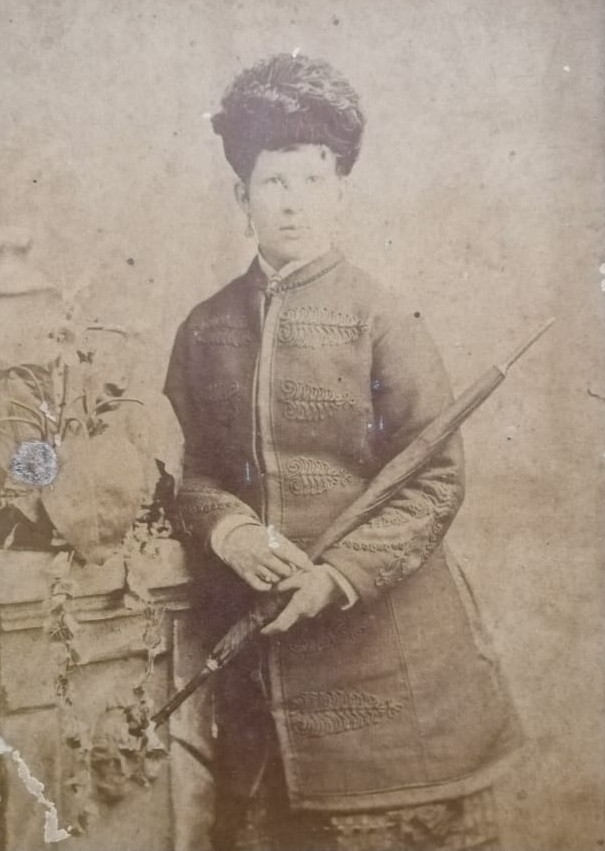 |
|
Clara Ann (Risley) Edmondson
photograph courtesy of Robert King
|
29 September 1859, in Blyth,
Nottinghamshire, England
William Risley
Emily
(Ward) Risley
Alfred
Edmondson on 23 November 1885 in St Peters Cathedral,
Pietermaritzburg, Natal
Alfred Edmondson is recorded as a bachelor, of full age. He is in the civil
service and resident in Pietermaritzburg. Clara Ann Risley is recorded as a
spinster, of full age, resident at Chase Valley, Pietermaritzburg. The
marriage was performed by Thos. Colley, Archdeacon and witnessed by William
Risley, Matilda Risley, Emily Ford and Frederick William Risley.
Clara emigrated to Natal aboard
the Natal Star, arriving in
Durban on 1 February 1867. She is recorded as aged 4, and surety was
stood by her father, William Risley, who had emigrated earlier, and her
uncle, Joseph Risley, both of Pietermaritzburg. Accompanying Clara on the Natal Star were her mother, Emily, and
siblings Emily, Arthur, Alice, William J., Fred H., John E. and Joseph.
In 1882, Clara was engaged to marry Robert John Hall, and when the
engagement was called off, Clara sued Robert for £2,000 damages for breach
of promise to marry. The parties eventually reached a settlement of £100 for
costs and £500 placed into trust from which Clara received the income during
her lifetime and after her death the capital was inherited by her children (Pietermaritzburg
Estate Files 1927 #12526 film 007866867 image 339). Clara was also
romantically linked to a family friend, Robert
John King. Robert's great-grandson, also Robert King, writes "at one
stage Robert was thought to be about to propose to Emily's sister Clara
Risley and they caused a scandal riding up from Pietermaritzburg to Lynedoch
(King home, Nottingham Road) without a chaperone".
9 July 1927, at 108 Boshoff Street,
Pietermaritzburg, Natal, South Africa
The cause of death is listed as cerebral
haemorrhage and apoplexy of duration a few hours.
English cemetery, Pietermaritzburg,
Natal, South Africa
dated 1 September 1902. Will no.
403/1927 held in Pietermaritzburg
Estate Files 1927 #12526 film 007866867 images 334-5
THIS IS THE LAST WILL AND TESTAMENT of me CLARA
EDMONDSON (born Risley) wife of ALFRED EDMONDSON of Pietermaritzburg, in
the Colony of Natal.
I hereby revoke, cancel, annul and make void all Wills, Codicils or
other documents of a Testamentary nature heretofore made and executed by
me.
I nominate, constitute and appoint JOHN EDWARD RISLEY of Durban,
Natal, Clerk, to be the Executor of this my Will and Trustee and
Administrator of my estate and effects, giving and granting to such
Trustee all such Powers and Authorities as are required or allowed in Law,
especially those of assumption, substitution and surrogation.
I give, devise and bequeath the whole of my estate and effects,
movable and immovable, personal and real, corporeal and incorporeal, and
whether the same be in possession, reversion or expectancy, nothing
excepted, unto my three children, MARY GLADYS, VIVIAN and IRENE, in equal
shares and proportions, and the lawful issue or lawful descendants of such
of them as may predecease the period of division.
In all cases where females take benefit under this my Will, the
same shall be free from the jus mariti and right of administration of any
husbands they may marry.
I reserve power of revocation of this Will, and also power to make
all such alterations or additions hereto from time to time and at all
times hereafter, desiring that any such alterations or additions in whole
or in part under my signature, whether by a separate act or at the foot
hereof shall be held as valid and effectual as if inserted herein.
All of which I declare to be my last Will and Testament desiring
that it may have effect as such or as a Codicil or otherwise in such
manner as my be found to consist with Law.
THIS DONE AND EXECUTED AT PIETERMARITZBURG aforesaid this first day
of September in the year of Our Lord One Thousand Nine hundred and Two.
"C. Edmondson".
SIGNED by the said Clara Edmondson (born Risley) the Testatrix of this
Will in the presence of us then both together, and affixing our signatures
hereto in the presence of the Testatrix and of each other.
"John Lister,"
"Leo. J. King"
1902: Pietermaritzburg, Natal (Pietermaritzburg
Estate Files 1927 #12526 film 007866867 image 334)
1927: "Chase View", 108 Boshoff Street, Pietermaritzburg, Natal
(Pietermaritzburg
Estate Files 1927 #12526 film 007866867 image 333)
1861: Blyth (West Side), Blyth,
Nottinghamshire
Clara Maria (Risley) Lister
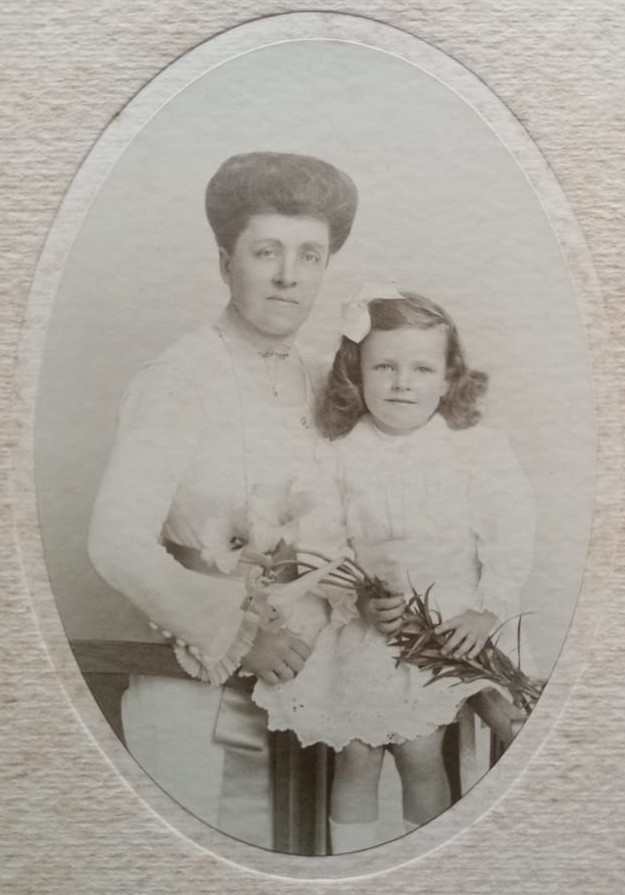 |
|
Clara Maria "Daisy" (Risley) Lister and
Eileen Mary Lister
photograph courtesy of Robert King
|
13 June 1870, in Pietermaritzburg,
Natal
Joseph Risley
Annie (Cox) Risley
John
Dunheved Lister on 15 July 1890 in St Peters Cathedral,
Pietermaritzburg, Natal
John Dunheved Lister is recorded as a bachelor, of full age. He is a
solicitor, resident in PMBurg. Clara Maria Risley is recorded as a spinster,
aged 20, born in PMBurg. The marriage was performed by Arthur H. D. Edwards,
and witnessed by Jos. Risley, Wm. Lister and Lillie Mary Murray.
Known as "Daisy"
On 23 July 1891 Clara gave birth to a still born son
The Natal Witness - Deaths 1891
(NAME, Gender, AGE, Date of Event, DATE OF ADVERT, Details)
Lister m still born, 23-July-1891, 27-July-1891,
at PMBurg Street the wife of John Lister of a son
9 May 1941, at 1.15 am, at Grey's
Hospital, Pietermaritzburg, Natal, South Africa
The cause of death is listed as haematemesis
of duration 8 days, gastric ulcer of duration years and mitral regurgitation
of duration years.
English Church cemetery,
Pietermaritzburg, Natal, South Africa
1941: 164 Longmarket Street, Pietermaritzburg, Natal (Natal
Civil Records Deaths 1941 Pietermaritzburg film 007751169 image 21)
- Aged 70 years, 10 months
and 26 days at death on 9 May 1941 from death notice at Pietermaritzburg
Estate Files 1941 #32636 film 007867977 image 1525; place from
death notice at Pietermaritzburg
Estate Files 1941 #32636 film 007867977 image 1525
- death notice at Pietermaritzburg
Estate Files 1941 #32636 film 007867977 image 1525; The
Natal Who's Who p118 (1906)
- Clara's death notice at
Pietermaritzburg
Estate Files 1941 #32636 film 007867977 image 1525 lists her
mother as "Annie Risley (nee Randal)", rather than Annie Cox. We know
that at the time he wrote his will in 1876, Joseph Risley was married to
his "present wife Annie Risley (born Cox)". It is possible that Joseph
married firstly Annie Randal who then died some time between Clara's
birth in 1870 and the writing of Joseph's will in 1876, and then he
married secondly Annie Cox, but I can find no evidence of such marriages
or deaths, while the marriage of a Joseph Risley and Anne Cox in
Edmonton, London in 1856 corresponds nicely with the birth of their
first child, Sara, in 1858. For these reasons I have surmised that the
information on Clara's death notice, supplied by her son, Randal, is in
error.
- Natal
Civil Records Marriages Pietermaritzburg 1890 #415
- Death notice at Pietermaritzburg
Estate Files 1941 #32636 film 007867977 image 1525; death
certificate at Natal
Civil Records Deaths 1941 Pietermaritzburg film 007751169 image 21
has the death date as 8 May 1841, but the exact time of death, early in
the morning of 9 May 1941 given in Pietermaritzburg
Estate Files 1941 #32636 film 007867977 image 1525 makes me think
that record is likely correct; cause of death from death certificate at
Natal
Civil Records Deaths 1941 Pietermaritzburg film 007751169 image 21
- Death certificate at Natal
Civil Records Deaths 1941 Pietermaritzburg film 007751169 image 21
Cyril Joseph Risley
 |
|
Cyril Joseph "Bull" Risley from a team
photo of the Durban High School cricket team in 1910
(click for full picture)
|
26 May 1895, at Loop Street,
Pietermaritzburg, Natal
26 June 1895, in St Peter,
Pietermaritzburg, Natal
Cyril Joseph is recorded as born on 26th April 1895, the son of Joseph
Charles and Harriet Risley. Joseph is a clerk, resident in P.M.Burg. The
baptism sponsors are David C. Dick, father and Annie Risley.
Joseph Charles
Risley
Harriet (Ellis) Risley
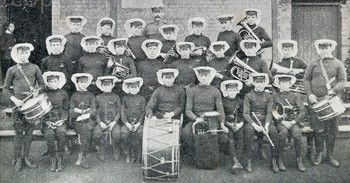 |
|
Cyril Joseph Risley is the side drummer
standing on the right in this photograph of the Maritzburg College
band in 1909
|
Maritzburg College,
Pietermaritzburg, Natal and Durban High School, Durban, Natal
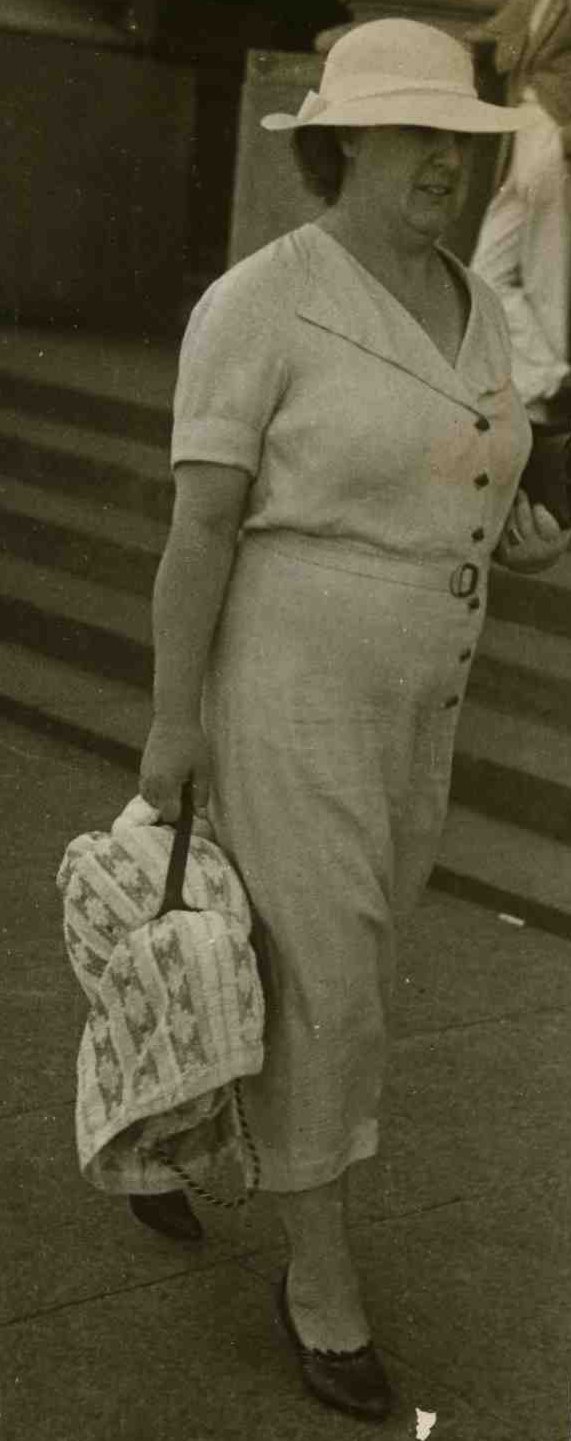 |
|
Beatrice Mary (Walker) Risley
This photograph was sent by Beatrice to her mother in England
between 1936 and 1938.
|
Beatrice Mary Walker on 4 August
1921, at St Mary, Greyville, Durban, Natal, South Africa
Cyril Joseph Risley is recorded as a bachelor, aged 26. He is an clerk,
resident at 25 Claribell Road, Durban. Beatrice Mary Walker is recorded as a
spinster, aged 24 and resident at The Lodge, Compton Hall, Wolverhampton,
Staffs. The wedding was witnessed by A.J. Risley, Rhy Risley and H. Ascough.
Beatrice was born on 3 December 1896, in Tettenhall, Staffordshire, England,
and baptised in Tettenhall Wood on 3 January 1897, the daughter of Edward
Walker and Gertrude Pearson. She died on 27 July 1976 at the Old Age Home in
Odendaalsrus, Orange Free State, South Africa, where she had resided for
about 18 months. The cause of death is listed as thrombosis
(trombose). Documents related to
her will and estate can be found at Orange
Free State Estate Files film 005176788 image #251. There is a memorial
to Beatrice and her husband at the Stellawood cemetery and crematorium in
Durban, Natal.
Census and Addresses:
1901: Henwood
Lane, Tettenhall, Staffordshire
1911:
Compton, Tettenhall, Wolverhampton, Staffordshire
1921: The Lodge, Compton Hall, Wolverhampton, Staffordshire (Natal
Civil Records Marriages Durban 1921#260)
1976: Mev Steyn Ouetehuis, Odendaalsrus, Orange Free State (death
notice in Orange Free State Estate Files film 005176788 image #251)
Clerk (1921); Swimming
Instructor (1957)
Bull Risley was the swim coach at Clifton Preparatory School in the 1950s. A
former student, Ian Robertson, remembers him:
Clifton
Preparatory School in the 1950s
Boys used the pool for recreation after school,
often under the gaze of the swimming coach Bull Risley, who we thought
resembled a giant bullfrog. He sat immobile in a wicker chair,
cloaked in a raincoat to protect himself from our splashes, and croaked
out his commands in rasping tones.
Cyril was known as "Bull Risley". He
served in France during World War I, where he met Beatrice, an English woman
serving in the Women's
Army Auxiliary Corps. Beatrice went to South Africa after the war
where she and Bill were married.
9 June 1957 at Addington Hospital,
Durban, Natal, South Africa, aged 62
The cause of death is listed as acute left ventricular heart failure, of
duration half and hour, due to chronic pyelonephritis
and diabetes mellitus of duration 13 years
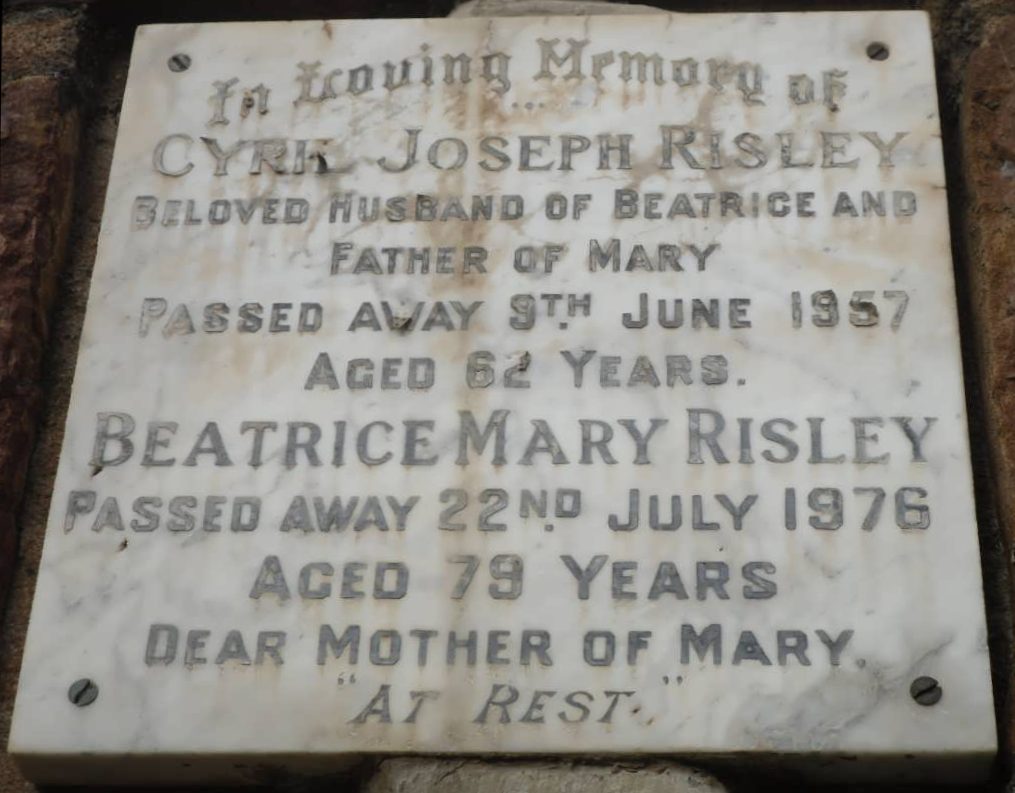 |
|
Memorial to Cyril Joseph Risley and
Beatrice Mary (Walker) Risley in Stellawood cemetery and
crematorium, Durban.
|
11 June 1957, at Stellawood
cemetery and crematorium, Durban, Natal, South Africa
The memorial reads:
In Loving Memory of
CYRIL JOSEPH RISLEY
Beloved husband of Beatrice and father of Mary
Passed away 9th October 1957 aged 62 years.
BEATRICE MARY RISLEY
Passed away 22nd July 1976 aged 79 years
Dear mother of Mary
"At Rest"
1921: 25 Claribell Road, Durban, Natal (marriage
registration)
1950: 17a Venice Road, Durban, Natal (Braby's Natal Directory 1950 p328)
1957: 17A Venice Road, Durban, Natal (death
registration)
Dulcie Edith Annie (Risley) Logan
9 August 1896 at Loop Street,
Pietermaritzburg, Natal
17 September 1896, in St Peter,
Pietermaritzburg, Natal
Dulcie Annie Edith is recorded as born on Aug 9th 1896, the daughter of
Joseph Charles and Harriett Risley. Joseph is a clerk, resident in Town
Lands. The baptism sponsors are father, mother, Edith May Ellis and Mary
Agnes Fenwick.
Joseph Charles
Risley
Harriet (Ellis) Risley
Kenneth Ainsley Logan on 25 October
1922 in St Mary, Greyville, Durban, Natal, South Africa
Kenneth Ainsley Logan is recorded as a bachelor, aged 32. He is a clerk,
resident at 19 Botanic Gardens Road, Durban. Dulcie Edith Annie Risley is
recorded as a spinster, aged 26, resident at 64 Eighth Avenue, Durban. The
marriage was performed by William Maddock and witnessed by A. J. Risley and
Allan Logan.
Kenneth was born on 4 January 1890 in Blackburn, Inanda district, Natal, the
son of William Henry Logan, a planter, and Margaret Elizabeth Gamley.
Kenneth played cricket for Natal, playing in 4 first class matches in which
he took 20 wickets and scored 4 runs. He died on 2 March 1978, in Durban.
Addresses:
1922: 19 Botanic Gardens Road, Durban, Natal (marriage
register)
1938: 129 Trematon Drive, Durban, Natal (death
notice of brother, Allan)
Edmund Risley
20 March 1801, in Edmonton,
Middlesex, England
19 April 1801, in All Saints,
Edmonton, Middlesex, England
Edmund Risley is recorded as born on 20 March, the son of William and Ann,
of Winchmre Hill
William Risley
Ann
(Hopes) Risley
Charlotte Meek on 23 December 1822,
in All Saints, Edmonton, Middlesex, England
Edmund Risley is recorded as a bachelor, living in the parish of Edmonton.
Charlotte Meek is recorded as a spinster, living in the parish of Edmonton.
The marriage, by banns, was officiated by Francis Ellaby, curate, and
witnessed by Ann Risley and John Risley.
In a deposition requesting the publication of banns, Edmund Risley is
recorded as a servant, living in Winchmore Hill and Charlotte Meek is
recorded as a lodger in the house of William and Ann Risley in Winchmore
Hill. The banns were published on Sunday 8 December 1822, Sunday 15 December
1822 and Sunday 22 December 1822.
Charlotte was born in 1796-9, in Herefordshire. She was a laundress.
Charlotte died in 1875, in Lambeth
district, Surrey, aged 76.
Census:
1841:
Edmonton, Middlesex
1851:
Lambeth, Surrey
1861:
Bedford Cottages, Lambeth, Surrey
1871:
Fenwick Place, Lambeth, Surrey
- Caroline Risley (1824 - ? )
- Charles Risley
- James Risley (1828/9 - 1854)
- George Risley (1833 - ? )
- Emma Risley (1837 - ? )
Gardener (1851); Servant (1861)
Edmund is mentioned in the will of his father, William Risley, dated 3
October 1846 (National
Archives PROB 11/2056/312)
I give all my
Estate and Effects (except my wearing apparel which I give unto my son
John Risley) to my wife for her life and after her decease I give the
same to my sons John and Edmund in equal shares absolutely
1865, in Lambeth
district, Surrey, England
2 April 1865 in Lambeth, Surrey,
England, aged 65
1841:
Edmonton, Middlesex
1851:
Lambeth, Surrey
1861:
Bedford Cottages, Lambeth, Surrey
- Parish registers of All
Saints, Edmonton, Middlesex (Baptisms 1801 p30); place from 1851, 1861
census
- Parish registers of All
Saints, Edmonton, Middlesex (Baptisms 1801 p30)
- Parish registers of All
Saints, Edmonton, Middlesex (Baptisms 1801 p30)
- Parish registers of
All Saints, Edmonton, Middlesex (Marriages 1822 p121 #379); banns
request data transcribed in parish register database at FreeReg
citing Phillimore's Transcripts, All Saints, Edmonton, Middlesex; banns
from parish registers of All Saints, Edmonton, Middlesex (Banns 1822
p145 #13); Charlotte birth from 1851, 1861, 1871 census and age at
death; Charlotte occupation from 1861, 1871 census; Charlotte death from
England
Death Index (2Q1875 Lambeth vol 1d p340)
- 1851, 1861 census
- England
Death Index (1Q1865 Lambeth vol 1d p302)
- Surrey
parish registers
- Edmund Risley
Eliza Risley
17 February 1805, in Weld Chapel
Southgate, Edmonton, Middlesex, England
Eliza is recorded as the daughter of Wm and Ann Rizley
William Risley
Ann
(Hopes) Risley
- Parish registers of All
Saints, Edmonton, Middlesex (Baptisms 1805)
- Parish registers of All
Saints, Edmonton, Middlesex (Baptisms 1805)
Eliza Risley
1828/9 in Edmonton, Middlesex,
England
John Risley
Sarah (Page) Risley
Dressmaker (1851)
1841: Bury
Street, Edmonton, Middlesex
1851:
Bury Street, Edmonton, Middlesex
Emily (Risley) Ford
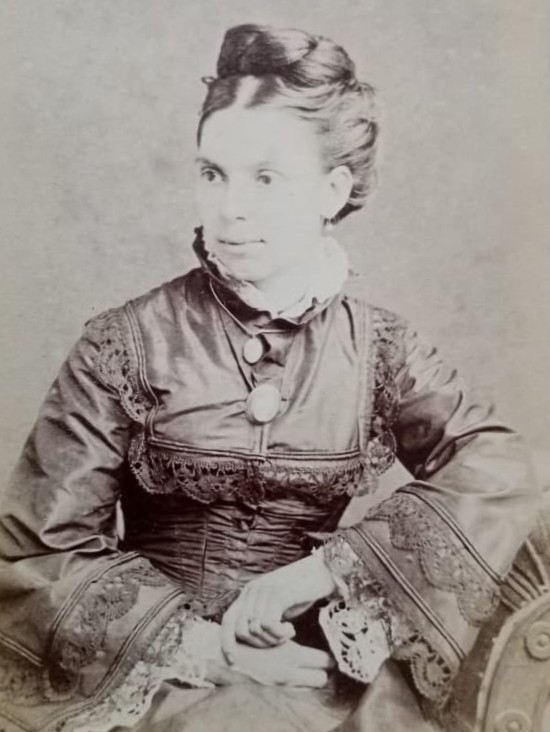 |
|
Emily (Risley) Ford
photograph courtesy of Robert King
|
29 November 1852, in Kingston,
Surrey, England
26 November 1854, in Kingston upon
Thames, Surrey, England
Emily is recorded as the daughter of William and Emily Risley, born on Nov
29 1852. William is listed as a gardener, of Kingston.
William Risley
Emily
Mason (Ward) Risley
Edward
Funnell
Ford on 28 September 1875, at St Peters Cathedral, Pietermaritzburg,
Natal
Edward Funnell Ford is recorded as a bachelor, aged 34. He is an engineer,
resident in Maritzburg. Emily Risley is recorded as a spinster, aged 22 and
resident in Maritzburg. The wedding was performed by Bishop John William
Colenso ("Jno. Natal") and witnessed by Wm. Risley and A. T. Ford.
Natal Witness 8 October 1875
Edward Funnell eldest son of Mr Edward Ford
formerley of Warblington House, Emsworth, Hants. To - Emily, eldest
daughter of William Risley of PMBurg, Natal
Emily emigrated to Natal aboard
the Natal Star, arriving in
Durban on 1 February 1867. She is recorded as aged 13, and surety was
stood by her father, William Risley, who had emigrated earlier, and her
uncle, Joseph Risley, both of Pietermaritzburg. Accompanying Emily on the Natal Star were her mother, Emily, and
siblings Arthur, Alice, William J., Fred H., John E., Clara and Joseph.
Emily's father-in-law, Edward Ford suffered from an ulcer on his leg in old
age and Emily told Robert King's father that a task in her first years of
married life, until Edward died in 1880, was to have to clean and bandage
the leg every day, not a pleasant experience for a young bride, on top of
giving birth to sons in 1876, 1878 and 1880.
The Daily Tribune - Wednesday October 26, 1938
WAGONS BROUGHT
BACK MEMORIES TO THIS WOMAN PIONEER
As
the Voortrekkerwagons creaked over the Pietermaritzburg streets this
morning they reminded the respected senior generation of the days when
wagons were not historic relics but were almost the sole means of
transport.
It was in one of those lumbering
vehicles that an excited little 14-years-old girl made her first journey
to the village which was to be her "home" for the remainder of her life.
In the midst of the Centenary celebrations today, Mrs. E.F. Ford, the
little girl of yesterday, recalled another gala day. It was the day when
the whole of Durban went on holiday to celebrate the opening of the long
anticipated lighthouse. It was on that same day that Mrs. Ford, her
mother and six younger brothers and sisters disembarked from the sailing
vessel Natal Star, in which they had sailed from England.
"We thought Durban was a lovely
place", smiled Mrs. Ford to a Daily Tribune reporter. "Everyone was on
holiday, just as they are to-day. Flags were flying everywhere. Even the
boats on the bay were decorated."
Their first home was a rambling
thatched roofed cottage with mud floors in Pietermaritz Street, opposite
Temple Street.
Mrs. Ford went to school in Miss
Newcombe's "Select Establishment for Young Ladies" in Pietermaritz
Street. Her brothers were foundation members of Hilton College, under
Dr. Neunham. Youth was hardy in those days. "After the holidays the boys
thought nothing of walking home from school", said Mrs. Ford.
Mrs. Ford's father was one of the
earliest city councillors of Pietermaritzburg.
A few months later she moved with
her husband to Chase Valley. There they set to work building a home for
themselves out of the veld. They planned gardens and planted citrus
trees, laying the foundations of what is now a thriving citrus farm,
Kingston Lodge.
QUEER
FARM NAMES
The Fords lived there for 40
years. A well-known neighbour of theirs was Judge Phillips, owner of
"The Chase". He had wonderful gardens and planted trees imported from
all parts of the world. The judge had a humerous taste as far as the
names of his various homes were concerned. His first farm at Karkloof
was called "The Start". Then he moved to "The Chase", and he ended his
journey at a farm at Cope's Folly, appropriately named "The Finish".
Mrs. Ford still remembers how
wildly excited she was when her husband bought their first motor car. It
was a regal affair that looked nice but had very limited capabilities.
It was one of the earliest models and travelling in it was hazardous, to
say the least. It took it all its time to get along itself without any
passengers sitting in it, said Mrs. Ford.
5 July 1943, at 167 High Ridge Road,
Durban, Natal, South Africa, aged 90
The cause of death is listed as myocarditis,
of duration 10 days, contributed to by chronic uraemia
of duration 2 months.
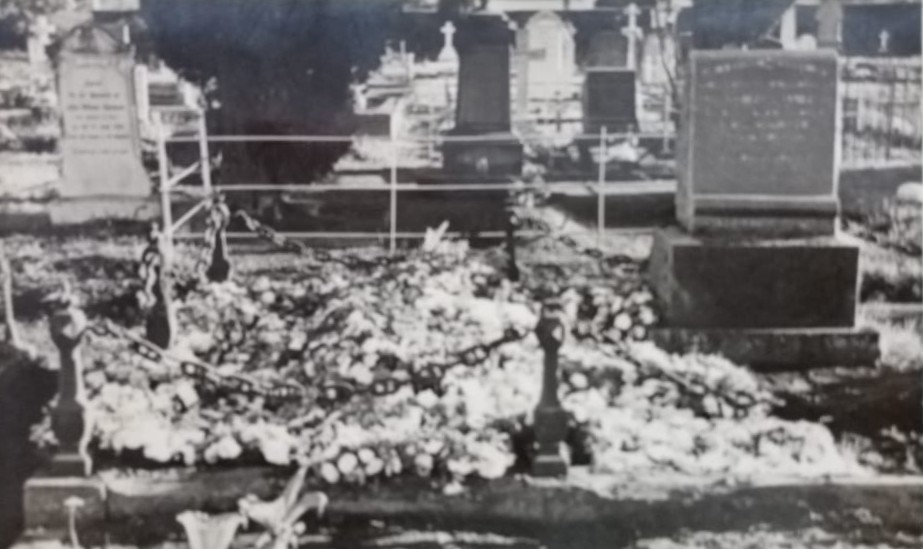 |
|
The grave of Emily (Risley) Ford and
Edward Funnell Ford in Pietermaritzburg, covered in flowers at
Emily's funeral in July 1943. Edward's headstone on the right in
this photograph was replaced by the joint headstone with Emily
shown below.
photograph courtesy of Robert King
|
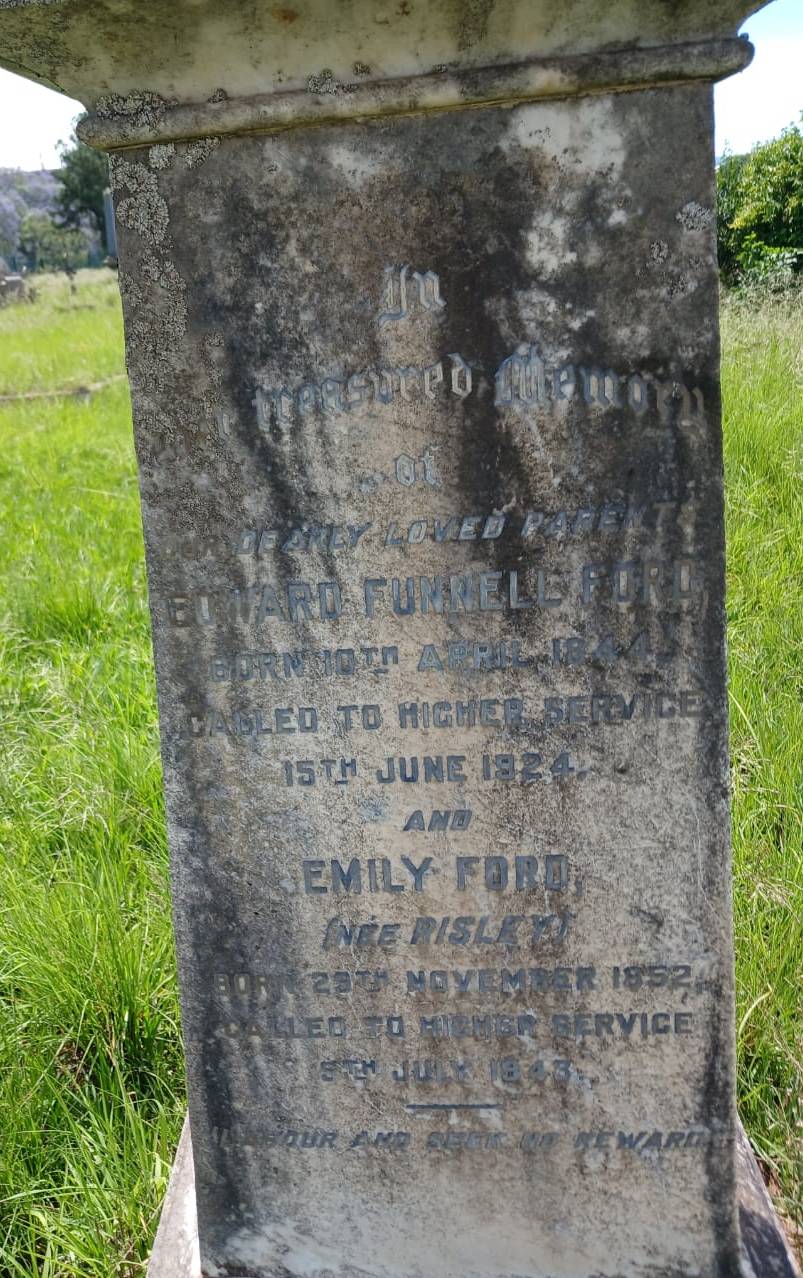 |
|
The headstone of Edward Funnell Ford and
Emily (Risley) Ford in the Commercial Road cemetery,
Pietermaritzburg.
photograph by Robert King
|
Commercial Road cemetery,
Pietermaritzburg, Natal, South Africa, in the same grave as her husband,
located in Block A Row C Plot 31.
The inscription on the headstone reads:
In treasured memory of
our deeply loved parents
EDWARD FUNNELL FORD
born 10th April 1844
called to higher service
15th June 1924
and
EMILY FORD
(née RISLEY)
born 29th November 1852
called to higher service
5th July 1943
Labour and seek no reward
1861: Blyth (West Side), Blyth,
Nottinghamshire
1943: 167 High Ridge Road, Durban, Natal (Natal
Civil Records Deaths 1943 film 007751181 image 1188)
|
 |
|
 |
|
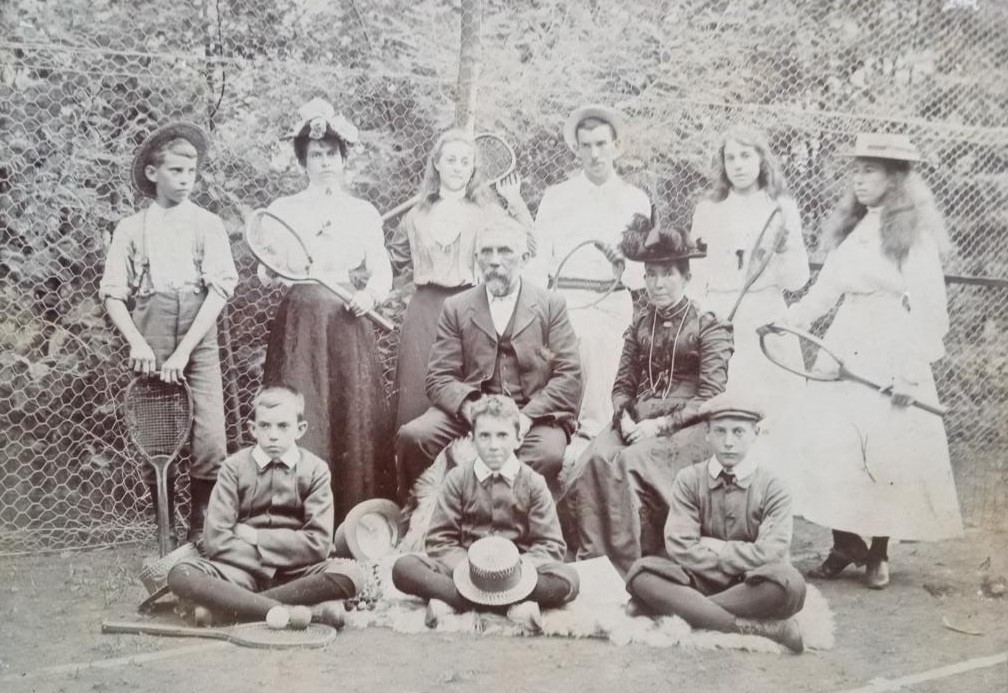 |
|
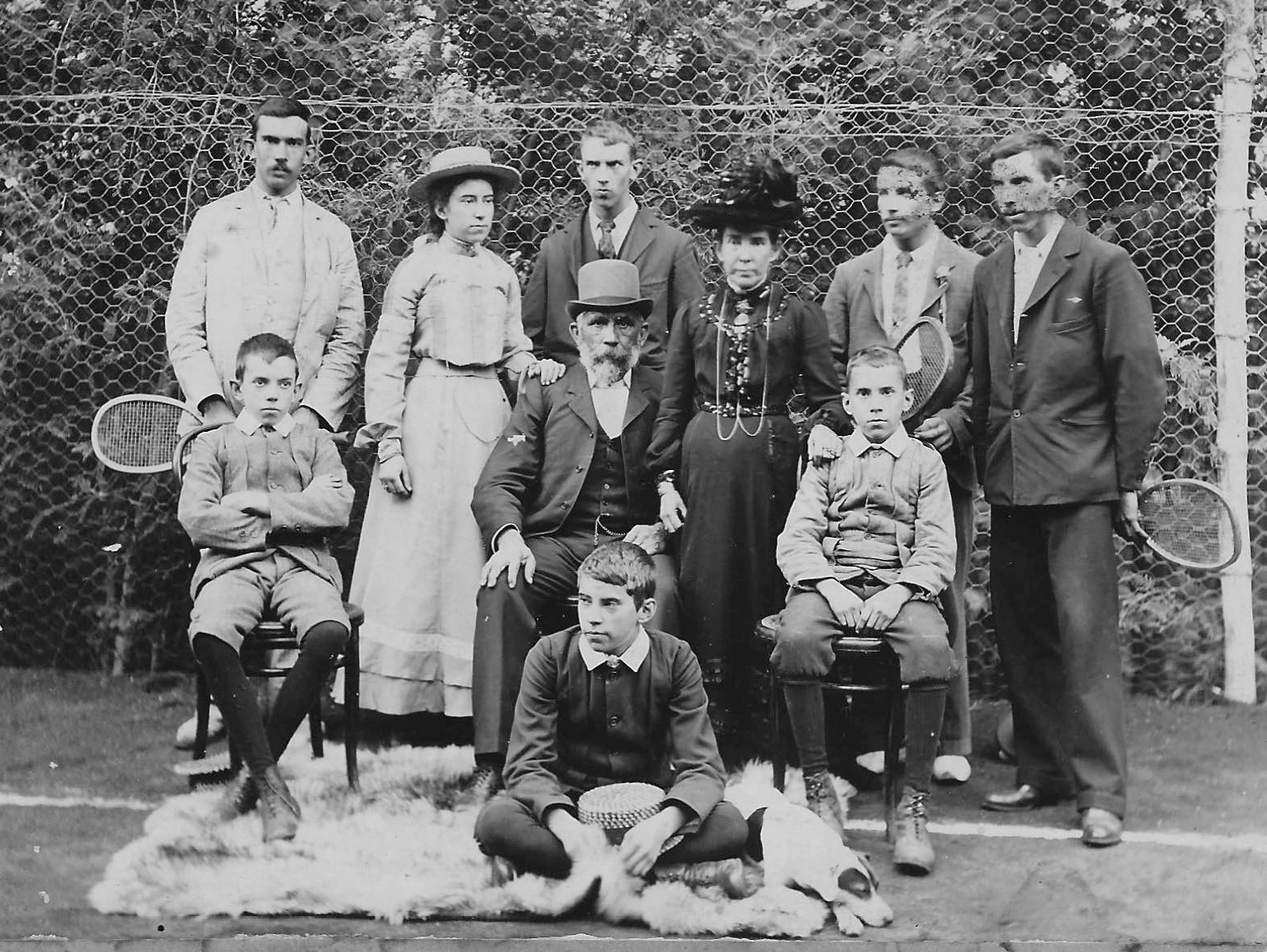 |
|
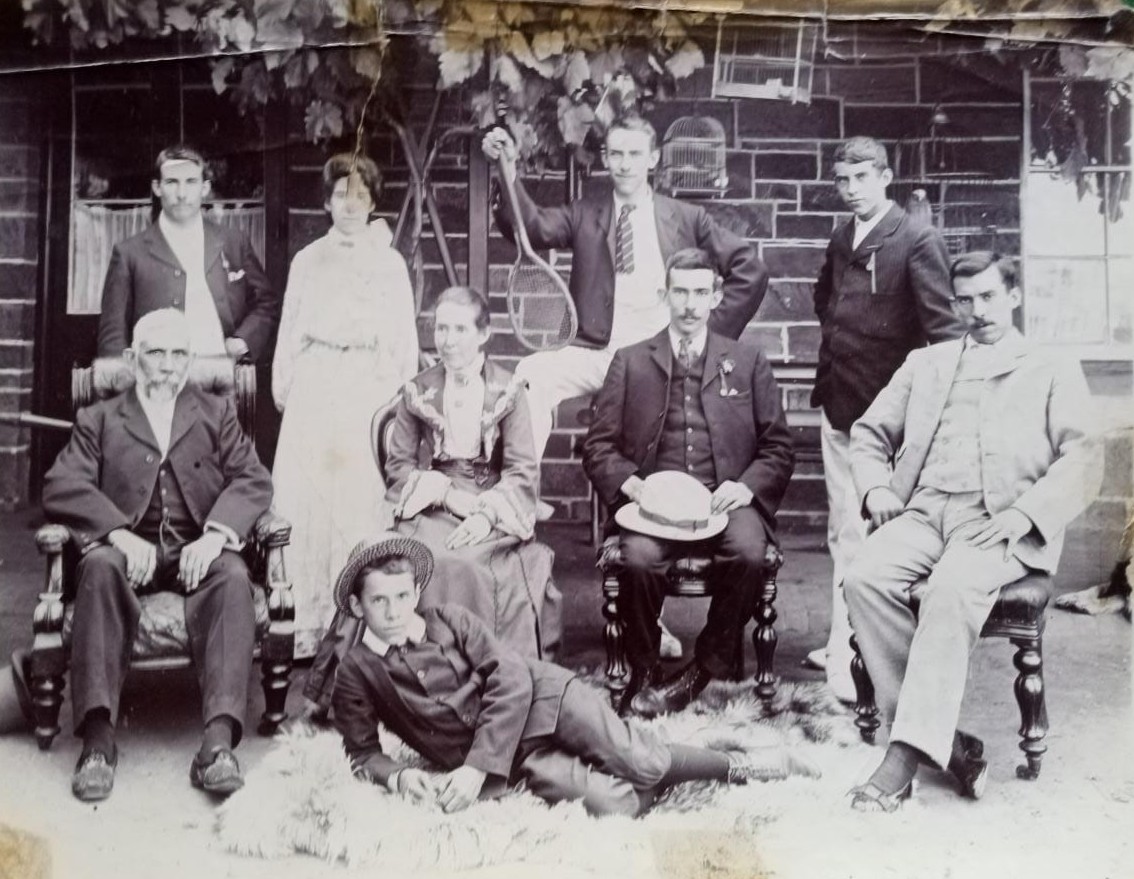 |
|
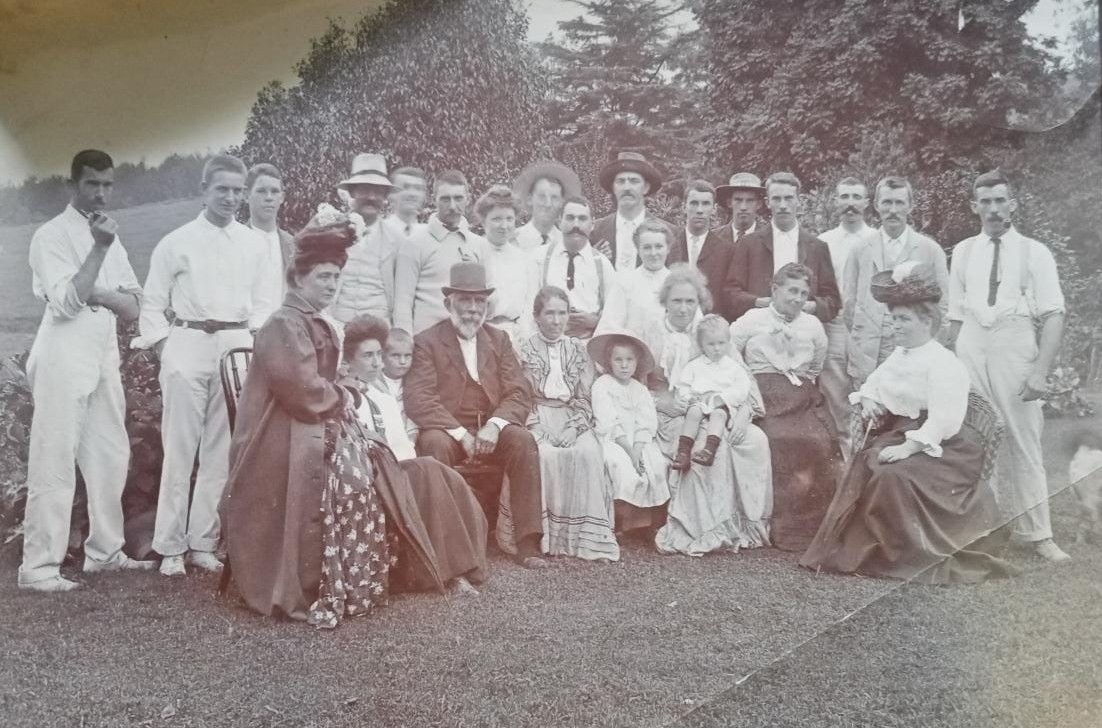 |
|
 |
|
 |
|
 |
|
 |
|
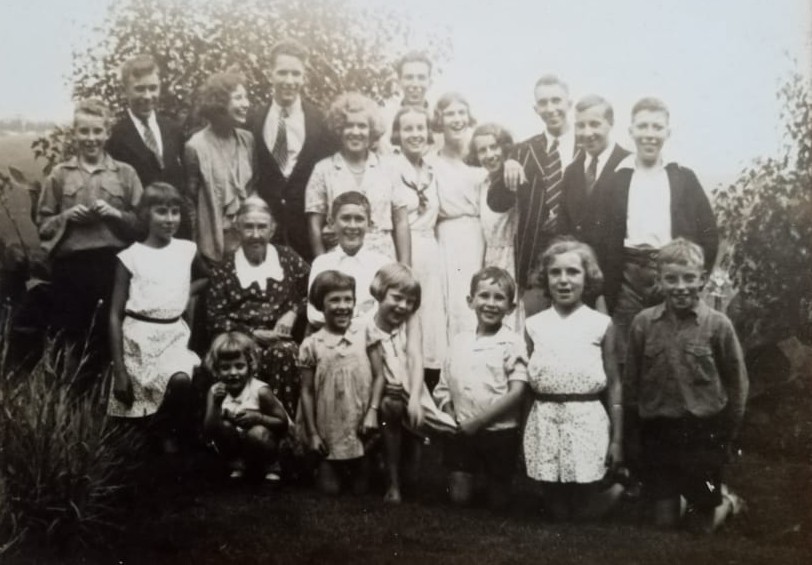 |
|
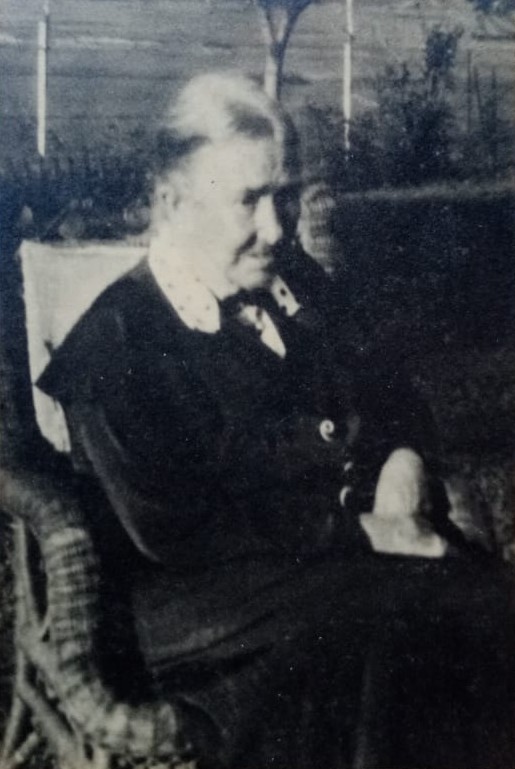 |
|
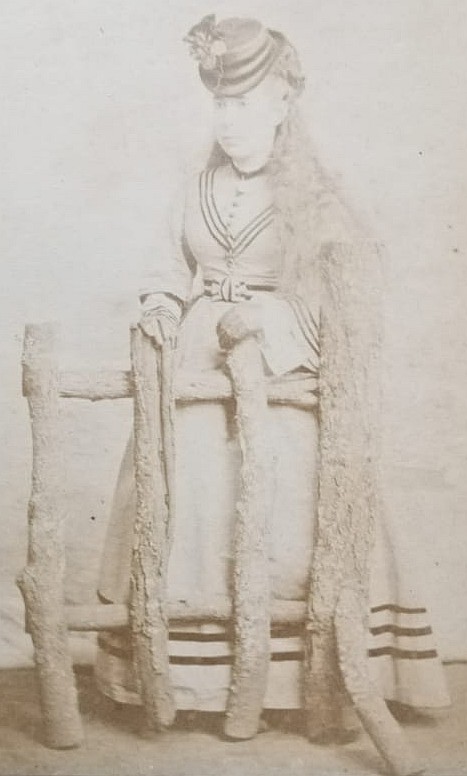
Emily Risley
This photo was carried by Edward Funnell Ford with a lock of
her hair in an envelope when he went to the diamond mines of
Kimberley while courting her.
photograph courtesy of Robert
King
|
|
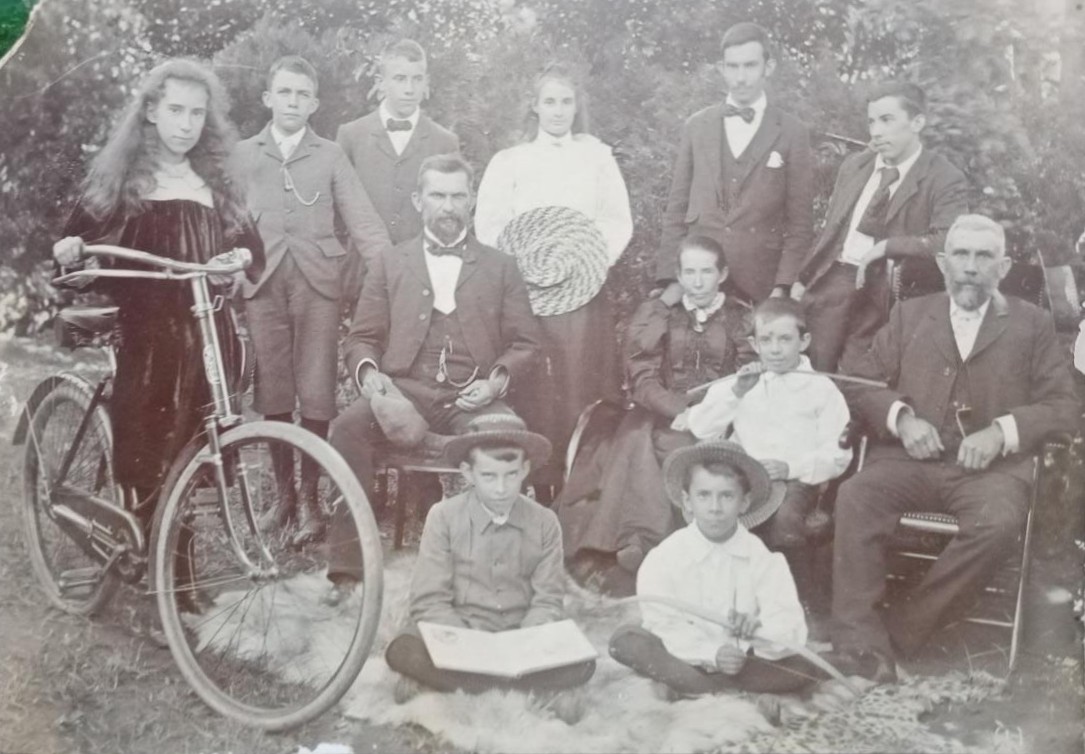
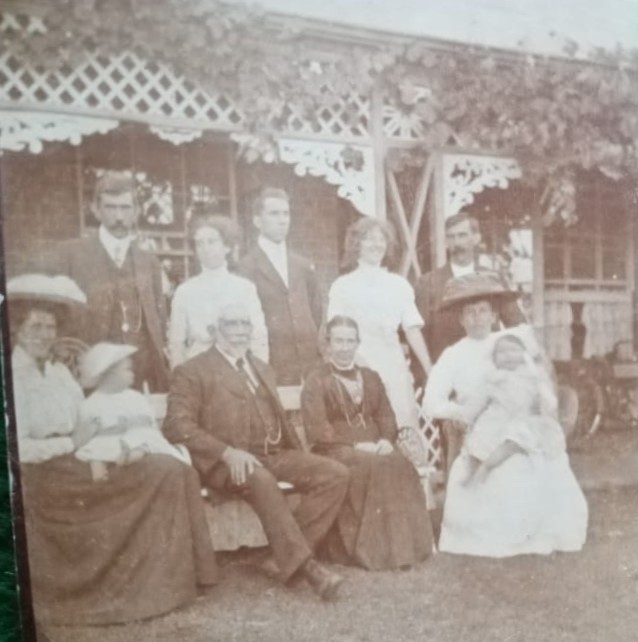
Emily (Risley) Ford is seated second
from left in this Ford family grouping, probably at Kingston
Lodge
photograph courtesy of Robert
King
|
|
Emily (Risley) Ford is seated right
in this photograph of a tennis party at Kingston Lodge
photograph courtesy of Robert
King
|
|
Fords at Kingston Lodge
L to R. Back: Alfred, Winifred, Joseph, George. Front:
Edward Funnell, Emily née Risley, John, Edward William. Very
front: Wilfred
photograph courtesy of Robert
King
|
|
Emily (Risley) Ford is seated fifth
from left in the front row in this photograph of a garden
party at Kingston Lodge circa 1907
photograph courtesy of Robert
King
|
|
Emily is seated fourth from left in
the front row in this photograph of a garden party at
Kingston Lodge circa 1907
photograph courtesy of Robert
King
|
|
Fords at Kingston Lodge, Christmas
1912
Emily (Risley) Ford is seated second from right.
photograph courtesy of Robert
King
|
|
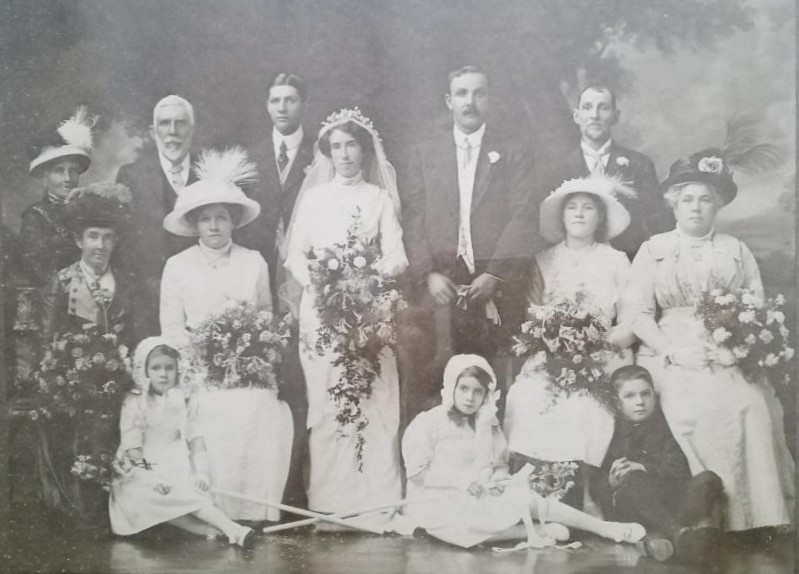
Emily is leftmost in the middle row
in the wedding photograph of John Herbert James King and
Emily Winifred Elizabeth Ford on 22 April 1914
photograph courtesy of Robert
King
|
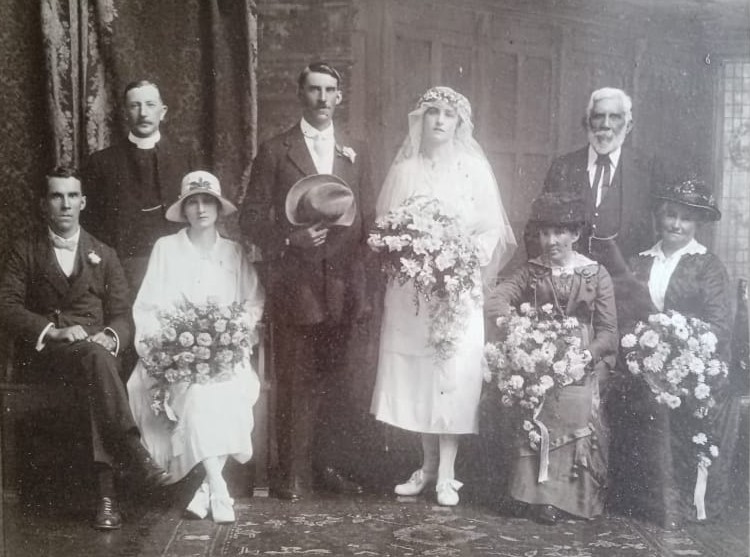
|
Emily is seated second from the
right in the wedding photograph of her son, George Herbert
Ford, and Lulu Iris Borain on 26 March 1919
photograph courtesy of Robert
King
|
|
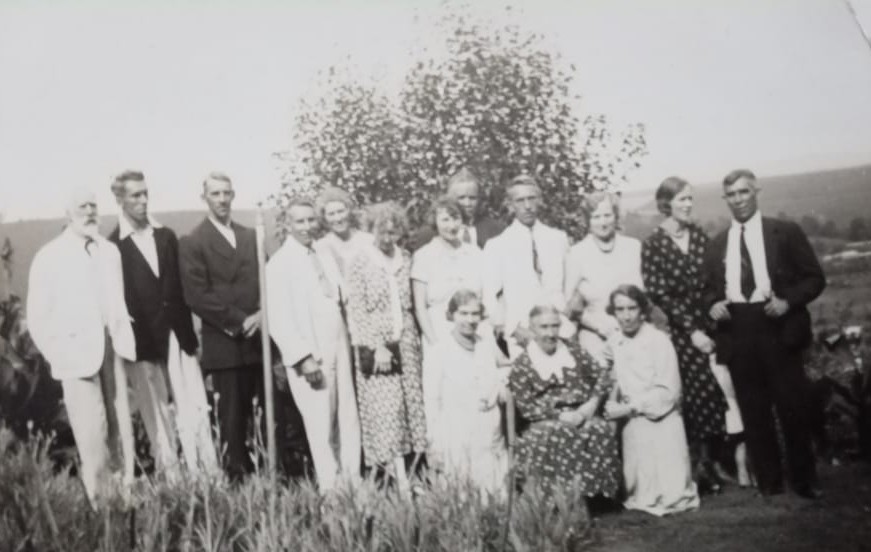
Emily's 80th birthday, at Kingston
Lodge, in November 1932. She is seated centre.
Back: Frederick William
Risley, Wilfred Ford, George Ford, Alfred Ford, Laura
(Scarlett) Ford, Ada (Wallis) Ford, Mona (Borain) Ford,
John King (behind), Joseph Clifford Ford, Lulu (Borain)
Ford, Nella (Borain) Ford and John Bartle Ford. Front: May
(Foaden) Ford, Emily (Risley) Ford, Winifred (Ford) King.
photograph courtesy of Robert
King
|
|
Emily's 80th birthday in November
1932. She is second from left in the middle row.
In this photograph, taken at Kingston Lodge, Emily is
surrounded by 19 of her 21 grandchildren born by that time,
as well as a grand-niece.
Back: Cecil Ford, Dennis
King, Peggy Ford, Herbert Ford, Frances Ford, Nell Ford,
Laurence Ford behind her, Margaret Potterill (great
niece), Joyce Ford, Mervin King, Jack Ford, Alan Ford.
Middle: Jean Ford, Emily Ford née Risley, Royden King.
Front: Bettie Ford, Mollie Ford, Madge Ford, Peter Ford,
Dulcie Ford and Errol Ford.
photograph courtesy of Robert
King
|
|
Emily (Risley) Ford
photograph courtesy of Robert
King
|
 scroll
with
your mouse to see more pictures; click on an image for enlargement
scroll
with
your mouse to see more pictures; click on an image for enlargement

Esmé Louisa Risley
9 October 1902
2 November 1902, in Harrismith,
Orange River Colony
Esmé Louisa was baptised the daughter of William Frederick and Mary Ann
Risley. William is recorded as a clerk, of Harrismith. The sponsors of the
baptism were father, Henrietta Burns and Priscilla Eleanor Gilbert.
William
Frederick Risley
Mary Ann (Burns) Risley
13 August 1986, in Durban, Natal,
South Africa, of congestive heart failure
Frederick William Risley
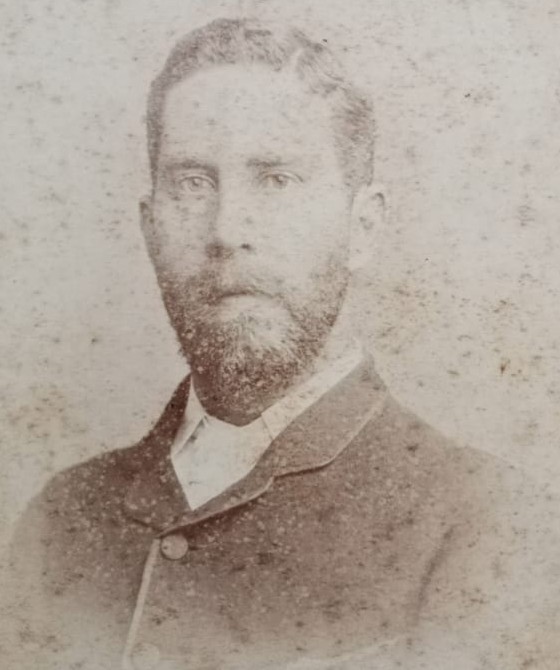 |
|
Frederick William Risley
photograph courtesy of Robert King
|
 |
|
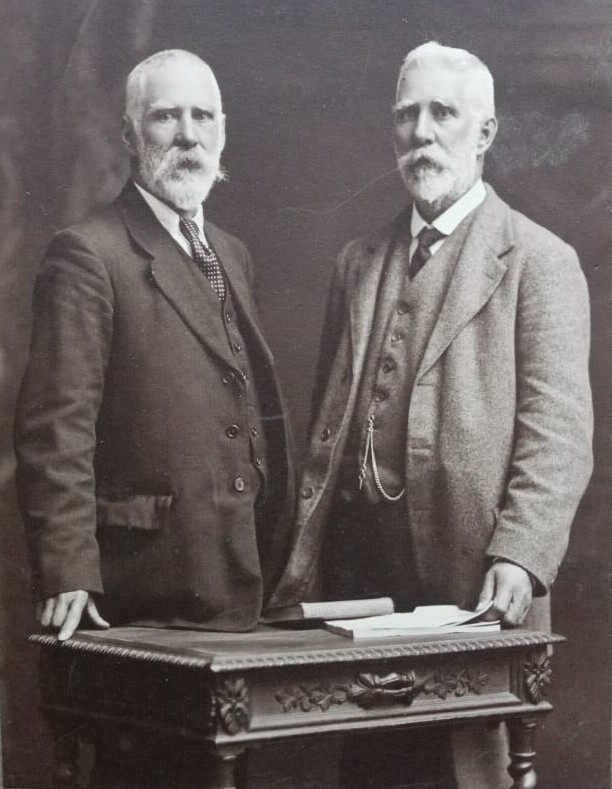
Frederick (left) and William Risley
photograph courtesy of Robert King
|
|
|
Frederick William Risley is leftmost in
the back row at the 80th birthday of his sister, Emily (Risley)
Ford at Kingston Lodge in November 1932.
photograph courtesy of Robert King
|
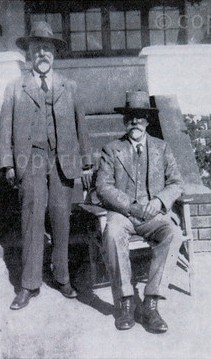
|
FOUNDATION PUPILS OF HILTON COLLEGE
Among the first pupils whom
William Orde Newnham enrolled in 1872 were twin brothers,
William Frederick Risley and Frederick William Risley. This
photograph of them was taken in old age, when William Frederick
was living in Harrismith and Frederick William in
Pietermaritzburg. William Frederick (seated in this photograph)
died on 11th August, 1935 at the age of 77 years, while
Frederick William (standing) died in 1952 at the age of 94
years. They were bom on 17th April, 1858 at Uxbridge, Middlesex,
England and arrived in the Colony of Natal when they were eight
years old. We reproduce this photograph in the hope that it will
be of interest to older generations of Old Boys.
|
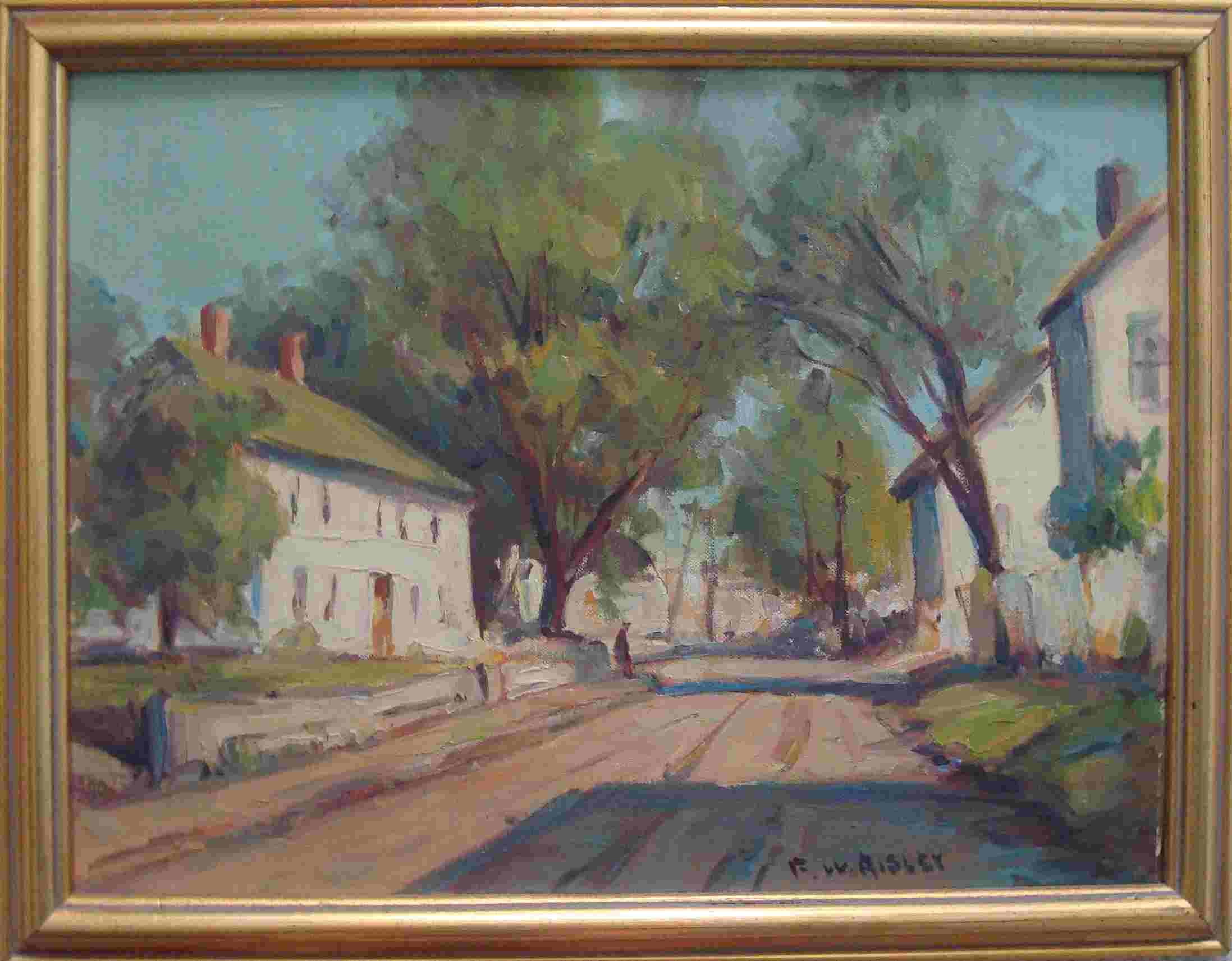 |
|
Oil painting by Frederick William Risley
painting in possession of Chris
Gosnell
|
17 April 1858, in Uxbridge,
Middlesex, England
11 July 1858, in St John the
Baptist, Hillingdon, Middlesex, England
Frederick William was baptised the son of William and Emily Risley. William
is listed as a gardener, of Hillingdon.
William Risley
Emily
(Ward) Risley
Frederick was a twin brother to William Frederick
Risley
Frederick emigrated to Natal aboard
the Natal Star, arriving in
Durban on 1 February 1867. He is recorded as aged 6 (an error - his
twin brother is listed with the correct age of 8), and surety was stood by
his father, William Risley, who had emigrated earlier, and his uncle, Joseph
Risley, both of Pietermaritzburg. Accompanying Frederick on the Natal
Star were his mother, Emily, and siblings Emily, Arthur, Alice,
William J., John E., Clara and Joseph.
Frederick was a foundation member of Hilton
College, Hilton, Natal, South Africa, in 1872, starting there the day
the school opened. The "little Risleys" are mentioned in the diary of Duncan
McKenzie who was also a founder pupil at Hilton. It did not take long for
them to get in a scrape, as recounted in this anecdote published in Lift Up Your Hearts pp 175-6 (Neville
Nuttall, 1971):
EXTRACTS FROM THE DIARY OF DUNCAN McKENZIE (1877)
9th June 1877
It is about a year since I left Hilton College, but
nevertheless I intend to return back to my school days and relate a few
interesting happenings of that period...
...
The first day we arrived at Hilton, we did not like it. We never
knew a soul, and the look of Mr. Newnham's big sjambok was quite enough
for me, as he came walking up to meet us; but when we came to hear that he
had no less than three, it frightened the lives out of us.
The big one he called Lamb's Tail, the second Cat's Tail and the
third Rat's Tail.
Mr Crowe, the senior master also had one, a two-tailed one, so
there were no less than four sjamboks in the school.
The first row that we got into was on Wednesday afternoon when some
of us set off to get some maas at some native's kraal.
When we got there, there was no one at the huts except children,
whom we told to go and call their parents.
As it was getting late we told a little girl to get us some maas,
which she did, and we paid her for it, and ate until we had had
sufficient, and then set to and splashed all the youngsters with the
remains, making their heads white; but when they started crying, we
decided it was time to leave. We had only gone about 300 yards when we saw
the kraal head, Gwen, arriving at a fast pace. He never stopped to ask his
children anything, as he could see what had happened, so we started
running; but we had about two miles to get back to school and were all in
a big fright, especially the little Risleys. One of them was singing out
not to leave him, as he was tired, so I caught his hand and helped him
along. We hid in the gum trees near school, until we thought all danger
was over.
As however some boys told us that Gwen had been to see Mr Newnham,
we waited in suspense, and sure enough next morning after prayers, Mr
Newnham said "Will all the boys that went to Gwen's for maas yesterday
please stand up." Up we stood, and he carried on, "Boys, you have only
been here a few days and I am sorry to say that you have misbehaved
yourselves, so you must pay 6d each for the maas, and you ought not to
have taken advantage of the children when their parents were away. That
will do." And right glad we were to get off so lightly."
Frederick performed well academically, receiving a prize at Hilton's first
prize-giving, as recorded in this report from the Natal
Witness on 27 December 1872:
HILTON
COLLEGE
On Wednesday 18th instant the pupils of Hilton
College were assembled for the purpose of distribution of prizes previous
to breaking up. A few friends had been invited to be present and it had
been intended that the masters and senior pupils should act the Merchant of Venice in the evening, but the sudden and dangerous illness
of Mrs Newnham put a stop to those festivities.
The pupils being all assembled, the Principal
addressed them in a few words. He pointed out the principle which guided
him in adjudging prizes and stated that he would never give a prize for
mere cleverness; that industry and good behaviour were what he desired to
encourage; that it was nothing to him if through the colony "Hiltonian"
and "cleverness" became synonymous; the desire of his heart was that
"Hiltonian" and "gentleman" should be convertible terms; that he had to
thank the parents of many of his pupils for their liberality, whereby they
had enabled him to mark the merits of many scholars whom he would have had
to pass over had he only depended on his own purse; that those boys who
had not obtained prizes must not be discouraged or think that they were
thereby marked out as bad or idle; that his pleasant though difficult task
had been, where all were good, to separate the very good.
He then called each prize-winner and with a pithy
exhortation delivered him his prize or prizes. The names are as follows:
First Division, including Fifth and Sixth Forms: A. Baker,
universal proficiency; J. Polkinghorne, 1st prize, distinguished advance;
W. Birkett, 2nd do.; A. McKenzie, 3rd do.; W. Henderson, 4th do.; J.
Polkinghorne, 1st prize, distinguished industry; W. Birkett, 2nd do,; R.
Dixon, 1st prize, special advancement; J. Allison, 2nd do.; G. Robinson,
3rd do.; S. Middleton, 4th do.; G. Salmon, 1st prize, general advancement
and honourable conduct; G. Law, 2nd do.; E. Acutt, 3rd do.
Second Division, including Third and Forth (sic) Forms: C.
Henderson, 1st prize, super-eminent advancement; A. Butcher, 2nd do; C.
Henderson, 1st prize, distinguished industry; A. Ross, 1st prize, special
advancement; W. Leathern, 2nd do.; F. W. Risley, 3rd do.; J. Peniston, 4th
do.; W. Bowes, 1st prize, general advancement; H. Acutt, 2nd do.
Third Division, including First and Second Forms: E. Randles,
super-eminent advancement; H. Brickhill, 1st prize, distinguished
advancement; -. Middleton, 2nd do.; -.Macfarlane, 1st prize, special
advancement; A. Newnham, 3rd do.
Carpenter.
A newspaper article about Frederick's father in 1908 mentions Frederick as
being "one of Natal's most energetic prospectors".
In 1880, Frederick was a sponsor at the baptism
of his nephew, John Bartle Ford in St Peters, Pietermaritzburg.
In 1913, Frederick made an application "for permission to shoot game on
native trust lands in the Mapumolo division". Frederick's death notice
records that he was single.
24 August 1951, in Hillcrest,
Pinetown district, Natal, South Africa, aged 93
The cause of death is listed as arterio sclerosis, of duration 1 month and
senile decay of duration 2 months
The Hiltonian November 1951 p58
RISLEY—Frederick
William Risley died recently in Maritzburg, at the age of 93. He was one
of the few remaining old colonists of Natal, and came to the province
with his parents in 1867. He was also one of the foundation scholars of
Hilton. On leaving school he lived for a time on the Rand and later on
in Zululand, finally returning to Maritzburg, where he lived until his
death.
Commercial Road cemetery,
Pietermaritzburg, Natal, South Africa
1861: Blyth (West Side), Blyth,
Nottinghamshire
1950: "Kingston Lodge", 69 Campbell Road, Chase Valley, Pietermaritzburg,
Natal (Braby's Natal Directory 1950 p1542)
1951: Kingston Lodge, Chase Valley, Pietermaritzburg, Natal (death
notice)
George Risley
31 January 1790, in All Saints,
Edmonton, Middlesex, England
George is recorded as the son of Randal and Eliz.th Risley
Randall Risley
Elizabeth
(Hutchinson) Risley
- Parish registers of All
Saints, Edmonton (Baptisms 1790)
- Parish registers of All
Saints, Edmonton (Baptisms 1790)
Helena Kate (Risley, Coltson) Reid
1867/8, in Pietermaritzburg, Natal
Joseph Risley
Annie (Cox) Risley
Charles
Cecil Davies Coltson on 27 April 1893 in St Peters Cathedral,
Pietermaritzburg, Natal
Charles Cecil Davies Coltson is recorded as a bachelor, of full age. He is
an accountant, Bank of Africa, resident in Pietermaritzburg. Helena Kate
Risley is recorded as a spinster, of full age, resident in Pietermaritzburg.
The marriage was witnessed by C. H. Dwyer and Lillie M. Mullay.
Ellis
Ramsay Reid on 23 November 1901 in Garrison Church, Pietermaritzburg,
Natal
Ellis Ramsay Reid is recorded as a bachelor, of full age. He is a Lt Colonel
Army Pay Corp, resident in Pietermaritzburg. Helena Kate Coltson is recorded
as a widow, of full age, resident in Pietermaritzburg. The marriage was
witnessed by J. O'Hara and James King.
19 July 1924, in Lexden
district, Essex, England, aged 56
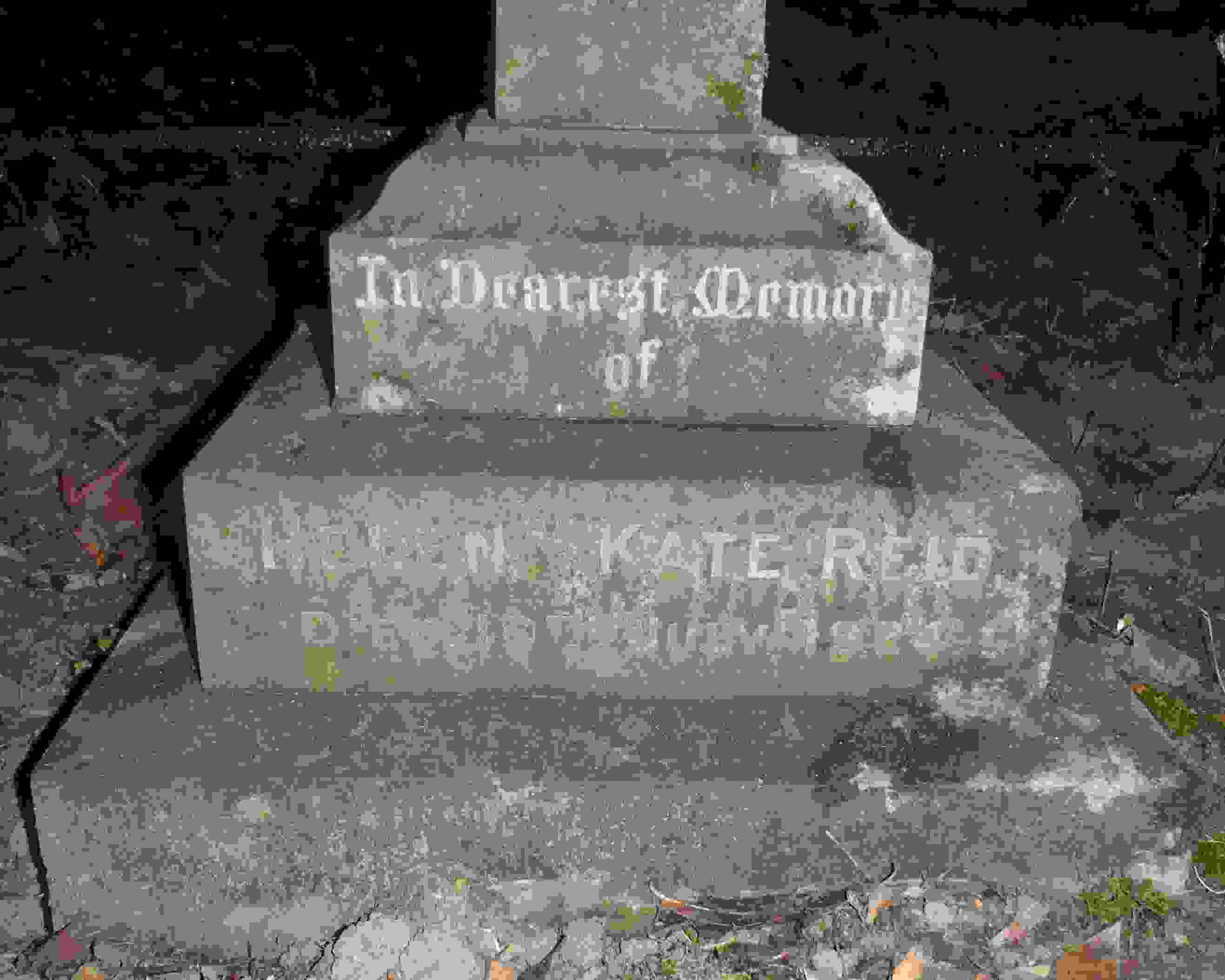 |
|
Headstone of Helena Kate (Risley, Coltson)
Reid in St Michael's churchyard, Berechurch, Colchester, Essex
|
St Michael's churchyard, Berechurch,
Colchester, Essex, England
The headstone reads:
In Dearest Memory of
Helen(a) Kate Reid
Died 19th July 1924
1893: Pietermaritzburg, Natal (Natal
Civil Records Marriages Pietermaritzburg 1893 #466)
1901: Pietermaritzburg, Natal (Natal
Civil Records Marriages Pietermaritzburg 1901 #62)
1911: 11 The
Retreat, Southsea, Portsmouth, Hampshire
1918: Blenheim Blackheath, Colchester, Essex (R.A.F.
Next of Kin Card)
Henry Risley
17 August 1864, in Worksop,
Nottinghamshire, England
17 August 1864, in St Mary
(Priory), Worksop, Nottinghamshire, England
Henry Risley is recorded as the son of William and Emily Risley, of Worksop.
William's occupation is Gardener.
William Risley
Emily
(Ward) Risley
18 August 1864, in Worksop
district, Nottinghamshire, England
James Risley
30 April 1780, in All Saints,
Edmonton, Middlesex, England
James is recorded as the son of Randal and Eliz.th Rizley
Randall Risley
Elizabeth
(Hutchinson) Risley
- Parish registers of All
Saints, Edmonton (Baptisms 1780)
- Parish registers of All
Saints, Edmonton (Baptisms 1780)
James Risley
8 August 1813
29 August 1813, in All Saints,
Edmonton, Middlesex, England
James is recorded as born on Augst 8th, the s.
of William, labourer of Winchmore Hill, and Ann, his wife
William Risley
Ann
(Hopes) Risley
3 August 1819, aged 6
James Risley is recorded as aged 6, resident at Winchmore Hill
- Parish registers of All
Saints, Edmonton, Middlesex (Baptisms 1813 p12 #89)
- Parish registers of All
Saints, Edmonton, Middlesex (Baptisms 1813 p12 #89)
- Parish registers of All
Saints, Edmonton, Middlesex (Baptisms 1813 p12 #89)
- Parish registers of All
Saints, Edmonton, Middlesex (Burials 1819 p110 #879)
James Risley
22 November 1831, in Middlesex,
England
25 December 1831 in All Saints,
Edmonton, Middlesex, England
James is recorded as born on 22 November 1831, the son of Joseph Risley,
gardener of Winchmore Hill, and his wife, Alice
Joseph Risley
Alice
(Simmons) Risley
1842, in Edmonton
district, Middlesex, England
9 February 1842, in St Mary,
Hornsey, Middlesex, England
James Risley is recorded as 10 years old, resident at Fortis Green. He is
immediately followed in the burial register by his 3 year old brother,
Alfred.
1841:
Felix Place, Hornsey, Middlesex
- Parish registers of
Edmonton, Middlesex (Baptisms 1831 p80 #633); place from 1841 census
- Parish registers of
Edmonton, Middlesex (Baptisms 1831 p80 #633)
- Parish registers of
Edmonton, Middlesex (Baptisms 1831 p80 #633)
- England
Death Index (1Q1842 Edmonton vol 3 p109)
- Parish registers of St
Mary, Hornsey, Middlesex (Burials 1842 p71 #567)
- James Risley
John Risley
15 June 1799, in Edmonton, Middlesex,
England
20 July 1799, in All Saints,
Edmonton, Middlesex, England
John Risley is recorded as born on June 15, the son of William, labourer of
Winchmore Hill, and Ann, his wife
William Risley
Ann
(Hopes) Risley
Sarah Page on 7 August 1825 in St
Lawrence Jewry with St Mary Magdalene Milk Street, London, England
Sarah was born in 1796/7, in Hertfordshire. She died on 28 March 1860, in Edmonton
district, England, aged 63, and was buried in Edmonton churchyard,
Middlesex.
Census:
1841: Bury
Street, Edmonton, Middlesex
1851: Bury
Street, Edmonton, Middlesex
Agricultural labourer (1851),
agricultural foreman (1861); gardener (1871)
John is mentioned in the will of his father, William Risley, dated 3 October
1846 (National
Archives PROB 11/2056/312)
I give all my
Estate and Effects (except my wearing apparel which I give unto my son
John Risley) to my wife for her life and after her decease I give the
same to my sons John and Edmund in equal shares absolutely
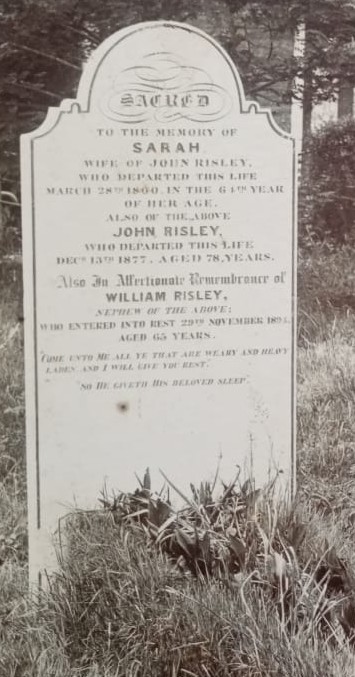 |
|
Gravestone of John Risley, Sarah Risley
and William Risley in Edmonton churchyard, London
photograph courtesy of Robert King
|
Edmonton churchyard, Middlesex,
England
John was buried in the same grave as his wife and nephew
The inscription reads:
Sacred / to the memory of
SARAH / wife of John Risley
who departed this life / March 28th 1860 in the 61st
year / of her age.
Also of the above
JOHN RISLEY,
who departed this life / Decr 13th 1877, aged 78
years.
Also in Affectionate Remembrance of
WILLIAM RISLEY,
nephew of the above:
who entered into rest 29th November 1894, / aged 65 years
"Come unto me all ye that are weary and heavy / laden and I will give
you rest."
"So He giveth his beloved sleep."
1841: Bury
Street, Edmonton, Middlesex
1851: Bury
Street, Edmonton, Middlesex
1861: Bury
Street, Edmonton, Middlesex
1871:
Edmonton, Middlesex
John Risley
1826/7 in Edmonton, Middlesex,
England
John Risley
Sarah (Page) Risley
Elizabeth Ann Greening in 1879 in Edmonton
district, England
Elizabeth was baptised on 17 August 1845 in St John the Evangelist, Eton,
Buckinghamshire, the daughter of William and Ann Greening.
Census & Addresses:
1871:
Edmonton, Middlesex
1881: Kings
Road, Brighton, Sussex
1890: 5 Linden Road, West Green, Tottenham, Middlesex (husband's
probate)
Dealer in Shares (Broker)
7 July 1890, at 5 Linden Road, West
Green, Tottenham, Middlesex, England
England & Wales, National Probate Calendar (Index of Wills and
Administrations)
1890
RISLEY John. Personal Estate £346 10s.
30
July The Will of John Risley formerly of 38 Cornhill in the
City of London and of 8 Beaufort-villas Chesnut-road Tottenham but late
of 5 Linden-road West Green Tottenham in the County of Middlesex
who died 7 July 1890 at 5 Linden-road was proved at the Principal
Registry by Elizabeth Ann Risley of 5 Linden-road Widow the Relict
the sole Executrix.
1841: Bury
Street, Edmonton, Middlesex
1861:
Tottersalls Hotel, 81&82 St Georges Square, Portsea, Hampshire
1871:
Edmonton, Middlesex
1881: Kings
Road, Brighton, Sussex
John Edward Risley
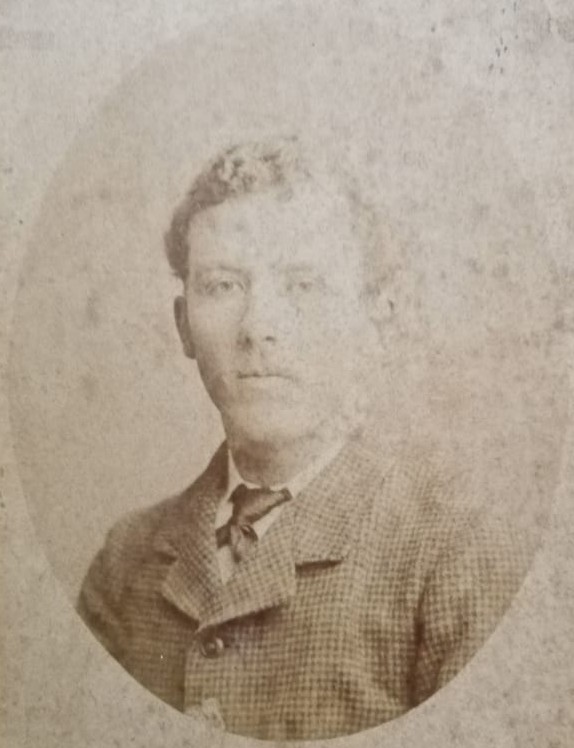 |
|
John Edward Risley
photograph courtesy of Robert King
|
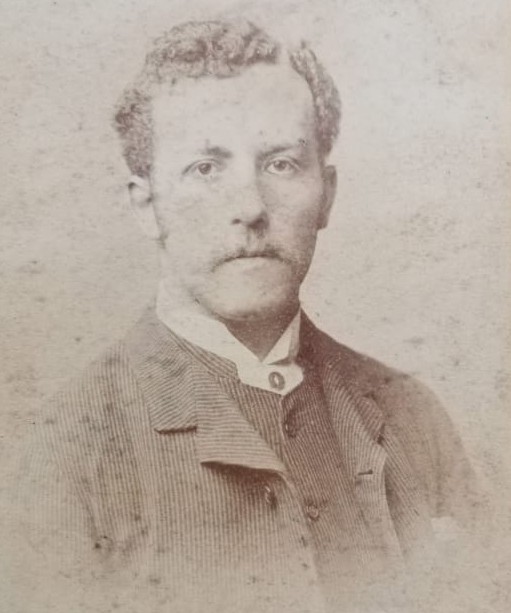 |
|
John Edward Risley
photograph courtesy of Robert King
|
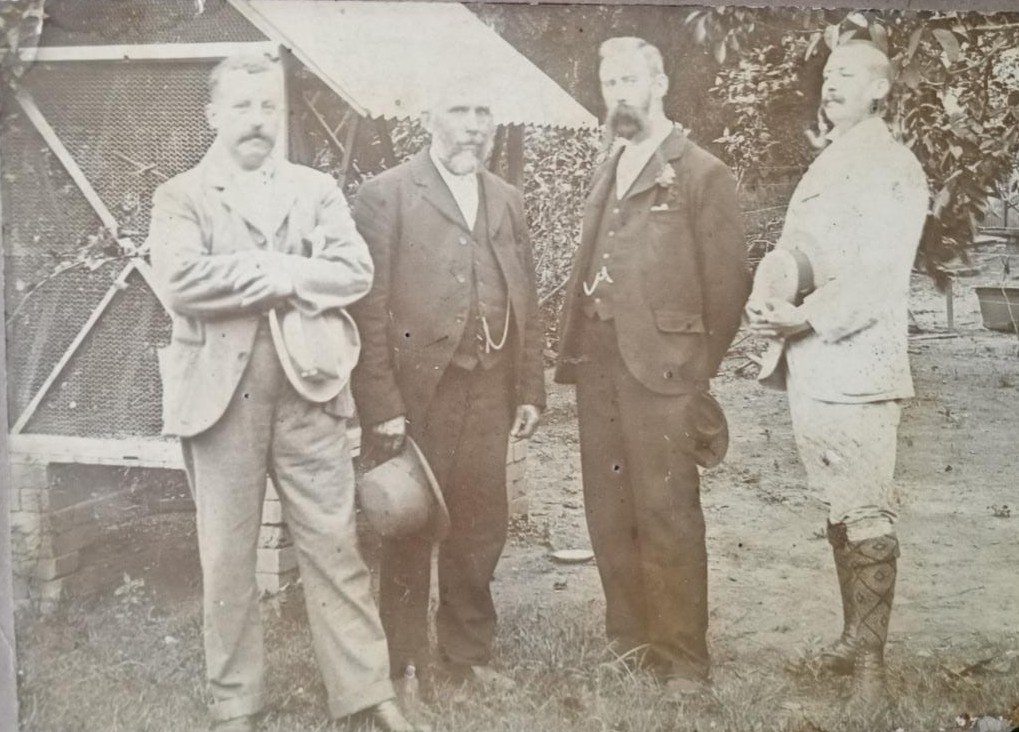 |
|
(left to right) John Edward Risley, Edward
Funnell Ford, William Frederick Risley and Alfred Edmondson
photograph courtesy of Robert King
|
 |
|
John Edward Risley
|
6 January 1863, in Worksop,
Nottinghamshire, England
4 February 1863, in St Mary
(Priory), Worksop, Nottinghamshire, England
John Edward Risley is recorded as the son of William and Emily Risley, of
Carlton Road. William's occupation is Gardener.
William Risley
Emily
(Ward) Risley
Maritzburg College,
Pietermaritzburg, Natal
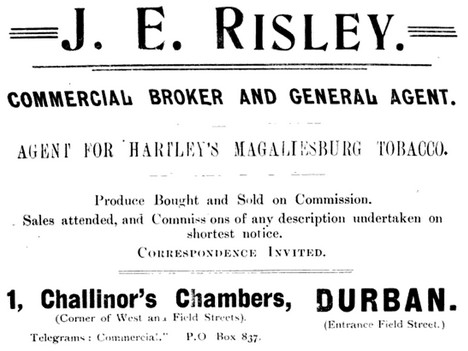 |
|
Advertisement for the business of J. E.
Risley
|
Agent and Broker
The
Natal
Who's Who 1906 p166
RISLEY,
John Edward; b. 1863, in
Worksop, Notts.; y.s. of late William Risley, an old an respected early
Colonist, and one of the pioneers of Kimberley. Educ. St Mary's and High
School, Pietermaritzburg. Add., Commercial Broker and General Agent, 1,
Challinor's Chambers, Field St., Box 837; Telegraph Add., "Commercial,"
Durban. Clubs: Durban Turf Club, R.N.Y.C. Came to Natal at an
early age, and spent practically all his life here. 25½ years with A.
Fass & Co., Merchants, Durban, and has therefore a full grasp of all
requirements, both local and up-country.
John emigrated to Natal aboard
the Natal Star, arriving in
Durban on 1 February 1867. He is recorded as aged 5, and surety was
stood by his father, William Risley, who had emigrated earlier, and his
uncle, Joseph Risley, both of Pietermaritzburg. Accompanying John on the Natal Star were his mother, Emily, and
siblings Emily, Arthur, Alice, William J., Fred H., Clara and Joseph.
In his will, John bequeaths a lifetime annuity to Myra Barthram (born
Stevens) with additional support for three of her children, Eva Barthram,
John Barthram and Edward Barthram, through their minority. It is not clear
to me, but it seems that the residue of his estate is also bequeathed to
Myra - no other persons are mentioned in the will apart from his Trustees.
Myra Stevens was a mixed race woman born in 1859/60, in the Cape Province,
the daughter of Sarah and Charles Stevens. She married Alfred Barthram, a
policeman, on 30 July 1878 in Durban - Myra was only 18 at the time and the
marriage license lists, curiously, that consent was provided by "friends".
Henry Albert Barthram was born on 12 July 1887 and baptised on 3 September
1887, the son of Alfred and Myra Barthram. Charles Thomas Barthram was
baptised in Durban on 27 September 1890, the son of Alfred Barthram,
labourer, and Myra. Eva Catherine Barthram was born on 2 June 1895 and
baptised in Durban on 11 August 1895, the daughter of Alfred and Myra
Barthram. Eva died on 6 December 1962 in Pietermaritzburg. John Francis De
Souza Bartram was born on 7 January 1897 and baptised in Durban on 21 March
1897. When Myra's mother, Sarah, died on 10 May 1916, she was living at 10
Melbourne, Durban, three doors down from 4 Melbourne Street, where John
Edward Risley was living at he time of his suicide in 1918. I have not been
able to find a baptism record for Edward Barthram. I believe that John
Francis may have changed his last name to Risley - when Charles was married
in Durban on 22 December 1921, and his brother Henry, then living in
Basutoland, was also married in the same place just four days later, some
three years after John Edward Risley's death, both those marriages were
witnessed by a J. F. Risley, and J.F Risley's signature there is identical
to that of John Francis Risley's signature on his own marriage certificate.
I can find no further record of John Francis Barthram, or Bartram, but the
marriage certificate of John Francis Risley ties him to the marriages of the
elder Barthram brothers, and his age and place of birth given at his death
in 1949 correspond exactly with that of John Francis Barthram. Myra died at
her home at 63 St George's Street, Durban, on 12 August 1929, from diabetes
mellitus, at which time she is recorded as a widow, and was buried in the
West Street cemetery in Durban.
These facts support, although do not exactly prove, the family story that
John Edward Risley cohabited with and fathered children with a woman of
colour, whom he did not marry.
31 July 1918, at Ocean Beach, Durban,
Natal, South Africa, aged 55
The cause of death is listed as drowning suicidal.
Pietermaritzburg College Magazine August 1919
p9
OBITUARY.
In Memoriam
J. E. RISLEY,
Drowned at Durban, July 31, 1918.
AVE ATQUE VALE.
1 August 1918, in St Peter and St
Saviour, Pietermaritzburg, Natal, South Africa
dated 24 September 1907, filed 20
August 1918
Pietermaritzburg
Estate Files 1918 #2901 film 007866804 images 692-4
THIS IS THE LAST WILL AND TESTAMENT of me,
JOHN EDWARD RISLEY, of Durban, in the Colony of Natal, Agent, I being at
the execution hereof, of sound mind, memory and understanding, and capable
of performing any act requiring thought, judgment and reflection, do
hereby declare to cancel, annul and make void all Wills, Codicils or other
testamentary acts heretofore made and executed by me.
I hereby leave, give, devise and bequeath all my property, estate
and effects, personal and real, moveable and immoveable, and whether in
possession, reversion, remainder or expectancy, and wheresoever situated,
nothing whatever excepted, unto FREDERICK WILLIAM DORE, of Durban,
Accountant, and WILLIAM DOULL, of Durban, Solicitor, jointly and
severally, and the survivors or survivor, acceptors or acceptor of them
(hereinafter call "my said Trustees") IN TRUST for the following uses,
intents and purposes :-
1. To pay my just debts, funeral and testamentary expenses.
2. To continue the business at present carried on by me under such
management and on such terms and conditions as my Trustees may deem
expedient, or otherwise, in their discretion to sell and dispose of the
said business on the best terms obtainable.
3. After payment of all salaries and all other expenses necessary
in and about the conduct of my said business to pay to MYRA BARTHRAM (born
Stevens) a sum of Fifteen pounds (£15) Sterling per month for the support
and maintenance of herself and her three children hereinafter mentioned
until such time as the youngest of these children shall have attained the
age of twenty one years.
4. When the youngest of the said three children, EVA BARTHRAM, JOHN
BARTHRAM, and EDWARD BARTHRAM attain the age of twenty one years the
aforesaid payment of Fifteen pounds (£15) per month to the said MYRA
BARTHRAM shall cease and determine, and in lieu thereof a monthly payment
of Ten Pounds (£10) Sterling shall be paid to the said MYRA BARTHRAM for
her own absolute use and benefit during the term of her natural life.
5. To invest the proceeds of the sale of my said business, should
my Trustees decide to sell that business, and any other moneys that may be
found in my estate, in mortgages or landed property, in the purchase of
landed property, and in such other securities as my Trustees may consider
good and to realise such investments and reinvest the proceeds and
to pay out of the interest or profit arising from such investments the
annuity to MYRA BARTHRAM referred to in paragraphs 3 and 4 hereof;
provided that my Trustees shall not be allowed to invest any part of my
estate in anything of a speculative character such as Stocks or Mining
Companies or in any Company or Corporation whatsoever where there is any
liability in respect of its shares.
With power to my said Trustees at any time to advance out of my
Estate any such sum or sums as they may deem desirable or expedient to any
or either of the aforesaid EVA BARTHRAM, JOHN BARTHRAM and EDWARD BARTHRAM
in the interests of his, her or their education or advancement in life,
any such sum or sums so advanced to be deducted from the share or shares
falling due to his, her or them under this my Will.
The lawful issue of any of the above named beneficiaries shall take
the place of his, her or their deceased parent by right of representation,
and in the event of any of the said beneficiaries dying without leaving
lawful issue the shares of such beneficiary shall accrue to the survivor
or survivors of said three children.
Any benefits conferred herein upon females shall be for their sole
use and enjoyment, free from the control, liabilities and obligations of
any husbands they may marry.
I hereby nominate, ordain, constitute and appoint the said
FREDERICK WILLIAM DORE and the said WILLIAM DOULL and the survivors or
survivor, acceptors or acceptor of them, jointly and severally, to be the
Trustees of this my Will and Administrators of my estate and effects,
giving and hereby granting unto them all such powers and authorities as
may be required or allowed in law, especially the powers of assumption,
substitution and surrogation.
All of which I declare to be my Last Will and Testament, desiring
it to have effect as such or as a Codicil or otherwise as may consist with
law, reserving to myself the right from time to time, and at all times to
cancel, amend or alter this Will at pleasure by a separate act or at the
foot hereof.
THUS DONE and EXECUTED at Durban, this twenty fourth day of
September in the Year of Our Lord One thousand nine hundred and seven in
the presence of the subscribing witnesses.
J. E. RISLEY
SIGNED by the above named Testator, JOHN EDWARD RISLEY in the presence of
us then present, both together and affixing our signatures as witnesses in
the presence of the Testator and of each other
Wm S. Fraser Clerk to Livingston & Co. of Durban
Solicitors
A T Goddard Clerk to Livingston & Co.
1902: Durban, Natal (Pietermaritzburg
Estate Files 1927 #12526 film 007866867 image 334)
1905: Durban, Natal (Pietermaritzburg
Estate Files 1909 vol 34 #212 film 007866827 images 461-8)
1907: Durban, Natal (Pietermaritzburg
Estate Files 1918 #2901 film 007866804 image 692)
1918: 4 Melbourne Road, Durban, Natal (Pietermaritzburg
Estate Files 1918 #2901 film 007866804 image 691)
- birth
entry in John's parents' bible; place recorded in birth
entry in John's parents' bible
is Worksop, although the death notice in Pietermaritzburg
Estate Files 1918 #2901 film 007866804 image 691 has the
birthplace as Blyth, Nottinghamshire
- death notice in Pietermaritzburg
Estate Files 1918 #2901 film 007866804 image 691
- St
Mary
(Priory) parish register transcribed at FreeReg
- The
Natal Who's Who p166 (1906); Pietermaritzburg College Magazine August
1919 p9
- The
Natal Who's Who p166 (1906)
- The
Natal
Who's Who p166 (1906); Immigration: passenger
lists transcribed at eGGSA from NAB Pietermaritzburg Archives,
Land and Immigration Board, Natal, Register of Immigrants Arrived, vol
65, p88; Myra Stevens birth from her age of 69 at her death on 12 August
1929 and birthplace from Natal
civil registrations Deaths Durban 1929 #1225; Myra marriage from parish
register of Durban St Paul Marriages 1878 p204 #462; Henry Albert
Barthram birth, baptism from parish
registers of Addington Baptisms 1887 p27; Henry Albert marriage
from parish
register of Durban St Paul Marriages 1921 p399 #92; Charles Thomas
Barthram baptism from parish
registers of Durban Baptisms 1890 p41; Charles Frederick marriage
from parish
register of Durban St Paul Marriages 1921 p399 #91; Eva Barthram
birth, baptism from parish
register of Durban St Paul Baptisms 1895 p303 #3024; Eva death
from Pietermaritzburg
Death Certificates 1962 #639/62; John Francis de Souza Bartram
birth, baptism from parish
register of Durban St Paul Baptisms 1897 p369 #3067; John Francis
Risley marriage from parish
register of Durban St Paul Marriages 1942 #29/42; John Francis
Risley death from Natal
civil registrations Deaths Durban 1949 #1694 and Pietermaritzburg
Estate Files 880/1949; Sarah Stevens death from death
notice in Pietermaritzburg Estate Files 1916 #317 ; Myra death,
burial from Natal
civil registrations Deaths Durban 1929 #1225;
- Natal
Civil Records Deaths 1918 Durban #449
- Parish
register of St Peter and St Saviour Pietermaritzburg Burials p118;
Natal
Civil Records Deaths 1918 Durban #449
- John Edward Risley
John Gray Montague Risley
19 January 1899
19 February 1899, in Harrismith,
Orange Free State
John Gray Montague was baptised the son of William Frederick and Mary Ann
Risley. William is recorded as a clerk, of Harrismith.
William
Frederick Risley
Mary Ann (Burns) Risley
John likely died as an infant or as a
child under the age of 16.
Joseph Risley
2 July 1788, in All Saints,
Edmonton, Middlesex, England
Joseph is recorded as the son of Randal and Elizth Risley
Randall Risley
Elizabeth
(Hutchinson) Risley
- Parish registers of All
Saints, Edmonton (Baptisms 1788 p260)
- Parish registers of All
Saints, Edmonton (Baptisms 1788 p260)
Joseph Risley
1806
12 October 1806, in Southgate
Chapel, Edmonton, Middlesex, England
Joseph s. of Willm and Ann Rizley
William Risley
Ann
(Hopes) Risley
Alice
Simmons on 12 March 1827, in All Saints, Edmonton, Middlesex, England
Joseph Risley is recorded as a bachelor of the parish of Edmonton. Alice
Simmons is recorded as as spinster of the parish of Edmonton. The marriage,
by banns, was officiated by Thomas Bissland and witnessed by John Risley and
Wm Hiosens(?).
Banns were published in All Saints, Edmonton on Sunday 25 February 1827, 4
March 1827 and 11 March 1927.
Labourer (1829) and gardener
(1831 - 1838)
Joseph is mentioned, and noted to be deceased, in the will of his father,
William Risley, dated 3 October 1846 (National
Archives PROB 11/2056/312)
I give the same
to my sons John and Edmund in equal shares absolutely provided that in
case either of my said sons should die during the lifetime of my said
wife I give the share of the son so dying to my Grandson William Risley
son of my late son Joseph Risley absolutely
1841, in Edmonton
district, Middlesex, England
2 June 1841 at St Mary, Hornsey,
Middlesex, England, aged 34
Joseph Risley is recorded as 34 years old, resident in Fortis Green.
- Aged 34 at burial on 2
June 1841, and before baptism date
- Parish registers of
Weld Chapel, Southgate, Edmonton, Middlesex (Baptisms 1806)
- Parish registers of
Weld Chapel, Southgate, Edmonton, Middlesex (Baptisms 1806)
- Parish register
database at FreeReg
citing Phillimore's Transcripts, All Saints, Edmonton, Middlesex; parish
registers of All Saints, Edmonton (Marriages 1827 p193 #578); banns from
parish registers of All Saints, Edmonton (Banns 1827 p185)
- Labourer from
baptism record of son William (1829); gardener from baptism records of
children James (1831), Caroline (1834), Joseph (1836) and Alfred (1838)
- England
Death Index (2Q1841 Edmonton vol 3 p76)
- Parish registers of St
Mary, Hornsey, Middlesex (Burials 1841 p66 #521)
- Joseph Risley
Joseph Risley
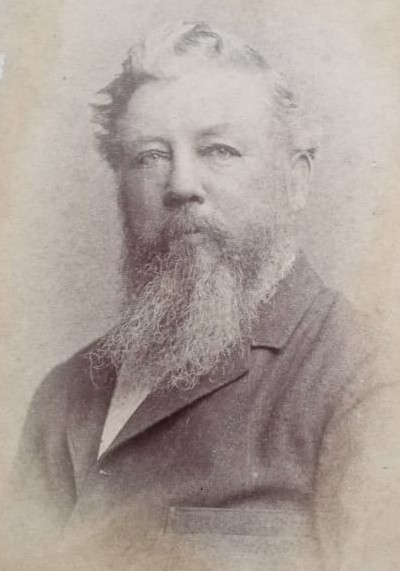 |
|
Joseph Risley
photograph courtesy of Robert King
|
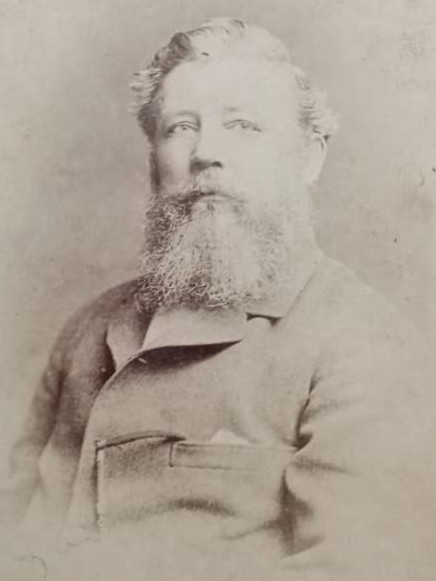 |
|
Joseph Risley
photograph courtesy of Robert King
|
1835/6, in Hornsey, Middlesex,
England
8 May 1836 in St Mary, Hornsey,
Middlesex, England
Joseph is recorded as the son of Joseph Risley, gardener of Fortis Green,
and his wife, Alice.
Joseph Risley
Alice
(Simmons) Risley
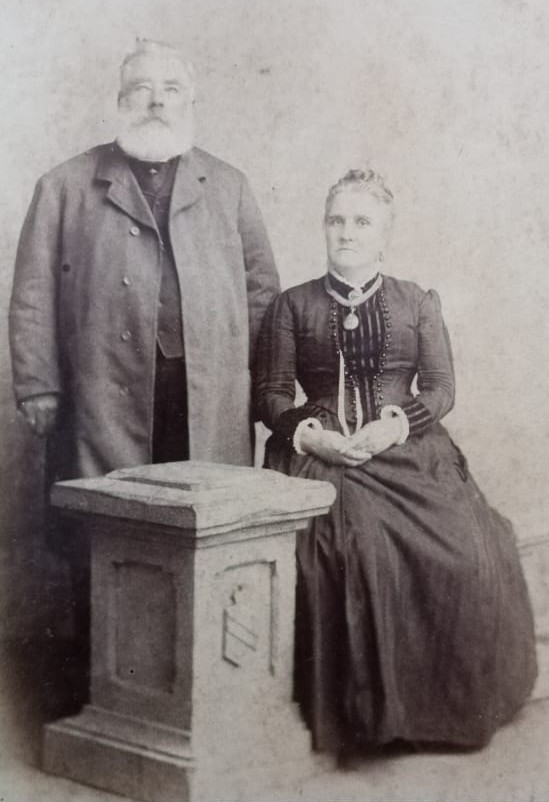 |
|
Joseph Risley and Annie (Cox) Risley
photograph courtesy of Robert King
|
Anne Cox on 28 October 1856, in St
Mary, Hornsey, Middlesex, England
Joseph Risley is recorded as a bachelor, of full age. He is a gardener,
resident in Kingston, the son of Joseph Risley, gardener. Anne Cox is
recorded as a spinster, of full age, resident in Hornsey. She is the
daughter of Frederick Cox, inn keeper. The marriage, by banns, was
officiated by Richard Harvey, rector, and witnessed by John Cox and Susan
Allisam.
Banns
of the marriage between Joseph Risley, bachelor of the parish of
Hornsey and Anne Cox, spinster of the parish of Hornsey, were published on
the previous Sundays, 12 October 1856, 19 October 1856 and 26 October 1856.
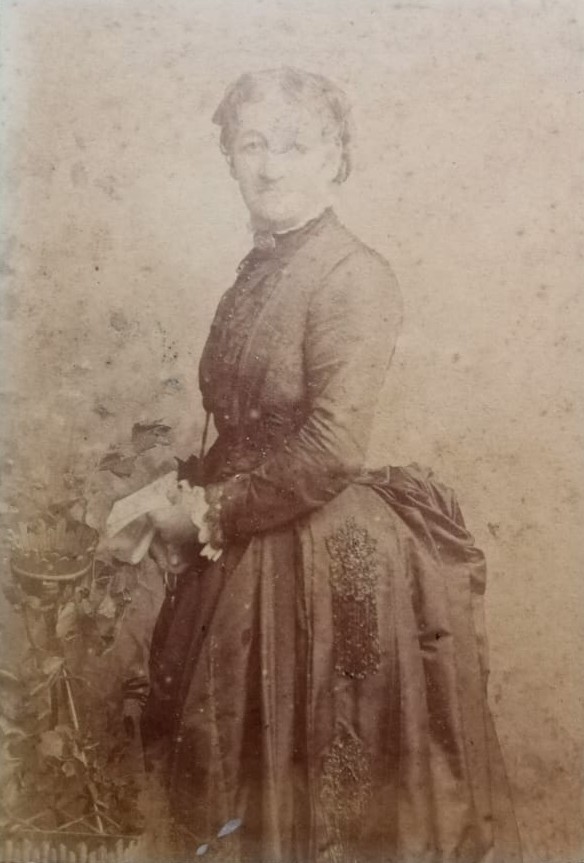 |
|
Annie (Cox) Risley
photograph courtesy of Robert King
|
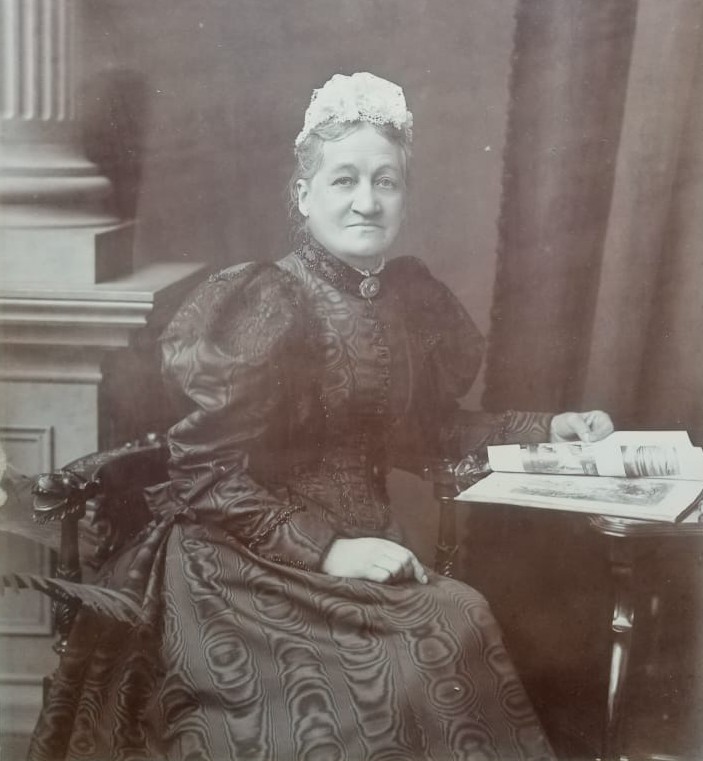 |
|
Annie (Cox) Risley
photograph courtesy of Robert King
|
Annie was born in 1830, in England, the daughter of Frederick Cox. She died
on 7 June 1903, at the home of her daughter, Mary Fenwick, Erf no. 74,
Heidelberg, Transvaal, aged 72. The cause of death is listed as apoplexy, of
duration six days. She is buried in the DRC and Presbyterian cemetery,
Pietermaritzburg, Natal. The grave is located in Old Lot No 1I (New Lot No
1B) Area 5.
Joseph's parents died while he was still young and Joseph was left in the
care of his elder brother, William. Joseph, like his brother, emigrated to
Natal and settled in Pietermaritzburg. He became a partner in the grocery
firm Harwin & Risley on Church Street in Pietermaritzburg. Joseph was
one of the City Fathers. We find a reference in 1875 that the "Tender Board
recommends Messrs. Harwin and Risley for the supply of candles to
Legislative Council".
27 March 1892, at Pietermaritz
Street, Pietermaritzburg, Natal, aged 56. The cause of death is listed as
disease of the liver.
Newspaper
cutting containing obituary (undated)
Death of Mr. Joseph Risley.
It is with sincere regret that we have
to record the demise of another old and esteemed citizen in the person
of Mr. Joseph Risley, who passed away peacefully whilst sleeping at two
o'clock yesterday morning. Deceased had been suffering for some time
from yellow jaundice, the immediate cause of death being flooding of the
heart. The deceased, who was 56 years of age, came to Natal with the
pioneer colonists in 1856, and was engaged successfully in business for
a time in Church Street. In the days of the first rush to the Diamond
Fields Mr. Risley left the City for Kimberley, where he was again
successful. Returning, as did many of the old colonists, to Maritzburg,
he joined Mr. Harwin and engaged in business in Church Street for a
number of years. Some 15 years ago the partnership was dissolved, and
since that time deceased has lived in retirement from business cares.
Deceased engaged actively in public life, and took a great interest in
municipal and other affairs pertaining to the welfare of Maritzburg. The
funeral took place yesterday afternoon, deceased being followed to his
last resting-place by a large concourse of representative citizens,
including the officers and members of the Loyal Natal Unity Lodge of Odd
Fellows, of which Order he was an active and zealous member. The
mourners were his son, Mr. Charles Risley, and Messrs. J. King, E. F.
Ford, A. Edmondson, J. Risley, J. Lister, and H. White. A large
gathering of citizens also assembled in the Presbyterian Cemetery, in
which burial-ground deceased was interred. The Rev. J. Gould-Smith
conducted the last sad rites at the grave. Among the older residents and
friends of deceased assembled around the grave we noticed His Worship
the Mayor (Mr. R. Mason) and Messrs. R. H. Mason, J, J, Chapman, E. S.
T. Stantial, J. Polglase, W. E. Bale, W. Lister, B. S. Kelly, O.
Hosking, Dr. J. Allen, and many others.
Presbyterian cemetery,
Pietermaritzburg, Natal
dated 11 January 1876 with a codicil
dated 6 October 1890 and a second codicil dated 24 March 1892, filed 22
February 1904
Transvaal
Probate Files 1904 #4629 film 007805516 images 1008-13
THIS IS THE LAST WILL and TESTAMENT of me
JOSEPH RISLEY of the firm "Harwin and Risley" of Pietermaritzburg in the
Colony of Natal South Africa, Merchant, married at Hornsey in England in
the United Kingdom of Great Britain and Ireland to my present wife Annie
Risley (born Cox) but without ante-nuptial Contract or Marriage Settlement
I DO HEREBY under and by virtue of Law XXII 1863 (Natal) entituled "To
prevent community of goods attaching to certain marriages and to enable
the spouses of such marriages to devise their properties" and under and by
virtue of all other powers in that behalf enabling me but subject to
certain Articles of Partnership entered into between me and John Harwin of
the said City of Pietermaritzburg on or about the twenty seventh day of
April 1867, revoke all former Wills and testamentary dispositions made by
me I GIVE DEVISE and BEQUEATH all my Estate and Effects both real and
personal moveable and immoveable wheresoever situate and whether the same
be in reversion remainder or expectancy unto ROBERT HUGHES MASON and
THOMAS HENRY TAYLOR both of Pietermaritzburg aforesaid their heirs
executors administrators and assigns respectively UPON TRUST that the said
Robert Hughes Mason and Thomas Henry Taylor or the survivor of them or the
heirs executors or administrators of such survivor or other the Trustees
or Trustee for the time being of this my Will (hereinafter referred to as
my Trustees or Trustee) shall permit my said wife to have the use of the
real or immoveable property or any part or portion thereof and the entire
annual rents revenue and income of the real and personal property during
the term of her natural life and until she marry (if she does marry again
after my decease for the support and maintenance of herself and the
several children of our marriage until such children respectively being
sons have attained the age of sixteen years or being daughters are married
a son attaining such age or a daughter being married having no claim to
further support or maintenance under this trust AND on the death or
remarriage of my said wife I will and direct direct that the Trustees or
Trustee for the time being of this my Will as soon as conveniently may be
shall sell the real or immoveable property in my Estate and shall call in
sell and convert in to money such parts of my personal and moveable estate
and effects as shall not consist of money and shall invest the proceeds of
such sales calling in and conversion and such monies of the Estate on good
security and shall stand possessed thereof IN TRUST out of the annual
income and revenue thereof to maintain and educate any minor child or
children of our marriage until such child or children being a son attains
the age of sixteen years old or being a daughter shall marry and
thereafter shall pay over the money proceeds of such investments to the
children of our marriage then living and to the issue of any deceased
child in such shares or proportions as my said wife by Deed may appoint
provided such Deed is executed by her before she marries again if ever she
does remarry and failing such appointment or so far as the same may not
extend then I direct that the same shall be paid in equal shares to all
the children of our marriage then living who being a son or sons shall
attain the age of twenty one years or being a daughter or daughters shall
attain that age or shall marry the lawful issue of any deceased child
taking per stirpes the share that would have been payable to his or her
deceased parent had such parent been alive or should only one child of our
marriage of the issue of a deceased child be then alive then to such child
or issue as the case may be absolutely the issue if more than one of any
deceased child taking share and share alike a minor child of such issue
being entitled to his share on attaining the age of twenty one years and a
minor female child of such issue being entitled to her share on attaining
that age or marrying AND I hereby declare that it is my desire and
intention that the Trustees or Trustee of this my Will in all matters
connected with the administration of my Estate shall study to carry out
the wishes of my said wife Annie Risley so long as she remains unmarried
after my death AND I hereby declare that if my Trustees hereby constituted
or or either of them shall die in my lifetime or if they or either of them
or ant Trustee appointed as hereinafter provided shall after my death die
or desire to be discharged or refuse or become incapable to act in the
trusts of this my Will then and in every such case it shall be lawful for
my said wife during her life if she does not remarry and after her decease
or remarriage for the continuing Trustees or Trustee or the Executors or
Administrators of the last acting Trustee to appoint any other person or
persons to be a Trustee or Trustees in the place of the Trustee or
Trustees so dying or desiring to retire from or refusing or becoming
incapable to act as aforesaid and upon every such appointment the said
property and premises shall become vested in every such new Trustee for
all the purposes of this Will as fully and effectually as if I had hereby
constituted him as a Trustee PROVIDED ALWAYS that any Trustee or Executor
for the time being of this my Will shall be chargeable only for such
property and monies as he or she shall actually receive and shall be
answerable and accountable only for his or her own acts receipts and
defaults and not for those of any other person AND ALSO that any Trustee
or Executor for the time being of this my Will may reimburse himself or
herself or pay out of the trust premises all expenses incurred in or about
the execution of this my Will I DEVISE unto my said trustees all Estates
vested in me as Trustee or Mortgagee upon the Trusts and subject to the
equities affecting the same Respectively AND I APPOINT my said wife Annie
Risley and the said Robert Hughes Mason and Thomas Henry Taylor to be the
Executrix and Executors of this my Will and I APPOINT my said wife
Guardian of our infant children.
In Witness whereof I the said Joseph Risley have hereto set my hand
this eleventh day of January 1876 One thousand eight hundred and seventy
six.
JOSEPH RISLEY
SIGNED and declared by the said Joseph Risley the Testator as and for his
last Will and Testament in the presence of us both being present at the
same time who at his request in his presence and in the presence of each
other have hereunto subscribed our names As Witnesses
E. Homersham Wiltshier
W. E. Purn
THIS IS A CODICIL TO THE WILL of me Joseph Risley, which Will bears
date the eleventh day of January (1876) One thousand eight hundred and
seventy six Whereas I have therein appointed Robert Hughes Mason and
Thomas Henry Taylor both of Pietermaritzburg in the Colony of Natal their
heirs executors administrators and assigns respectively the Trustees or
Trustee and Executors or Executor of the said Will - And Whereas I am now
desirous of nominating my son-in-law JAMES KING of Lynedock Nottingham
Road, Colony of Natal aforesaid in the place and in the stead of the said
Thomas Henry Taylor, Now Therefore I do hereby appoint the said Robert
Hughes Mason and the said James King their heirs executors administrators
and assigns respectively the Trustees or Trustee and Executors or Executor
of the said Will AND I DIRECT my said Trustees or Trustee upon the
decease of my said wife to divide the annual rents revenue and income of
my real and personal estate equally between my several children if they
are all agreeable OTHERWISE I DIRECT my said Trustees or Trustee to
dispose of the whole of my real and personal estate for the best price
obtainable and thereafter to divide the proceeds thereof equally between
my several children. In all other respects I confirm the said Will.
Dated this sixth day of October (1890) Eighteen hundred and ninety.
JOS. RISLEY
Signed by the said Joseph Risley and declared by him to be a Codicil of
his said Will in the sight and presence of us both present at the same
time who in his sight and presence at his request and in the presence of
each other have hereunto subscribed our names as attesting Witnesses
O. Hosking
And. Maited Turnbull
THIS IS A CODICIL TO THE WILL of me Joseph Risley of Pietermaritzburg
Gentleman which Will bears dated the 11th day of January 1876, And Whereas
I have therein appointed Robert Hughes Mason as one of the Trustees and
Executors of the said Will And Whereas I am now desirous of nominating my
son-in-law John Lister of Pietermaritzburg, Solicitor in the place and
stead of the said Robert Hughes Mason Now Therefore I do hereby appoint
the said John Lister and the said James King mentioned in the Codicil to
said Will bearing dated the 6th. October, 1890 to be Executors or Executor
and Trustees or Trustee of my said Will hereby giving and granting unto
them all such powers and authority as are required or allowed in law
especially those of assumption substitution and surrogation I HEREBY
DECLARE it to be my wish and desire and hereby empower my said Executors
as soon as conveniently may be after my death to sell and dispose of to
the best advantage any or all of my immoveable properties other than my
property situate in West Street in the Town of D'Urban and that situate in
Church Street, Pietermaritzburg and at the date of the execution of these
presents being in the occupation Messieurs Nathan Brothers and to apply
the proceeds of such sales First:- In paying off any Mortgages that may be
on the properties and Secondly:- In paying off the Bonds now existing over
aforesaid properties situate in West Street D'Urban and Church Street,
Pietermaritzburg. After the death or remarriage of my wife Annie Risley I
hereby direct my said Executors out of the readiest moneys in my said
Estate to pay to my daughter Kate Helena the sum of (£500) Five Hundred
Pounds Sterling for her own use and benefit absolutely and free from the
control of any husband she may hereafter marry, and I hereby declare that
this bequest shall not be included in computing the said Kate Helena
Risley's portion of my said Estate. In all other respects I confirm the
said Will dated 11 January 1876 and Codicil dated 6th October, 1890.
DATED this 24th day of March 1892 at Pietermaritzburg aforesaid.
JOS. RISLEY
SIGNED by the said Joseph Risley and declared by him to be a
Codicil to his said Will, the interlineation of the word "moneys" on the
6th line of this page having first been made in the sight & presence
of us both present at the same time who in his sight and presence at his
request and in the presence of each other have hereunto subscribed our
named as Attesting Witnesses.
Witness:-
And. Maited Turnbull, Solicitor.
M.A. Thring.
In 1925, 33 years after Joseph's death, some additional assets to his estate
came to light. Both of his executors (James King of Lyndoch, Nottingham
Road, and J.D. Lister of Pietermaritzburg) were also dead by then, and
Joseph's daughter, Mary, applied
to the courts for a summary appointment of a successor. Joseph's
remaining heirs in 1925 were Daisy Lister, Alice King and Mary Fenwick -
Kate Reid having died in England some months earlier.
1841:
Felix Place, Hornsey, Middlesex
1851: Fortis
Green, Hornsey, Middlesex
1856: Kingston, Surrey (marriage record)
- Aged 56 at death in 1892;
aged 5 in 1841 census; place from 1851 census
- Parish registers of St
Mary, Hornsey, Middlesex (Baptisms 1836 p141 #1125)
- Parish registers of St
Mary, Hornsey, Middlesex (Baptisms 1836 p141 #1125)
- Parish registers of St
Mary, Hornsey, Middlesex (Marriages 1856 p186 #372); England Marriage
Index (4Q1856 Edmonton vol 3a p158); place also from Transvaal
Probate Files 1904 #4629 film 007805516 image 1008; banns from banns
notice in the parish registers of Hornsey, Middlesex; the death
notice of Joseph's youngest daughter, Clara, at Pietermaritzburg
Estate Files 1941 #32636 film 007867977 image 1525 lists her
mother as "Annie Risley (nee Randal)", rather than Annie Cox. We know
that Joseph was married to Annie Cox in 1856 and at the time he wrote
his will in 1876, Joseph was married to his "present wife Annie Risley
(born Cox)", so I surmise that the information on Clara's death notice,
supplied by her son, Randal, is in error.; Annie birth from aged 72
years and 10 months at death in June 1903 with place from death
certificate at Transvaal
Civil Records Deaths Heidelberg 1903 film 007751193 image 168;
Annie death from death certificate at Transvaal
Civil Records Deaths Heidelberg 1903 film 007751193 image 168 and
death notice in Pietermaritzburg
Estate Files 1919 #4295 film 007866833 image 935
- Pioneers
of Natal - The Natalian (Pietermaritzburg), September 11 1908;
Harwin & Risley grocers - Old
Maritzburg
(Natalia 40); candles - National
Archives
of South Africa (Database: Pietermaritzburg Archives Repository)
- Pietermaritzburg
death registers 1892 p146 #46
- Newspaper
cutting
containing obituary
- Joseph Risley
Joseph Risley
1 April 1861, in Blyth,
Nottinghamshire, England
William Risley
Emily
(Ward) Risley
Margaret (Wheeler) Watson on 30
June 1898 in St Mary, Johannesburg, South African Republic
Joseph Risley is recorded as a bachelor, aged 39. He is a carpenter,
resident in Johannesburg. Margaret Watson is recorded a widow, aged 44,
resident in Johannesburg. The marriage was performed by John
L. Darragh and witnessed by E. R. Moorby and W. Watson.
Margaret was the daughter of James Napoleon Wheeler, an early settler at
Port Natal who arrived on the Pilot in
March 1842, and two months later helped to row Dick
King across the Bay to escape the Boer seige of Port Natal and ride to
Grahamstown for help. She married firstly Francis Lane Watson on 2 January
1871, in Greytown, Natal, and had five children, Lilian, Hugh, Daisy, Walter
and Francis. Francis Lane Watson drowned on 23 January 1883 in Howick,
Natal. Margaret died on 26 May 1926, at Chelmsford Road, Durban, Natal. The
cause of death is listed as chronic interstitial
nephritis of duration years and uraemia
of duration 10 days. She was buried in Stellawood cemetery, Durban.
Addresses:
1926: 53 Leathern Road, Durban, Natal
Carpenter
Known as Joe.
Joe emigrated to Natal aboard
the Natal Star, arriving in
Durban on 1 February 1867. He is recorded as aged 3, and surety was
stood by his father, William Risley, who had emigrated earlier, and his
uncle, Joseph Risley, both of Pietermaritzburg. Accompanying Joseph on the Natal Star were his mother, Emily, and
siblings Emily, Arthur, Alice, William J., Fred H., John E. and Clara.
In 1873, Joe was a member of the St Peters choir in Pietermaritzburg. A
newspaper article in 1908 about Joseph's father mentions Joseph as being "on
the Rand".
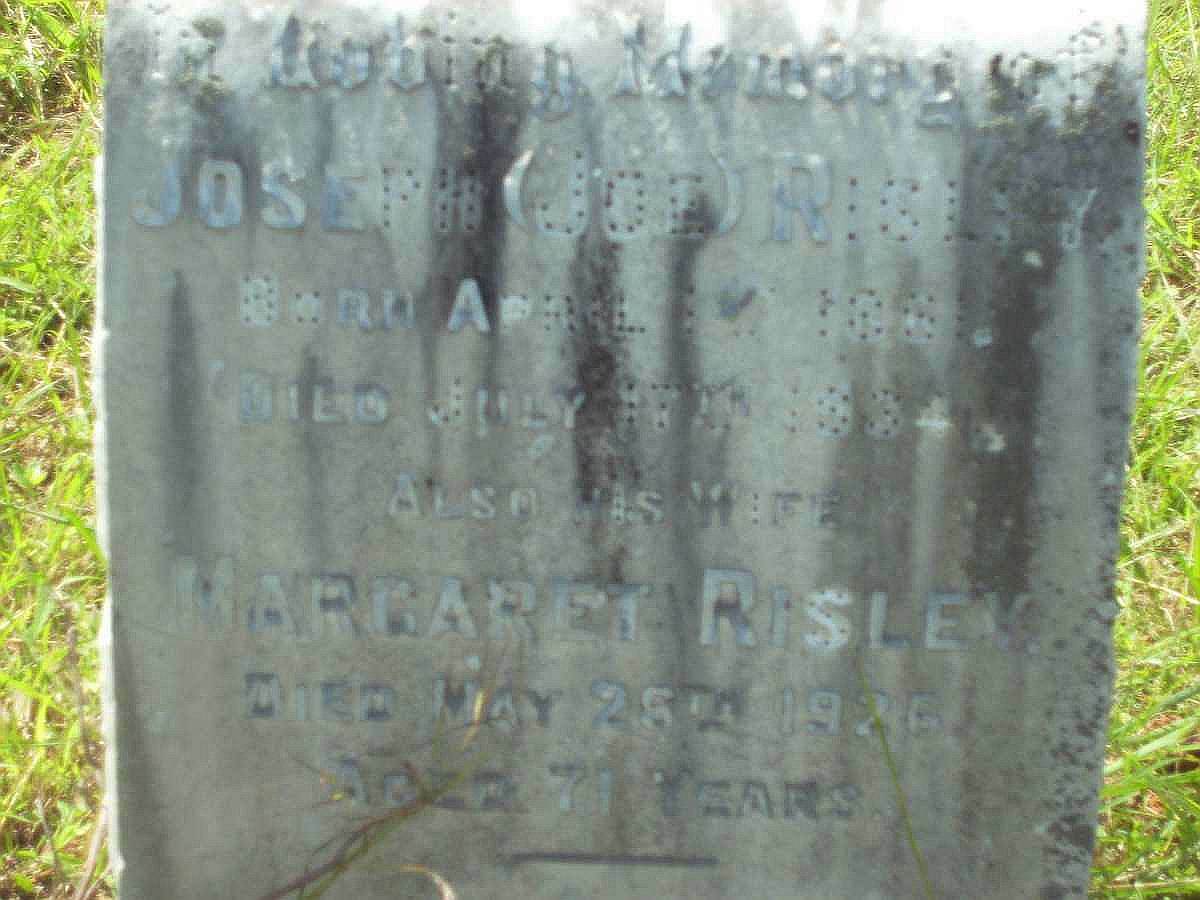 |
|
Headstone of Joseph Risley
|
17 July 1934, at Addington hospital,
Durban, Natal, South Africa
The cause of death is listed as acute bronchial asthma concurrent with
chronic myocarditis, of duration 3 weeks
Stellawood cemetery, Durban, Natal,
South Africa.
Joe and Margaret are buried together. The headstone reads:
In Loving Memory of
JOSEPH (JOE) RISLEY
BORN APRIL ? 1861
DIED JULY 17th 1934
ALSO HIS WIFE
MARGARET RISLEY
DIED MAY 25th 1926
AGED 71 YEARS
dated 4 August 1932, filed 24 July
1934
Pietermaritzburg
Estate Files 1934 #21169 film 007867948 image 1133
THIS IS THE LAST WILL AND TESTAMENT of me,
JOSEPH RISLEY, of Centenary Home, Bartle Road, Durban, in the county of
Durban, Natal, made this fourth day of August, in the year of our Lord one
thousand nine hundred and thirty two.
I hereby revoke all wills made by me at any time heretofore. I
appoint my nephew, RUPERT S. FORD, of Durban, Natal, to be my executor,
and direct that all debts and funeral expenses shall be paid as soon as
conveniently may be after my decease.
I give and bequeath unto my nephew RUPERT S. FORD, all my property
movable and immovable.
J. Risley
Signed by the Testator "J. RISLEY" in the presence of us, present at the
same time, who at his request in his presence, and in the presence of each
other, have subscribed our names as witnesses:
"H.COMBER" 435, West Street. Durban
"J.H.COOMBER" 14, Barclay Mansions, Durban.
1861: Blyth (West Side), Blyth,
Nottinghamshire
1932: Centenary Home, Bartle Road, Durban, Natal (Pietermaritzburg
Estate Files 1934 #21169 film 007867948 image 1133)
1934: Centenary Home, Bartle Road, Durban, Natal (Pietermaritzburg
Estate Files 1934 #21169 film 007867948 image 1128)
Joseph Charles Risley
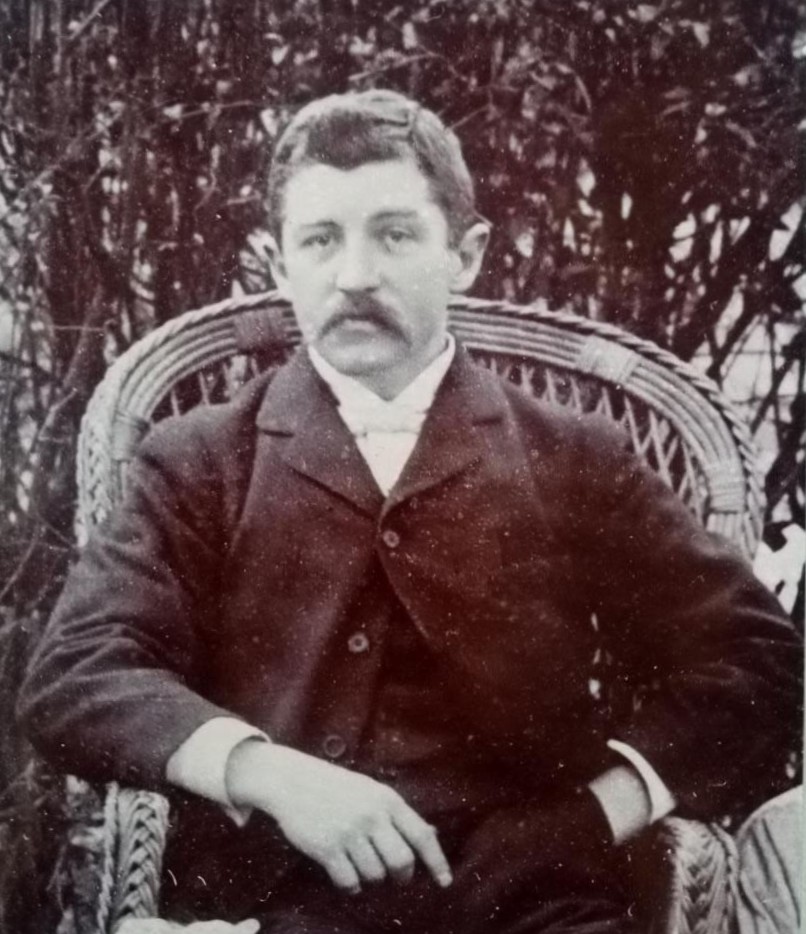 |
|
Joseph Charles Risley
photograph courtesy of Robert King
|
January/February 1866, in
Pietermaritzburg, Natal
Joseph Risley
Annie (Cox) Risley
Harriet Ellis on 1 February 1893 at
Slang Spruit, Pietermaritzburg, Natal
Joseph Charles Risley is recorded as a bachelor, aged 26, He is a farmer,
resident in Maritzburg. Harriet Ellis is listed as a spinster, aged 24,
resident in Umgeni. The marriage was witnessed by Arthur E. Ellis and Kitty
Francis.
Harriet was born on 12 January 1868, in Pietermaritzburg, and baptised on 13
February 1868, the daughter of Arthur Edward Ellis, a carpenter, and
Elizabeth Platten (Francis) Ellis. She married secondly Clark Ascough on 25
July 1908 in St Cyprian's Church, Durban. Clark died on 9 August 1953 in
Durban, and Harriet died in 1958.
Address:
1901: 333 Berg Street, Pietermaritzburg, Natal (Parish
records of St Peters Pietermaritzburg Baptisms 1901 p86 #990)
1903: 284 Loop Street, Pietermaritzburg, Natal (Pietermaritzburg
Estate Files GS film 001295192 image 01014)
1911: 281 Avondale Road, Durban, Natal (Pietermaritzburg
Estate Files GS film 001295292 image 00820)
Farmer (1893); Trader (1894);
Clerk (1895, 1896); Government Conductor (1898); Clerk with the Army Service
Corps (1900)
Joseph Charles Risley or Charles
Joseph Risley? The man's marriage certificate, death certificate and
gravestone all name him as Joseph Charles, but the legal proceedings around
his intestate estate clearly name him as Charles Joseph, in some places even
correcting where he is simply named as Joseph with an inserted "Charles"
before the "Joseph". On his marriage certificate which names him as Joseph
Charles, he signs his name as Chas. Risley. The baptism records of his five
children list him four times as Joseph Charles and once as Charles Joseph.
In his father's obituary, he is named as Mr. Charles Risley. My best guess
through these discrepancies is that he was actually named Joseph Charles,
but used the name Charles (probably to distinguish himself from his father).
19 July 1900, at 333 Berg Street,
Pietermaritzburg, Natal, of croupous pneumonia, aged 34 years and 5 months
Joseph Charles Risley died on 19th July 1900 at 333 Berg St, PMBurg. He is
recorded as a clerk, aged 34. The cause of death is listed as croupous
pneumonia.
Joseph Charles died intestate. A number of documents regarding the
administration of his estate can be found at Pietermaritzburg
Estate Files GS film 001295192 image 01015
21 July 1900, in DRC and
Presbyterian cemetery, Pietermaritzburg, Natal, aged 34. The grave is
located in Old Lot No 1I (New Lot No 1B) Area 5, grave #219.
1894: Desart, Pietermaritzburg (baptism
record of son Arthur)
1896: Townlands, Pietermaritzburg, Natal (baptism
record of daughter Dulcie)
1900: 333 Berg Street, Pietermaritzburg, Natal (Pietermaritzburg
Estate Files GS film 001295192 image 01014)
Joseph Charles Ellis Risley
25 February 1901, at 333 Berg Street,
Pietermaritzburg, Natal
14 April 1901, in St Peter,
Pietermaritzburg, Natal
Joseph Charles Ellis is recorded as born on Feb. 25 1901, the son of Joseph
Charles (dec.) and Harriet Risley, of 333 Berg Street. The baptism sponsors
are John Eric Short, John Edward Risley and Annie Ellis Locker.
Joseph Charles
Risley
Harriet (Ellis) Risley
Zilla Thelma Thompson on 5
April 1930, at St Aidan, Yeoville, Johannesburg, Transvaal, South Africa
Charles Ellis Risley is recorded as a bachelor, aged 29, born in South
Africa. He is a clerk for South African Railways, resident at Cedarville,
East Griqualand. Zilla Thelma Thompson is recorded as a spinster, aged 26,
born in South Africa. She is resident in Johannesburg. The wedding was
witnessed by L. Howard and J. Grant.
Joseph and Zilla were divorced in 1945.
Zilla was born in 1903/4, in South Africa.
Mary Kathleen (Heasman) van
Wyk on 5 August 1950 in Pietermaritzburg, Natal, South Africa
Joseph Charles Risley is recorded as a divorcé, aged 49, born in Natal,
South Africa. He is a clerk for South African Railways and resident at the
Crown Hotel, Pietermaritzburg. Mary Kathleen van Wyk (born Heasman) is
recorded as a divorcée, aged 40, born in Transvaal, South Africa. She is a
shop assistant, resident at 62 Chapel Street, Pietermaritzburg.
Mary was born on 18 February 1910, in the Transvaal, and baptised on 3 April
1910 in St Peter Krugersdorp, Transvaal, the daughter of Henry James
Heasman, a police constable of Krugersdorp, and Jacobia Hendrick Heasman.
She married, firstly, Tjaart Petrus Van Wyk on 1 July 1928 in St Mary,
Potchefstroom, Transvaal. This marriage ended in divorce in 1944. Mary's
occupation is listed as shop assistant on both of her marriage records, in
1928 and in 1950.
Addresses:
1928: Kruger Street, Potchefstroom, Transvaal
1950: 62 Chapel Street, Pietermaritzburg, Natal
Clerk for South African Railways
29 December 1961, at Grey's Hospital,
Pietermaritzburg, Natal, South Africa
The cause of death is listed as right lobar
pneumonia of duration 6 days and chronic cor
pulmonale of duration 10 years.
Mountain Rise, Pietermaritzburg,
Natal, South Africa
1930: Cedarville, East Griqualand, Cape Province (1st
marriage record)
1950: Crown Hotel, Pietermaritzburg, Natal (2nd
marriage record)
1961: 113 West Street, Pietermaritzburg, Natal (death
record)
Joshua Risley
24 April 1798
20 May 1798, in All Saints,
Edmonton, Middlesex, England
Joshua Risley is recorded as the son of Randall and Elizabeth Born April 24
Baptised May 20 Laborer Palmers Green
Randall Risley
Elizabeth
(Hutchinson) Risley
12 August 1798, in All Saints,
Edmonton, Middlesex, England
Joshua Risley is recorded as aged 10 months the son of Randall and Elizabeth
Laborer Winchmore Hill
- Parish registers of All
Saints, Edmonton (Baptisms 1798 p14)
- Parish registers of All
Saints, Edmonton (Baptisms 1798 p14)
- Parish registers of All
Saints, Edmonton (Baptisms 1798 p14)
- Parish registers of All
Saints, Edmonton (Burials 1798 p85)
Mary Risley
1826/7, in Middlesex, England
Joseph Risley
Alice
(Simmons) Risley
Mary is possibly the "Mary Ann
Risley" who married Samuel Welford on 24 November 1847 at Islington, St
Paul, where the bride is described as a spinster of full age, residing at 2
Elizabeth Place in Holloway, London, and daughter of Joseph Risley,
gardener.
1841:
Felix Place, Hornsey, Middlesex
- Aged 14 in 1841 census;
place from 1841 census
- 1841 census
- Mary Risley
Mary Agnes (Risley) Fenwick
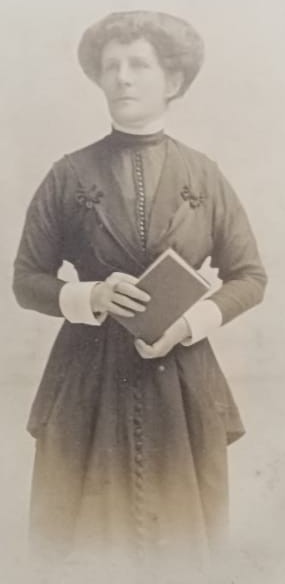 |
|
Mary Agnes (Risley) Fenwick
photograph courtesy of Robert King
|
February/March 1864, in
Pietermaritzburg, Natal
Joseph Risley
Annie (Cox) Risley
John Fenwick on 27 June 1888 at St
John's Presbyterian church, Pietermaritzburg, Natal
John Fenwick is recorded as a bachelor, aged 28. He is a salesman, resident
in Durban. Mary Agnes Risley is recorded as a spinster, aged 24, resident in
Pietermaritzburg. The marriage was witnessed by Jos. Risley and A.H.
Fenwick.
John was born on 7 November 1859 in Whithorn, Wigtownshire, Scotland, the
son of John Fenwick and Elisabeth Wales. He was a
storekeeper and farmer. John died on 15 February 1913, at Lynedoch (the home
of his sister-in-law), Nottingham Road, Natal, South Africa. The cause of
death is listed as diabetes and gangrene
of lungs.
Will: dated 17 March 1905; filed 17 April 1913 held at Transvaal
Probate Files 1913 #22037 film 007805969 images 726-7
LAST WILL AND TESTAMENT
BE IT HEREBY KNOWN UNTO ALL WHOM IT MAY CONCERN:
That on this the Seventeenth day of March in the year of Our Lord
One thousand Nine Hundred and Five, in the presence of us the undersigned
witnesses, personally came and appeared:
JOHN FENWICK
and
MARY AGNES FENWICK born RISLEY
both residing at Heidelberg District Heidelberg, in the Colony of the
Transvaal, married in community of property according to the laws of this
Colony but married without community of property according to the laws of
the Colony of Natal.
And these testators, being in health of body, of sound and
disposing mind, memory and understanding, and capable of doing any act
that requires thought judgement or reflection declared it to be their
intention to make and execute their last will and testament.
Wherefore hereby revoking and anulling all wills, codicils and
other Testamentary acts heretofore passed by them or either of them, the
Testators declared to nominate and appoint the survivor of them, to be the
sole and universal heir of the first dying, of all his or her estate,
goods, effects, stock inheritances inheritances, chattels credits and
things whatsoever and wheresoever the same shall be, nothing excepted,
which shall be left at the death of the first dying of them, whether
movable or immovable and whether the same be in possession reversion,
remainder or expectancy.
The Testator JOHN FENWICK declared to nominate and appoint WALTER
RAWLINSON and ADRIAAN VON GEUSAU to be the joint Executors of this his
will and Testament and the Administrators of his Estate and effects hereby
giving and granting unto them all such powers as are required or allowed
in law.
The Testatrix MARY AGNES FENWICK declared to nominate and appoint
her husband the said JOHN FENWICK to be the sole Executor of this her will
and testament and Administrator of her Estate and Effects, hereby giving
and granting unto him all such powers as are required or allowed in law.
The Testators declared to reserve to themselves the power from time
to time and at all times hereafter, to make all such alterations in or
additions to this will as they shall think fit, either by a separate act
or at the foot hereof, desiring that all such alterations or additions so
made under their own signature, shall be held as valid and effectual as if
they had been inserted herein.
All of which having been clearly and distinctly read over to the
Testators they declared that they fully understood the same and that it
contains their last will and Testament, desiring that it may have effect
as such or as a codicil or otherwise in such manner as may be found to
consist with law.
Thus done and passed at Heidelburg, aforesaid the day month and
year afore written in the presence of the undersigned witnesses.
Jno. Fenwick
Mary Agnes Fenwick (Risley)
AS WITNESSES
W.C.Brown
H. Burnett
Census & Addresses:
1861:
Whithorn, Wigtownshire
1905: Heidelberg, Transvaal (Transvaal
Probate Files 1913 #22037 film 007805969 image 726)
1913: Heidelberg, Transvaal (Pietermaritzburg
Estate Files 1913 #23 film 007866871 image 935)
23 July 1942, at Grey's Hospital,
Pietermaritzburg, Natal, South Africa, aged 78 years and 4 months
The cause of death is listed as bronchiolitis
of duration 14 days and arterio sclerosis of duration 15 years.
General cemetery, Pietermaritzburg,
Natal, South Africa
dated 3 July 1941, with a codicil
dated 6 August 1941; filed 30 July 1942. Will no. 852/1942 held at Pietermaritzburg
Estate Files 1942 #35082 film 007869094 images 2066-70
THIS IS THE LAST WILL AND TESTAMENT of me MARY
AGNES FENWICK, of Pietermaritzburg, Widow.
I cancel and annul all wills or other testamentary acts heretofore
made or executed by me.
I nominate and appoint JOHN OSWALD SMYTHE and ALFRED VIVIAN
EDMONDSON, both of Pietermaritzburg, to be the executors of this my will
and administrators of my estate and effects, giving and granting unto them
all such powers and authority as are required or allowed in law. I direct
that they shall not be required to give security for the due
administration of my estate as either executors or administrators.
It is my desire that I be buried beside my late husband. I direct
that my executors shall arrange for the necessary inscription to be made
upon the gravestone, and that any expense incidental thereto shall be paid
out of my estate.
I direct that out of the readiest moneys in my estate shall be paid
my just debts and the expenses of administration.
I give and bequeath to the administrators of my estate my holding
of Pietermaritzburg Municipal Corporation (1930-40) Stock amounting to
£3,500, whatever its value may be, to be held by them in trust, to pay the
interest therefrom to my niece, EILEEN MARY WELLS, for a period of fifteen
years from the date of my death. I direct that my administrators shall,
upon the expiration of such period of fifteen years, pay over to my said
niece one-half of such stock, and hold the remaining moiety to pay the
income therefrom to my said niece for her life, and upon her death to pay
over the same to her children in equal shares. If my said niece shall die
before the expiration of such period of fifteen years, I direct that the
whole of such stock shall be held by the administrators of my estate to
pay and apply the income therefrom for the maintenance, education and
advancement in life of any child or children of my said niece in equal
shares, share and share alike. If there shall be no children surviving my
said niece the capital fund shall be divided between such other
beneficiaries hereinafter mentioned as may then be living, proportionately
to the bequests made to them respectively.
I make the following special bequests, which I direct shall shall
be paid to the several beneficiaries within one year from the date of my
death.
I give and bequeath to my niece, ALICE DAISY KING, the sum of ONE
THOUSAND POUNDS (£1,000).
I give and bequeath to my niece, FLORENCE KATHLEEN COLTSON, the sum
of ONE THOUSAND POUNDS (£1,000).
I give and bequeath to ALFRED VIVIAN EDMONDSON, the debentures
which I hold, amounting to two thousand on hundred pounds (£2,100) in the
Durban North Estate, whatever their value may be. I make this bequest to
him in gratitude for all the kindness he has shewn me and the help he has
given me from time to time.
I give and bequeath to my nephew, RANDAL ARTHUR LISTER, the sum of
TWO HUNDRED AND FIFTY POUNDS (£250).
I give and bequeath to my nephew, JOHN BRYAN WALTON LISTER, the sum
of FIVE HUNDRED POUNDS (£500).
I give and bequeath to my cousin, GLADYS MARY POTTERILL, the sum of
FIVE HUNDRED POUNDS (£500).
I give and bequeath to my cousin, JESSIE IRENE MARKHAM, the sum of
FIVE HUNDRED POUNDS (£500).
I give and bequeath to ST.PETER'S CHURCH, MARITZBURG, the sum of
ONE HUNDRED POUNDS (£100), directing that the said sum shall be paid to
the churchwardens of the parish of St.Peter, to be applied by them to such
purposes in connection with the said parish as they may think best.
I give and bequeath the three hundred shares held by me in the
Randfontein Estates Goldmining Company, Limited, to the administrators of
my estate, to be held by them in trust for RAE ANNE EDMONDSON. I direct
that they shall not be required to give security in connection with the
administration of this trust. The said shares shall be held by them with
power to sell or transfer the same, and to invest the proceeds, either in
the purchase of other goldmining shares or in any other form of
investment, and to apply the income from time to time received in respect
of such shares, or the proceeds thereof, for the education and benefit of
the said RAE ANNE EDMONDSON until she shall attain majority and upon the
attainment by her of majority to transfer to her the said shares, or any
other shares held in place thereof, or the proceeds thereof. In the event
of her death before attaining majority I bequeath the said shares, or the
proceeds thereof, for division among the next of kin of the said RAE ANNE
EDMONDSON.
I give, devise and bequeath to the said ALFRED VIVIAN EDMONDSON my
house property in Pietermaritzburg, described as Subdivision f,g,h,i, of
Erf 82 Burger Street.
The residue of my estate, if any, I give and bequeath to be divided
equally between my nieces, FLORENCE KATHLEEN COLTSON and EILEEN MARY WELLS
and the child or children (if there be more than one in equal shares) of
the said Alfred Vivian Edmondson; the amount falling to be paid to or
divided between the child or children of the said Alfred Vivian Edmondson
to be held by him in trust for such child or children until the attainment
of majority, the income therefrom to be used and applied by him for the
maintenance, education and advancement in life of such child or children.
It is my will that any bequests to females shall be taken by them
for their sole use and enjoyment, and free from the debts, engagements or
control of their husbands.
I reserve to myself the power to alter or add to this my will at
any time, either by a separate act or at the foot hereof.
All which I declare to be my last will and testament, desiring that
it may have effect as such, or in such manner as may consist with law.
IN WITNESS whereof I have hereunto set my hand in Pietermaritzburg
on the 3rd day of July, in the year of our Lord one thousand nine hundred
and forty-one.
MARY FENWICK
Signed by the testatrix, the said MARY AGNES FENWICK, in the presence of
us then present both together, who in the presence of the testatrix and of
each other have subscribed our names hereto as witnesses.
ETHEL FROUDE
M.R.ARMITAGE
THIS IS A CODICIL to the last will and testament, dated the 3rd day of
July, 1941, of me, MARY AGNES FENWICK, of Pietermaritzburg, Widow.
The provision in my said will concerning the Pietermaritzburg
Municipal Corporation Stock is not sufficiently clear regarding the
devolution of the stock, or moiety thereof, upon the death of my niece,
Eileen Mary Wells. It is my will that the trust fund held by the
administrators of my estate in terms of my will shall be paid to and
divided between the children of the said Eileen Mary Wells in equal
shares, share and share alike; provided, however, that if any child shall
then be a minor, his or her share shall be held by my administrators in
trust until the attainment of majority of such child.
All which I declare to be a codicil to my last will and testament,
desiring that it may have effect as such, or in such manner as may consist
with law.
IN WITNESS whereof I have hereunto set my hand in Pietermaritzburg
this 6th day of August in the year of our Lord one thousand nine hundred
and forty-one.
MARY FENWICK
Signed by the testatrix, the said MARY AGNES FENWICK, as and for a codicil
to her last will and testament, in the presence of us then present both
together , who in the presence of the testatrix and of each other have
subscribed our names hereto as witnesses.
ETHEL FROUDE
M.R.ARMITAGE
Conflicting legal opinions interpreting some provisions in this will can be
found at Pietermaritzburg
Estate Files 1942 #35082 film 007869094 images 2097-2102
1905: Heidelberg, Transvaal (Transvaal
Probate Files 1913 #22037 film 007805969 image 726)
1913: Heidelberg, Transvaal (Pietermaritzburg
Estate Files 1913 #23 film 007866871 image 935)
1942: Victoria Hotel, Pietermaritzburg, Natal (Natal
Civil Records Deaths 1942 Pietermaritzburg film 007751171 image 3011)
Matilda (Risley) Risley
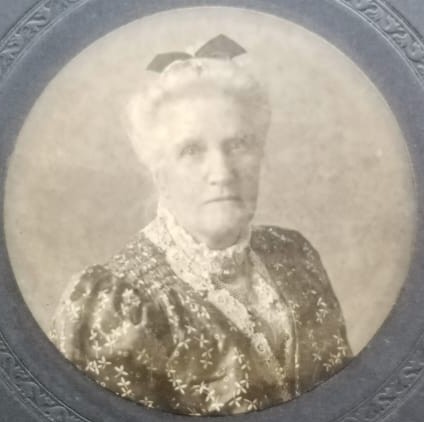 |
|
Matilda (Risley) Risley
photograph courtesy of Robert King
|
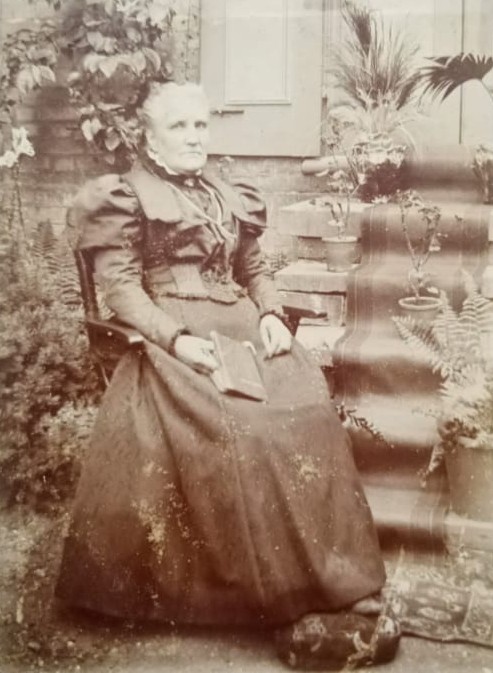 |
|
Matilda (Risley) Risley
photograph courtesy of Robert King
|
1835/6 in Edmonton, Middlesex,
England
John Risley
Sarah (Page) Risley
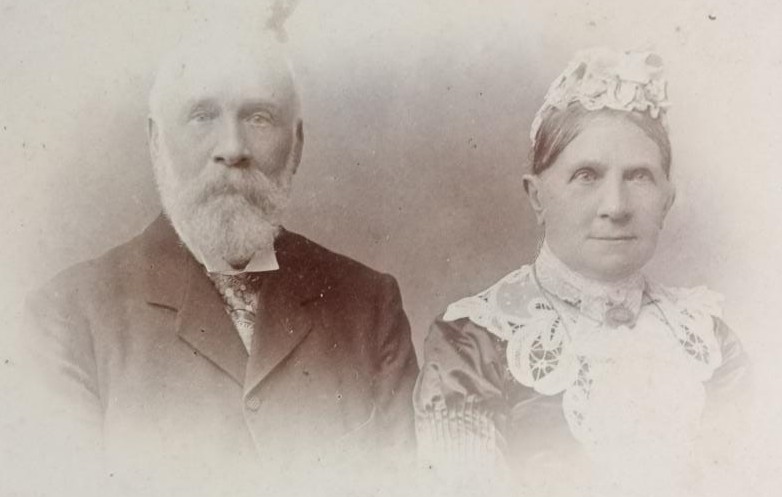 |
|
William and Matilda Risley
photograph courtesy of Robert King
|
William Risley on 6 May 1879 in the
parish of St George Hanover Square, Middlesex, England
William Risley is recorded as a widower, of full age, the son of Joseph
Risley, a nurseryman. William is a nurseryman, resident in St George Hanover
Square. Matilda is recorded as a spinster, of full age, the daughter of John
Risley, a farmer. She is resident in Edmonton. The marriage, by license, was
officiated by Charles Edward Greenside and witnessed by William Pidsley and
Emily Annie Brownett.
William Risley and Matilda Risley were first cousins, William's father,
Joseph Risley, being the younger brother of Matilda's father, John Risley.
Matilda was a witness to the wedding
of Clara Risley and Alfred Edmondson on 23 November 1885 in
Pietermaritzburg, Natal.
30 August 1909, in Biggleswade,
Bedfordshire, England, aged 73
dated 5 August 1905, with a codicil
dated 18 September 1908, proved 13 September 1909
Pietermaritzburg
Estate Files #37/61 film 007866875 image 441-4
IN HIS MAJESTY'S HIGH COURT OF JUSTICE.
BE IT KNOWN that upon search being made in the Principal Probate
Registry of the High Court of Justice it appears that on the thirteenth
day of September in the year of our Lord 1909 the last Will and Testament
with one Codicil thereto of MATILDA RISLEY late of Biggleswade in the
County of Bedford Widow deceased who died at Biggleswade aforesaid on the
thirtieth day of August 1909 was proved in the said High Court of Justice
by HENRY CHAUNDLER the Executor named in the said Will save as to property
situate in Natal and which Probate now remains of record in the said
Registry
The true tenor of the said Will and Codicil is in the words following to
wit:-
I MATILDA RISLEY of Biggleswade in the County of Bedford Widow
hereby revoke all former Wills by me made and declare this to be my last
Will and Testament I appoint WILLIAM FREDERICK RISLEY (son of my
late husband WILLIAM RISLEY) and EDWARD F FORD (a son in law of my said
late husband) to be EXECUTORS of this my Will so far only as relates to my
property and effects situate in the Colony of Natal AND for all other
purposes I appoint HENRY CHAUNDLER of Biggleswade aforesaid Solicitor to
be EXECUTOR of this my Will I give and devise all the messuages
stores and landed property belonging to me situate at Pietermaritzburg in
the Colony of Natal (subject to any mortgages or charges thereon) and also
all rents or profits arising therefrom due from the tenants thereof or in
the hands of my Agent ay Pietermaritzburg at the time of my death unto the
said WILLIAM FREDERICK RISLEY and EDWARD F FORD UPON TRUST that they or
the survivor of them or the executors administrators or assigns of such
survivor shall as and when they think fit sell call in and convert into
money the same and after payment thereout of all costs and expenses
connected therewith and any charges or duty payable thereon shall stand
possessed of the residue UPON TRUST to divide the same equally between
such of the seven children of my late husband WILLIAM RISLEY living at my
death or the issue of any of such children as may have died in my lifetime
such issue to take equally their respective parents share I give my
diamond locket and gold necklet to ALICE MILDRED WHITE a granddaughter of
my late husband I give to my niece ANNIE ADA MATILDA COLLINS a
leagacy of twenty pounds I give to my nephew EDWARD JOHN ERNEST
DUNKLING a legacy of twenty pounds I give to my niece KATE REID my
cluster diamond ring I give to my niece SARAH ANN WRIGHT my other
two rings my oval table my wardrobe my bedroom furniture and bedding and
half of my table and bed linen and a legacy of forty pounds I give
to the said HENRY CHAUNDLER a legacy of one hundred pounds UPON TRUST for
LEONARD GARNER and MARJORY RISLEY GARNER (the two children of my late
niece FLORENCE JENNETT GARNER) as and when they attain the age of twenty
one years and in case either of them should die before attaining the age
of twenty one years then I direct that the survivor of them shall take the
share of the one so dying AND I direct that the said HENRY CHAUNDLER
shall accumulate the income of the said one hundred pounds or the residue
thereof until the said LEONARD GARNER and MARJORY RISLEY GARNER shall
respectively attain the age of twenty one years or apply it for their
maintenance or otherwise as he shall in his absolute discretion deem
proper I give to the said HENRY CHAUNDLER a legacy of twenty pounds
for his trouble in acting as executor of this my Will and I direct that he
shall be entitled to charge my estate for all business done by him in
relation to my estate or the trusts of my Will in the same manner as he
would have been entitled to charge in case he had not been executor
hereof. I give and devise all the residue of my property as well
real as personal subject to the payment of my debts and funeral expenses
(including the erection of any monument to my memory which the said HENRY
CHAUNDLER may think fit) and the legacies given by this my Will and the
testamentary expenses and duty payable in respect of my property situate
in England unto my niece ELIZA DOWNEY IN WITNESS WHEREOF I have
hereto set my hand this fifth day of August one thousand nine hundred and
five
MATILDA RISLEY
Signed and acknowledged by the said MATILDA RISLEY as and for her last
Will and Testament in the presence of us who at her request in her
presence and in the presence of each other have hereunto subscribed our
names as Winesses the words "my Oval Table my wardrobe" having first been
interlined on the first page hereof and by us observed
A.K. BROOKES A.LAWRENCE LEWIS Clerks to Messrs
CHAPMAN & CHAUNDLER Solrs Biggleswade
THIS is a Codicil to the hereinbefore written Will of me MATILDA
RISLEY of Biggleswade in the County of Bedford Widow I revoke the
legacy to the said EDWARD JOHN ERNEST DUNKLING of twenty pounds I
revoke the bequest to the said SARAH ANN WRIGHT of my other two rings and
I give such rings to the said MARJORY RISLEY GARNER I revoke the
legacy to the said SARAH ANN WRIGHT of forty pounds and in place thereof I
give her a legacy of twenty pounds I direct that the duty payable
out of my residuary estate shall include any legacy settled estate or
other duty payable in respect of all specific or pecuniary bequests of my
property situate in England In all other respects I confirm my said
Will IN WITNESS WHEREOF I have hereunto set my hand this eighteenth day of
September one thousand nine hundred and eight MATILDA RISLEY
Signed and acknowledged by the said MATILDA RISLEY as and for a Codicil to
her last Will in the presence of us who in her presence at her request and
in the presence of each other have hereunto subscribed our names as
Witnesses A.K.BROOKES P.R.CHAUNDLER Clerks to Messrs
CHAPMAN & CHAUNDLER Solrs Biggleswade
IN FAITH and testimony whereof these Letter Testimonial are issued
GIVEN at London as to the time of the aforesaid search and the sealing of
these presents this fourth day of November in the year of our Lord one
thousand nine hundred and nine
(Sgd) ROBT. A. PRITCHARD Registrar (Seal)
England & Wales, National Probate Calendar (Index of Wills and
Administrations)
RISLEY Matilda of Biggleswade,
Bedfordshire widow died 30 August 1909 Probate London 13
September to Henry Chaundler solicitor Effects £405 3s. 5d.
1841: Bury
Street, Edmonton, Middlesex
1861:
Broadheath, Wandsworth, Surrey
1871:
Edmonton, Middlesex
1891:
Bycullah Road, Enfield, Middlesex
1901: Hitchin
Street, Biggleswade, Bedfordshire
Randall Risley
Elizabeth
Hutchinson on 4 January 1773, in St Luke, Finsbury, Middlesex, England
Randall Rizlee is recorded as a batchelor of the parish of St Luke.
Elizabeth Hutchinson is recorded as a spinster of the parish of St Luke. The
marriage, by banns, was officiated by John Davis, curate, and witnessed by
William Mears and William Passell.
Labourer
14 September 1837, in Hampstead
workhouse, Edmonton
district, Middlesex, England
Randal Risley is recorded as a pauper, aged 84. The cause of death is
"mortification from ossified vessels". The informant was W. Barroclough,
master of the Workhouse Hampstead.
17 September 1837, in All Saints,
Edmonton, Middlesex, England
Randall Risley is recorded as aged 88, resident in Hampstead.
Randal Risley
28 September 1799
1 December 1799, in All Saints,
Edmonton, Middlesex, England
Randal Risley is recorded as the son of Randal and Elizabeth Born September
28 Baptised December 1. Laborer Winchmore Hill
Randall Risley
Elizabeth
(Hutchinson) Risley
5 January 1801, in All Saints,
Edmonton, Middlesex, England
Randal Risley is recorded as aged 1 the son of Randall and Eliz.th
Lab.r Palmers Green
- Parish registers of All
Saints, Edmonton (Baptisms 1799 p23)
- Parish registers of All
Saints, Edmonton (Baptisms 1799 p23)
- Parish registers of All
Saints, Edmonton (Baptisms 1799 p23)
- Parish registers of All
Saints, Edmonton (Burials 1801 p100)
Rhy Ida Harriet (Risley) Mitchell
22 October 1898, at 27 Boshoff
Street, Pietermaritzburg, Natal
8 April 1900, in St Peter,
Pietermaritzburg, Natal
Rye Harriet Scott is recorded as born on October 22 1898, the daughter of
Charles Joseph and Harriet Risley. Joseph is a government conductor,
resident in P.M.Burg. The baptism sponsors are Annie Donaldson, Elizabeth
Cooper Scott and William Thomas Scott.
Joseph Charles
Risley
Harriet (Ellis) Risley
Alec Wilson Mitchell on 6 March
1931, at St Paul, Durban, Natal, South Africa
Alec Wilson Mitchell is recorded as a bachelor, aged 43, born in Wales. He
is a cable operator, resident at Esplanade, Durban. Rhy Ida Harriet Risley
is recorded as a spinster, aged 31, born in South Africa. She is resident at
231 Windermere Rd, Durban. The wedding was witnessed by A. J. Risley and C.
Vaughan Thomas.
Alec was born in 1888, in Penarth, Glamorganshire, Wales, the son of William
and Harriett E. Mitchell. He died in 1954.
Census and Addresses:
1891:
Bradford Place, Penarth, Glamorganshire
1901:
Cutliffe Grove, Bedford Western Ward St Paul, Bedfordshire
1931: Esplanade, Durban, Natal (Natal
Civil Records Marriages Durban 1931)
30 October 1964, at Entabeni
Hospital, Durban, Natal, South Africa, aged 66
The cause of death is listed as status
asthmaticus, of duration 24 hours
Stellawood crematorium, Durban,
Natal, South Africa
1931: 231 Windermere Rd, Durban, Natal (marriage
registration)
1964: 68 Grandborough, South Beach, Durban, Natal (death
registration)
Robert Risley
2 June 1793, in All Saints,
Edmonton, Middlesex, England
Robert is recorded as the son of Randall and Elizabeth Risley
Randall Risley
Elizabeth
(Hutchinson) Risley
- Parish registers of All
Saints, Edmonton (Baptisms 1793)
- Parish registers of All
Saints, Edmonton (Baptisms 1793)
Samuel Risley
18 January 1779, in All Saints,
Edmonton, Middlesex, England
Samuel is recorded as the son of Randal and Eliz.th Risley.
Randall Risley
Elizabeth
(Hutchinson) Risley
- Parish registers of All
Saints, Edmonton (Baptisms 1779 p211)
- Parish registers of All
Saints, Edmonton (Baptisms 1779 p211)
Sarah Alice (Risley) King
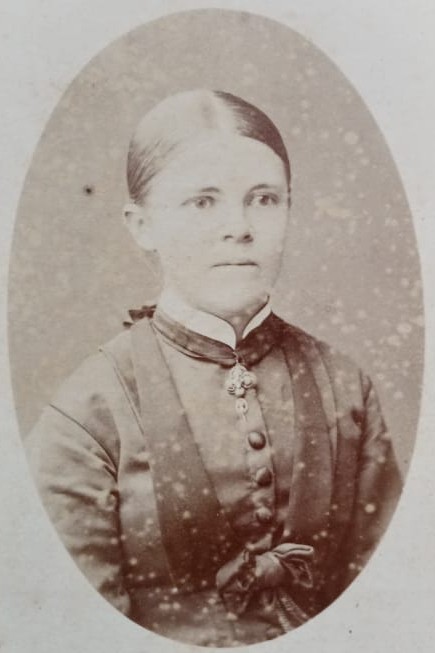 |
|
Sarah Alice (Risley) King
photograph courtesy of Robert King
|
July/August 1858, in
Pietermaritzburg, Natal
Joseph Risley
Annie (Cox) Risley
James
King on 17 June 1880 at St John's Presbyterian church,
Pietermaritzburg, Natal
James King is recorded as a bachelor, aged 34. He is a farmer, resident at
Lynedoch, Co. P.M.Burg. Sarah Alice Risley is recorded as a spinster, aged
21, resident in Pietermaritzburg. The marriage was witnessed by Robt. King,
Charles J. Smythe and Lily Campbell.
Sarah and James signed
a lengthy ante-nuptial contract in which James assigned one quarter of
his farm "Lynedoch" (734 of 3,083 acres) to trustees in favour of his
wife, with the condition that he could continue to operate it during his
life, in exchange for the marriage not being in community of property. The
purpose seems to have been to protect the remainder of Lynedoch to the King
family in the event of there being no children from the marriage.
23 February 1931, at Lynedoch,
Nottingham Road, Lions River, Natal, South Africa, aged 72 years and 6
months
dated 29 December 1910. Will no.
135/1331 held in Pietermaritzburg
Estate Files GS film 001295410 image 01279-84
THIS IS THE LAST WILL AND TESTAMENT of me SARAH
ALICE KING (born Risley) wife of JAMES KING of Lynedoch, Nottingham Road,
Lions River Division, County of Pietermaritzburg, Province of Natal,
Farmer.
I cancel annul and make void all former Wills or Codicils or any
Deeds or Documents of Testamentary nature heretofore executed by me.
I nominate constitute and appoint my husband the said JAMES KING
and my three sons CHARLES JOHN RISLEY KING, LEOPOLD JOSEPH KING and ROBERT
ARCHIBALD KING or the Survivor or Survivors of them to be the Executors of
this my last Will and Testament and Trustees and Administrators of my
Estate and Effects (hereinafter called the said Trustees) hereby giving
and granting to the said Trustees all such powers as are usually conferred
upon them by Law and especially those of assumption substitution and
surrogation.
I hereby nominate and constitute my husband the said JAMES KING to
be the sole guardian of my minor children whom failing the Trustees of
this my last Will and Testament.
I give devise and make over to the said Trustees the whole of my
Estate and Effects movable and immovable, personal and real, corporeal and
incorporeal and whether the same be in possession reversion remainder or
expectancy nothing excepted but that in trust only for the ends uses and
purposes following, namely :-
First: Out of the first
and readiest of my means and estate to pay all my just and lawful debts
death-bed and funeral expenses and the expenses incidental to the carrying
out of these presents.
Second: That whereas I am
the owner of one-quarter undivided share of the farm Lynedoch, I direct my
Trustees to allow my said husband the free and undisturbed possession and
usufruct of the same for the remainder of his natural life should he
survive me, and on his death or re-marriage I bequeath the same to my
eight sons absolutely, share and share alike: should any of my said sons
predecease my husband, then on the death of my husband the issue male of
such predeceasing child or children shall take his father's share by
representation, but failing such issue male such predeceasing child's or
children's share shall be divided equally amongst the remaining surviving
sons; And should any of my said sons desire a division of the said farm I
direct and empower my Trustees to give effect as far as possible to such
wish; And I declare it to be my wish and intention and the bequest of the
said one-quarter share of the said farm to my said sons is made on
condition that no son shall sell or dispose of his share or interest in
the said farm to any person other than one or more of his brothers.
Third: I direct my
Trustees upon my death to hand over to my daughter Alice Daisy the whole
of my jewellery silver plate and other personal effects as her own
property absolutely.
As to the remainder and residue of my Estate and Effects I direct
my Trustees to equally divide the same amongst all my children directing
that my Trustees shall be the only judge of such division of the remainder
or residue of my Estate.
In all cases where females take benefit under this my Will and
Testament the same shall be exclusive always of the "jus mariti" and
rights of administration of any husband that they may marry and I reserve
to myself the power from time to time and at all times to make all such
alterations in and additions to this my last Will and Testament as I may
think fit desiring that the same shall have effect as such or as a Codicil
or otherwise as may consist with Law.
Thus done and executed at Lynedoch on the 29th day of Dec. 1910.
Signed by the said Sarah Alice King the Testatrix in the presence of us
both present at the same time who in her presence and in the presence of
each other have hereunto set our names as witnesses.
E. B. Jaffray
B. McKenzie
Sophia Risley
1787/8
Randall Risley
Elizabeth
(Hutchinson) Risley
22 March 1801, in All Saints,
Edmonton, Middlesex, England
Sophia Risley is recorded as aged 13, the daughter of Randal and Elizabeth,
labourer of Southgate
- Aged 13 at burial on 22
March 1801 from parish registers of All Saints, Edmonton (Burials 1801
p101)
- Parish registers of All
Saints, Edmonton (Burials 1801 p101)
- Parish registers of All
Saints, Edmonton (Burials 1801 p101)
Sophia Risley
17 October 1808
25 December 1808, in All Saints,
Edmonton, Middlesex, England
Sophia is recorded as born on Octobr 17, the d. of William,
labourer of Winchmore, and Anne, his wife
William Risley
Ann
(Hopes) Risley
- Parish registers of All
Saints, Edmonton, Middlesex (Baptisms 1808 p54)
- Parish registers of All
Saints, Edmonton, Middlesex (Baptisms 1808 p54)
- Parish registers of All
Saints, Edmonton, Middlesex (Baptisms 1808 p54)
William Risley
1774/5, in Middlesex, England
3 September 1775, in Southgate
Chapel, Edmonton, Middlesex, England
William is recorded as the child of Randall and Elizabeth Risley
Randall Risley
Elizabeth
(Hutchinson) Risley
Ann
Hopes on 20 July 1795, in St Andrew, Enfield, Middlesex, England
William Risley is recorded as a bachelor of the parish of Enfield, and Ann
Hopes is recorded as a spinster of the parish of Enfield. The marriage was
by banns and conducted by Richard Newton, vicar. The marriage was witnessed
by Charles Baldam(?) and Elizabeth Hopes.
Elizabeth (_____) Egerton on
24 June 1833, in Shoreditch St Leonard, Middlesex, England
William Risley is recorded as a widower, of the parish of St Leonard
Shoreditch. Elizabeth Egerton is recorded as a widow, of the parish of St
Leonard Shoreditch. The marriage, by banns, was officiated by Walter Kelly,
curate, and witnessed by Geo. Yarrow and Jemima France. Although the
marriage record states the bride's name as "Elizabeth Egerton", she signs
the register as "Sarah Egerton".
Elizabeth _____ was born in 1773/4, in Buckinghamshire. She was married
first to _____ Egerton. Elizabeth died in 1852, in Edmonton district,
Middlesex, and was buried on 5 December 1852 in All Saints, Edmonton,
Middlesex, aged 78, at which time her abode is recorded as Winchmore Hill.
Census & Addresses:
1841:
Winchmore Hill, Edmonton, Middlesex
1851:
Winchmore Hill, Edmonton, Middlesex
1852: Winchmore Hill, Edmonton, Middlesex (burial record)
Labourer (1799, 1808, 1811),
"farmer and cowman" (1844) and dairyman (1846)
On 15 September 1844, William's dairy
farm in Winchmore Hill was the scene of a brutal assault on a policeman
investigating milk theft from William's herd.
The Illustrated London News 21 September 1844
p186
ACCIDENTS AND OFFENCES.
ATTEMPT OF ONE POLICEMAN TO MURDER
ANOTHER.—On Monday Mr. Mores and Mr. Busk
county magistrates, sat at the Police-station, Edmonton, to investigate
the following charge:—Patrick Harvey, 392 N, police-constable, was
placed before them for examination. The facts were stated to be, that
Mr. Risley, a cow-keeper, at Winchmore hill, had repeatedly complained
that some parties unknown were in the habit of stealing milk from his
cows in the field, and early on Sunday morning Policemen Hannett, who
was doing duty, placed himself in the field to detect the delinquent.
About four o’clock he observed the prisoner, who was on duty as
constable of the beat, make his way stealthily down the fence into the
field, and begin to draw milk from one of the cows into a bottle; and
while he was so occupied, Hannett advanced, and laid hold of him to take
him in custody to the station house; the prisoner, however, render
desperate by the detection, and unable to break away from him made a
sudden attack upon him with his truncheon, beating him in the most
dreadful manner about the head, until the truncheon broke. Hannett,
however, still kept his hold, until his cries of “murder” brought the
cow-keeper’s men to his assistance, when the prisoner was secured and
given in custody to Sergeant Hill at the station. Hannett was found to
be so seriously injured, that on Sunday morning one of the magistrates
proceeded to take his deposition, as he then appeared to be in immediate
danger of death, but he afterwards rallied. The prisoner declined making
any defence at present, and the magistrates remanded him for a
fortnight.
The record of the trial of Patrick Harvey at the Old Bailey provides some
interesting background on William's dairy operation, and William testified
at the trial. Excerpts from:
The
Proceedings of the Old Bailey
PATRICK HARVEY.
Breaking Peace: wounding.
21st October 1844
...
ROBERT HANNANT (police-constable N 325.) I have been
in the police force eight years—about the 15th of Sept. I was instructed
by my sergeant and Mr. Risley to watch one of Risley's fields, at
Winchmore-hill, Edmonton—I went there a little before two o'clock in the
morning, and placed myself in a tree in the field—I had been there an hour
and a half, or more—there were cows in the field—about twenty minutes to
four o'clock I saw the prisoner come towards the tree where I was, within
six or seven yards of where I stood—he was in his police clothes—he was a
policeman at the time, and was on duty near that spot, in the road, about
120 yards from the spot in the field where I saw him—the cows were lying
within thirty yards of me—he turned to where the cows laid—he put one of
them up and drove it towards the fence—I saw him stoop towards the cow, as
if in the act of milking it—it was a dark morning, but the cow was white—I
stepped up nearly to him, and heard as if milk rattled into some vessel—I
think he saw me, for he got up from the cow—I approached him, and said,
"Harvey, you villain, what are you about?"—he said, "What do you mean?"
and at the time I heard something rattle behind him in his pocket, as if
it was milk—it was the noise of something running down on the ground—I
flew to get hold of it—I went up to him, and got hold of his hand, which
was behind him—he had his great-coat on, which had pocket behind—I
succeeded in getting hold of his hand, and felt it was wet—he tried to
trip me up—we had a scuffle, and both fell—I was on the top—I succeeded in
taking a bottle from his great-coat pocket—it contained milk—being white,
I could see, and it was warm—while he was on the ground, he said,
"Hannant, for God's sake, forgive me, I know I am guilty; forgive me, for
the sake of my wife and dear children; for God's sake, forgive me"—I said
I could not—he then asked me to let him get up, which I did—I had hold of
his collar—he asked me to take hold of his hand which I did—he asked what
I intended to do with him—I said I would treat him as I would anybody
else—I shifted my hand from his collar to his wrist; and while in the act
of putting the bottle into my own coat pocket, he attempted to get from
me—my hat came off in the struggle, and he struck me a violent blow two or
three times with his stave—the first blow was on the top of my head—I
found myself stunned, and lost my sight, with that blow—I could not hear
or see—I shifted my hold then, and got hold of his collar—he struck me two
or three times—I think I recollect his Have breaking—I think then we went
on the ground, but I lost my recollection for a time from the effects of
the blow—when I came to my recollection, I was up, and had hold of him by
the collar, and he was biting my hand to get clear from me—here are the
scars now—I felt my head, and felt a hole in it and the blood was running
from all quarters of my head—I said, "Harvey, you villain, you have
murdered me"—he said, "No, I have not; leave go of me, and lay on my
coat"—he was then in the act of getting his coat off, and threw it down on
the ground, asking me to lay on it—I said, "No, Harvey, I will never leave
you while I have life"—I called, "Murder," and Risley's boy, William, came
to my assistance—I told him I had caught Harvey milking his master's cow,
and asked him to assist me—Harvey said, "No, I have caught Hannant,
"meaning me—we took him out of the field, into the road to Risley's house,
the boy holding him with me—when we got near the house, the boy let go, to
undo the door, and Harvey made another desperate effort to get away—he
dragged me along six, seven, or ten yards, trying to get away—I have
measured it since, and it is fourteen yards—assistance came, and we got
him into Risley's house, as the boy came back—Risley came down, and we got
further assistance—I got exhausted, and was obliged to sit down—Risley
fastened the door to keep him in—I said, in Risley's presence, "Harvey,
how could you serve me in the way you have done?"—he said, "B—y into you,
it serves you right; you are always after me; you have always been
watchine me, or dodging after me, when you have no business;" or
some such words—Mr. Cresswell, the surgeon, afterwards attended me—I was
not conscious of anything but the stave being used till I was stripped in
the house—I then said he must have stabbed me, and found I had been
stabbed in each arm, and, on looking at my coat, I found it was stabbed
through—I had also one wound in my throat, others on my head and face, and
one right through—I could put my tongue through one—I had a stock on—Mr.
Cresswell my wouds—I was carried home afterwards—I gave the bottle of milk
to Mrs. Risley—I had a stave in my hand a little before the prisoner came
into the field, and after I got into Risley's house, I think the prisoner
said, "Where is your stave?"—I looked for it, and could not find it—I did
not use it at all in the struggle—I never could have strength, for I was
stunned from the first blow.
...
WILLIAM FREEMAN . I am in the service of Mr. Risley, a
farmer and cowman on Winchmore-hill. On the 15th of Sept., about four
o'clock in the morning, I was alarmed by a noise, and heard Hannant the
prosecutor's voice—I heard him cry "Murder!"—I knew his voice—it came from
the further side of master's field, where the cows were—I did not hear any
other voice calling for assistance till I got close to them—I went into
the field, and found Hannant and the prisoner struggling—the prosecutor
called to me, "Bill, come to me, he has almost killed me, "and said,
before I got up to him, "I have caught Harvey milking your cows"—the
prisoner said, "No, I have caught him at it"—he was trying to get away—the
prosecutor said, "Take hold of his hand or arm, and help to take him out
of the field, for he will get away from me now"—I took hold of him, and
assisted Hannant in taking him to master's house—when I got near master's
house I let go of him, to go and unlock the door—he then tried to get from
the prosecutor—I ran back, and Hannant said, "Come, Bill, or else
he will get from me"—I ran back, and succeeded in getting him into
master's house—I got a light—Hannant's face was covered with blood, also
his cape, and the front part of his coat—his strength was almost
exhausted—he could scarcely stand upright—I saw no mark of injury on the
prisoner—there was some of the blood which had come from Hannant on
him—master got up, and Mr. Cresswell, the surgeon, was sent for—Hannant
gave mistress a bottle with milk in it—it was afterwards given to sergeant
Emery—I had got up that morning to watch the cows, having lost milk
before—Hannant was aware that I was going to get up that morning—I was up
at the time the alarm morning—I was up at the time the alarm was given.
Cross-examined. Q. This was the time you usually get up, was it
not? A. I generally get up about five o'clock, but I had been up
an hour and a half—master called me at half-past two o'clock—I know the
prosecutor perfectly well, and so does my master—I do not know the
prisoner so well—I never heard a complaint made to the prisoner about our
missing milk.
MR. PRENDERGAST to HANNANT. Q.
Do not you know that the prisoner was aware of the complaints about
the milk being missed? A. I told him Risley had complained to me about it.
WILLIAM RISLEY . I am a cow-keeper at Winchmore-hill. In
consequence of missing milk from the cows I gave Hannant directions to
watch the field where they were, and on the 14th of Sept., about four
o'clock in the morning, I was called up—my boy had got up about two
o'clock—I called him, but he did not go out till about four o'clock—when I
was called up I heard the prosecutor say, "For God's sake, Risley, come
down, for I am a murdered man"—I went down stairs—my boy, who had the key,
unlocked the door—I went out and saw the prisoner trying to get from the
prosecutor, tassling with him—they were about twelve yards from the door
when I first saw them—my boy assisted in bringing the prisoner into the
house, and while he was there Hannant said, "You cruel wretch, how could
you use me so?"—he answered, "B—y into you, it serves you right; you are
always looking after me"—I saw that they were all bloody, and the
prosecutor was wounded wonderfully—my wife had much to do to stop the
blood—the prisoner was not wounded at all—I had not given the prisoner
permission to go into the field.
Cross-examined. Q. You had complained of the loss of your milk? A.
Yes, to many people—I knew Hannant in the neighbourhood, but I was not
more intimate with him than the prisoner—I do not know that the boy got up
when I called him—he generally gets up at five o'clock.
...
JOHN MITCHELL . About six o'clock on the morning of the
15th I went to Mr. Risley's field where the cows had been, and found this
chisel—there was blood on it, much more than there is now—it was quite
fresh blood, and on the spot where I found it there was a great quantity
of blood, as if somebody had been bleeding there, and marks of a struggle
having taken place—it was fifty or sixty yards from the tree further from
Risley's house than the tree—I know Horlin's field—there are two or three
gardens between that and Risley's field.
...
JAMES RADFORD . My father has a field at Winchmore-hill,
near Mr. Risley's cow field—on the Saturday, two or three days after the
prisoner was found there, I found a stave in my father's field—they would
not hare to cross my father's field, from where the cows were, to get to
Risley's—there is a road between our field and Mr. Risley's—the road goes
down past Mr. Risley's house—my father's field is one side of the road,
and Mr. Risley's on the other—I took the stave up, and gave it to Risley's
man, Freeman.
Cross-examined. Q. To get to the cow field at Risley's house do you
go by a road at all? A. Yes, you can go to the house from the
field without going along a road, but not without breaking bounds.
COURT. Q. Is there a gate from the field to the
road? A. Yet—you go out at the gate into the road to get to the
house.
...
WILLIAM RISLEY re-examined. I called my boy up
about two o'clock in the morning, to go to watch the cows—I had told him
that the night before—I had also told Hannant about it, about eight
o'clock the night before—I told him I had missed milk a good many times,
and thought it was done on Sunday night—I told him I had got a lad and
another man coming to watch that same morning, and I wished him to watch
that night, until my lad and man earae, which I thought would be between
three and four.
GUILTY on 4th and 5th Counts. Aged 26.— Transported
for Fifteen Years.
17 December 1846, in Winchmore Hill,
Middlesex, England, aged 71
William's death is recorded as occurring on Seventeenth December 1846 at
Winchmore Hill. He is a milkman, aged 71 years. The cause of death is age
and debility, of duration 3 months. The informant was Sarah Beard, of
Winchmore Hill, Edmonton, present at the death.
24 December 1846 in All Saints,
Edmonton, Middlesex, England, aged 71
William Risley is recorded as 71 years old, resident in Winchmore Hill
dated 3 October 1846
This is the
last Will and Testament of me William Risley of Winchmore Hill in
the parish of Edmonton in the county of Middlesex Dairyman I give all my
Estate and Effects (except my wearing apparel which I give unto my son
John Risley) to my wife for her life and after her decease I give the
same to my sons John and Edmund in equal shares absolutely provided that
in case either of my said sons should die during the lifetime of my said
wife I give the share of the son so dying to my Grandson William Risley
son of my late son Joseph Risley absolutely provided and I direct that
my said estate and effects shall not nor shall any part thereof be sold
during the life of my said wife notwithstanding the same estate and
effects or some part thereof may be of a perishable nature without her
consent and that she shall be at full liberty to use and enjoy the same
estate and effects and to carry on my business for her own benefit and
for that purpose to employ the proceeds of any part of the same estate
and effects that may be sold and generally to deal with my said estate
and effects as if they were her own And I appoint my said wife sole
Executrix of this my will I revoke all former wills, dated this third
day of October one thousand eight hundred and forty six.
Signed by
George Fisher of Hoppers Road Winchmore Hill
in the presence of the above named Testator Wm Risley and by
his direction and acknowledged by the said Testator to be his last will
and testament in the presence of us present at the same time who at the
said Testator's request in his presence and in the presence of each
other have subscribed our names as witnesses.
Richard King Winchmore Hill Shoemaker
John Yeo at Mr Hannes next house to the testator
George Fisher of Hoppers Road Winchmore Hill
granted 22 May 1847 to Elizabeth
Risley, widow, the relict
In the Prerogative Court of
Canterbury
In the Goods of William Risley
Appeared
Personally George Fisher of Hoppers Road Winchmore Hill in the County of Middlesex Servant to the New River
Company, Richard King of Winchmore Hill aforesaid Shoemaker and John Yeo
formerly of Winchmore Hill aforesaid but at present of No 9
Birds Buildings Lower Road Islington in the same County Police Officer
and jointly and severally made oath that they are the attesting
witnesses to the last will and testament of William Risley late of
Winchmore Hill aforesaid deceased and which will is hereunto annexed and
begins thus "This is the last Will and Testament of me William Risley of
Winchmore Hill in the parish of Edmonton in the county of Middlesex
Dairyman" ends thus "dated this third day of October one thousand eight
hundred and forty six" and is thus subscribed "George Fisher" And these
deponents further made oath that on the said third day of October last
they these deponents attended at the house of the said Testator for the
purpose of attesting the execution of the said will by the said Testator
and that there was also present John Radford Esquire of Winchmore Hill
aforesaid the drawer and writer of the said will And these deponents
further made oath that the said Testator being unable to either read or
write the said John Radford in the presence and hearing of all these
deponents read the said will over audibly and distinctly to the said
Testator and asked him if he fully understood and approved of the same
to which the said Testator replied that he did and he the said Testator
then asked this deponent George Fisher to sign the said will for him
which the deponent accordingly did by signing his own name George Fisher
at the foot or end thereof in manner and form as the same now appears in
the presence of the said Testator and these deponents Richard King and
John Yeo all present at the same time and these deponents further made
oath that after this deponent the said George Fisher had so as aforesaid
signed his name for the Testator he the said Testator in the presence of
all these deponents acknowledged the said name to have been so written
and signed for him and by his direction and acknowledged the paper
writing to be and contain his last will and testament and requested all
these deponents to witness the said will which they then accordingly did
by signing their respective names thereto in the manner and form as the
same now appears in the presence of the said Testator — George Fisher —
Richard King — John Yeo — On Thursday the 20th day of May
1847 the said George Fisher Richard King and John Yeo were duly sworn to
the truth of this affidavit Before me A. F. Bayford Just.
Fred J. Clarkson Noty
Proved at London the 22nd May 1847 before the
worshipful Augustus Frederic Bayford Doctor of Laws and Surrogate by the
oath of Elizabeth Risley widow the relict the sole executrix to whom
admon was granted having been first sworn duly to administer.
1841:
Winchmore Hill, Edmonton, Middlesex
1846: Winchmore Hill, Middlesex (will)
- Aged 71 at death on 17
December 1846; place from 1841 census
- Parish registers of All
Saints, Edmonton (Baptisms 1775 p126)
- Parish registers of All
Saints, Edmonton (Baptisms 1775 p126)
- Marriage
register of St Andrew, Enfield, Middlesex 1795 p41 #97
- Middlesex
parish registers; parish registers of St Leonard Shoreditch
(Marriages 1833 p299 #897); probate of William's will granted to
Elizabeth Risley, the relict at National
Archives PROB 11/2056/312; Elizabeth birth from 1851 census;
Elizabeth 1st marriage from name in record of her second marriage (which
states she is a widow); Elizabeth death from England
Death Index (4Q1852 Edmonton vol 3a p80); Elizabeth burial from
parish registers of All Saints, Edmonton (Burials 1852 p227 #1814)
- Labourer from
baptism records of children John (1799), Sophia (1808) and James (1811);
dairyman from William's will held at National
Archives PROB 11/2056/312
- England
Death Index (4Q1846 Edmonton vol 3 p107); details from death
certificate
- Parish registers of All
Saints, Edmonton (Burials 1846 p76 #603)
- National
Archives PROB 11/2056/312 - Will of William Risley, Dairyman of
Edmonton, Middlesex
- National
Archives PROB 11/2056/312 - Will of William Risley, Dairyman of
Edmonton, Middlesex
- William Risley
William Risley
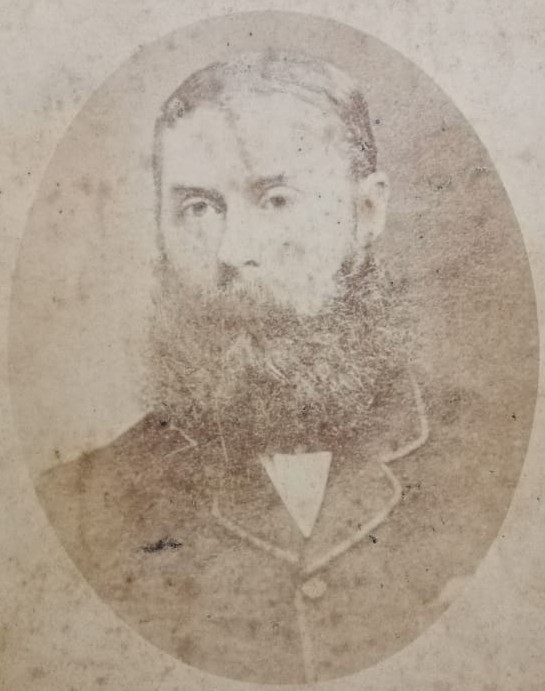 |
|
William Risley
photograph courtesy of Robert King
|
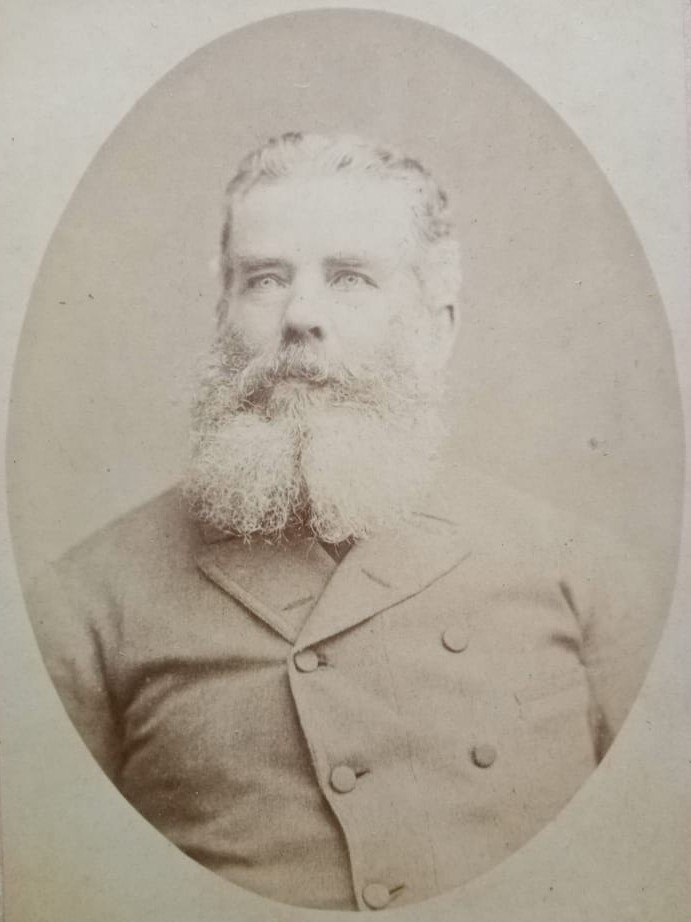 |
|
William Risley
photograph courtesy of Robert King
|
7 February 1829, in Edmonton,
Middlesex, England
A biography written in a South African newspaper, The
Natalian on September 11, 1908 states that William was born in
Muswell Hill, but this likely a mis-remembering for Winchmore Hill where we
know his father lived at the time and which corresponds with the 1861 census
which states William's birthplace as the parish of Edmonton, Middlesex (the
Natalian article also mis-states William
birth year as 1828, rather than the 1829 documented in his baptism record)
8 March 1829 in All Saints,
Edmonton, Middlesex, England
William is recorded as born on 7 February 1829, the son of Joseph and Alice
Risley. Joseph is a labourer, of Winchmore Hill.
Joseph Risley
Alice
(Simmons) Risley
Emily
Mason Ward on 22 June 1851 in St Michael Chester Square in the parish
of St George Hanover Square, Middlesex
William Risley is recorded as a bachelor, of full age, the son of Joseph
Risley, gardener. William is a gardener, resident at Besborough Lodge,
Putney. Emily Mason Ward is recorded as a spinster, of full age, the
daughter of Thomas Ward, clerk. She is resident at 31 Eaton Square. They
were married after banns by J. H. Hamilton, witnessed by George Delang and
Alicia Gandy.
Banns
of the marriage between William Risley, bachelor of the parish of St
Mary Putney, Surrey, and Emily Mason Ward, spinster of the parish of St Luke
Chelsea, Middlesex, were published on the previous Sundays, 1 June 1851, 8
June 1851 and 15 June 1851.
| |
|
William and Matilda Risley
photograph courtesy of Robert King
|
Matilda
Risley on 6 May 1879 in the parish of St George Hanover Square,
Middlesex, England
William Risley is recorded as a widower, of full age, the son of Joseph
Risley, a nurseryman. William is a nurseryman, resident in St George Hanover
Square. Matilda is recorded as a spinster, of full age, the daughter of John
Risley, a farmer. She is resident in Edmonton. The marriage, by license, was
officiated by Charles Edward Greenside and witnessed by William Pidsley and
Emily Annie Brownett.
William Risley and Matilda Risley were first cousins, William's father,
Joseph Risley, being the younger brother of Matilda's father, John Risley.
Gardener and florist
Gardeners
Chronicle 8 October 1887 p421
AFRICAN
TUBEROSES. — Grown by WM. RISLEY, Natal, now arrived in fine condition.
For sample and price, apply at the Office of Mr. WM. G. MACGREGOR,
Langbourne Chambers, Fenchurch Street, E.C.
At the time of his death, William was working as a florist for Floral
nursery on Southbury Road, Enfield, Middlesex.
The newspaper article quoted below indicates that William emigrated to Natal
in 1860 and was followed by his wife and children in 1866. This is
inconsistent with the 1861 census and his seventh child being born in
Nottinghamshire in August of 1864. It seems more likely that William only
went to Natal some time in 1864 or 1865.
William is mentioned in the will of his grandfather, also William Risleydated 3
October 1846 (National
Archives PROB 11/2056/312)
I give the same
to my sons John and Edmund in equal shares absolutely provided that in
case either of my said sons should die during the lifetime of my said
wife I give the share of the son so dying to my Grandson William Risley
son of my late son Joseph Risley absolutely
In the 1870's William purchased a farm in the Chase Valley, near
Pietermaritzburg, which he named Muswell Hill, supposedly after his
birthplace in London although, as discussed above, it is more likely that he
was born in Winchmore Hill.
William was a sponsor at the baptism of his grandson, Edward William Ford,
in 1876, and a witness to the wedding
of Clara Risley and Alfred Edmondson on 23 November 1885 in
Pietermaritzburg, Natal, meaning that he and Matilda returned to South
Africa after their marriage in England for a period before their eventual
return to England.
Extract from The
Natalian - September 11, 1908
PIONEERS OF NATAL
THE MEN WHO MADE THE COLONY
"There were Giants in those Days"
WILLIAM
RISLEY
"An honest man's the noblest work of God"
Who of old Natal, and especially of the old days of
Pietermaritzburg, does not remember the rugged, kindly face and the short,
sturdy well-knit form of William Risley — once so well known in our
streets, on our Market Square or throughout the colony!
In the Days of his
Youth
The subject of this biography was no means born in the lap of
luxury. He first saw the light in 1828 at Muswell Hill - then quite a
country place but now a thriving suburb of the great metropolis of the
Empire - and from his earliest boyhood his was a life of strenuous effort
and of hard work. Losing his father and mother at an early age, he was
left with the care of a younger brother on his youthful shoulders, but
nobly and well he performed the self-imposed task. This brother was the
late Joseph Risley (also well-known and well-remembered in
Pietermaritzburg), who afterwards became a partner in the then firm of
Harwin & Risley (now Harwin & Co.) and was for some time one of
our most respected City Fathers.
His Education
William Risley was not only a self-made man - he was a
self-educated man, and he has often told the present writer with glee, how
after his day's work was done, he copied an old English dictionary, from
end to end, three times, so as to perfect himself in the spelling and
meaning of every word in the English language! Truly a Herculean task and
one which only a youth of the dogged determination of a subject of "this
autobiography would" attempt. But horticulture was his hobby, and he made
himself a theoretical and practical master of the art in every branch, and
all its attendant industries. He served for many years in various large
nurseries, and afterwards in sundry positions of high trust on gentlemen's
estates in the old country, thus perfecting his earlier technical
education.
His Advent in
Natal
But all this arduous toil was telling even on William Risley's
splendid constitution, and it became necessary for him to seek a warmer
climate than that of old England. He had married a most estimable lady,
and, leaving her in charge of their family of seven young children (of
whom his eldest sons were twins), he came to this colony in the year 1860,
and proceeding at once to Pietermaritzburg, he commenced business as a
practical gardener and florist in Pietermaritz Street, in what was then
known as "Winter's Field," near the foot of Raven Street, - a couple of
hundred yards from where the "Natalian" office in Church Street now
stands. He varied his hard work at this occupation by occasional shooting
trips, for he was a splendid shot and an expert taxidermist, and he was
one of the first of Natalians to send Home cases of specimens of South
African birds and fauna. Many of to-day's followers of the art of
taxidermy in Natal owe their knowledge to lessons from William Risley.
During this period he, with the most laudable of intentions,
attempted for Natal what has proved such a curse in the eastern colonies
of Australia. He introduced some thirty pairs of rabbits, but they
increased and multiplied and spread to such an extent that Mr. Risley
speedily saw that what he had intended as a blessing would become a curse,
so he summoned the assistance of some local sportsmen, and in a day's
"battue" put an end to the existence of "bunny" in Natal.
As Farmer and
Transport Rider
But as to-day, so then — business in this city, in the sixties, was
not flourishing, and in partnership with his old friend, William Pidsley,
William Risley tried his hand at farming on one of the late Mr.
Vanderplank's blocks of land in the neighbourhood of New Leeds. Their
efforts met with some success, and with the addition of several up-country
transport-riding trips the partners succeeded in making farming, on modern
systems, pay. But William Risley's energetic nature required greater scope
than that accorded by the tenure of a leasehold farm, and after a few
years the opportunity he sought occurred.
As Diamond Digger and
Gold-Seeker
His wife and family had joined him here in 1866, coming out in the
ship "Natal Star" (Captain Hodge), and in 1869 the news of the first
discovery of diamonds in West Griqualand reached Natal, and William
Risley, accompanied by four other old Pietermaritzburgers - "Ben" Moody,
McGregor (subsequently Mayor of Kimberley), James, and Burmiston, set off
for the new El Dorado to try their luck.
The usual vicissitudes of the pioneer digger's life attended them,
and after a year of hard work resulted in bare living expenses - and often
very poor living at that. On his first arrival, in what is know Kimberley,
he "pegged", five claims, but as subsequently the mining law allowed only
two to one man, he gave one away, sold one for £5, and parted with one for
a secondhand umbrella - and not too good an umbrella either!. And such is
the irony of fate that no sooner had Risley thus disposed of some of his
surplus ground than the claims he had parted with began to yield diamonds
galore, while the two he had retained proved for months practically
barren! For a time it looked as though there was nothing for it but a
return to Natal empty-handed and with empty pockets, but at last the
fickle goddess, Fortune, smiled upon Risley's efforts; and, having once
turned her face in his direction, made such ample amends for previous
neglect, that in 1871 the temptation to look once more upon the scenes of
his boyhood proved stronger than the mere amassing of wealth, and he took
a trip Home. And he made the same mistake as was made by hundreds of
others ---- the continuity of the lasting powers of the greatest diamond
fields the world has ever seen. His claims were in the very heart of the
Kimberley Mine, and had he only "held on" until the great amalgamation
came off, William Risley would have become a multi-millionaire. But,
unfortunately for himself in a way, he was one of those "of little faith",
so instead of placing his property in the hands of responsible friends for
a time, he sold out - lock, stock, and barrel, and sailed for the dear
home-land.
On his return to South Africa he tried his luck for some months at
alluvial gold digging at the Pilgrim's Rest Fields, but with only limited
success.
As Seedsman and
Florist
Returning to Natal, he successfully set to work to
re-establish his old seed and nursery business, this time purchasing the
block of ground in Church Street, in this city, on which now stands the
millinery establishment of the Misses A. & A. Meadows. He also secured
a farm in the Chase Valley, where his eldest daughter and her husband (Mr.
and Mrs. E. F. Ford) now reside and this farm supplied and fed an
ever-increasing business. His noble wife and his sons and daughters, all
lent a helping hand, and the business prospered, and rapidly became the
most flourishing seed and plant business in Natal - in fact its fame
spread throughout the length and breadth of South Africa. It was at Mr.
Risley's farm, in the Chase Valley, that the tuber-rose industry was
initiated, and for some years there it flourished, and only a change of
fickle fashion prevented it becoming a permanent local industry. William
Risley, too, may be styled the "father" of Natal's wattle bark industry,
for he was the first to recognise the enormous possibilities it contained
for the colony.
A Great Bereavement
In 1878 William Risley suffered an irreparable loss in the
death of his wife who had so bravely struggled with him in days of
poverty, and who had so nobly helped him towards prosperity. His family
lost a dearly-loved mother, and the whole community lost a true friend and
a grand example. The death of Mrs. Risley made a breach in the charitable
ranks of Pietermaritzburg which was hard to fill. Her charity was "not as
sounding brass" - it was unostentatious, unassuming; and kindly. Her left
hand hardly knew what her right did, but to this day many can testify to
the many solid acts of true Christian kindness of one who had well bourne
her burden and share in the hard work, and difficult struggles, in the
early days when Natal was in the making. The late Mrs. Risley did the
present writer many a little kindness in his early days in this colony,
and he salutes her memory with deep respect. May she rest in peace!
Closing Scenes
For some eight years after his sad loss, William Risley
remained in Natal, and for a brief period he was a member of the Town
Council of this city, but to a man of his energy and vitality the
pettiness of parish politics were repugnant. As a councillor, he believed
rather in the "fortiter in re" than the "suaviter in mode", and as he
abhorred narrow-mindedness, he retired from the Council Chamber, to the
regret of a great majority of his fellow citizens. In conjunction with Mr.
P.R. Murphy, he was for many years a churchwarden of St. Peter's
Cathedral, and nothing pleased him better than to give picnics to the
choir and Sunday School children of the church. One of my earliest
recollections of this city is a picnic given by Mr. Risley at The Chase on
New Year's Day of 1877, and a most enjoyable day it was. His experience in
arboriculture and horticulture was such that even to-day his notes are
Natal's highest authority, and are to-day referred to as final on abstruse
points.
He married again, and decided to end his days in his native land,
and he accordingly returned to England, and at Muswell Hill he
successfully produced roses, carnations, grapes, tomatoes, etc., etc., for
the Covent Garden market. But increasing years and the hardships,
privations, and exposures of his early days made him a martyr to
rheumatism, and his latter time was aggravated by its ravage. ...........
Muswell Hill ....... he died on the ... November 1894, in the sixty-sixth
year of his age and the mortal remains of one of the men who had helped
not only to make the colony, but who been largely instrumental in making
this city, were laid to rest in Edmonton Church-yard. "Peace to his ashes,
rest to his ransomed soul".
William Risley was essentially one of the men who, by sheer pluck,
by hard work, by an indomitable will, were the Pioneers of Natal. He was
no frothy politician, no windy orator. He believed in the old Latin motto,
"Res non verba", and he acted up to it. Men of William Risley's stamp are
the men wanted in Natal to-day.
His Descendants
Of his family, one of his sons is in one of the largest
business houses in Harrismith; another is one of Natal's most energetic
prospectors; a third is on the Rand; and the youngest is a leading agent
and broker in Durban. His oldest daughter is the wife of Mr. E. F. Ford,
the well-known carriage-builder and wagon-maker; and the two others are
well-known and highly respected residents in this city.
William Risley lived an earnest, energetic, strenous life, and his
example is one which is worthy of every imitation by Natalians of the
generation of to-day.
By "AJAX"
29 November 1894, at Floral
Nursery, Southbury Road, Enfield, Middlesex, England, aged 65
Middlesex Gazette 1 December 1894 p3
DEATHS.
RISLEY.— On
29th Nov., at Floral Nursery, Southbury Road, Enfield, William Risley,
after a long illness, in his 66th year.
|
|
|
Gravestone of John Risley, Sarah Risley
and William Risley in Edmonton churchyard, London
photograph courtesy of Robert King
|
Edmonton churchyard, Middlesex,
England
William was buried in the same grave as his uncle and aunt, John and Sarah
Risley
The inscription reads:
Sacred / to the memory of
SARAH / wife of John Risley
who departed this life / March 28th 1860 in the 61st
year / of her age.
Also of the above
JOHN RISLEY,
who departed this life / Decr 13th 1877, aged 78
years.
Also in Affectionate Remembrance of
WILLIAM RISLEY,
nephew of the above:
who entered into rest 29th November 1894, / aged 65 years
"Come unto me all ye that are weary and heavy / laden and I will give you
rest."
"So He giveth his beloved sleep."
dated 29 March 1889
THIS IS THE LAST WILL of me WILLIAM RISLEY of
Natal House Bycullah Road Enfield Middlesex Gentleman I nominate and
appoint Peter Rathbone Murphy of Oldbury Villas Southbury Road Enfield
Gentleman Executor of this my Will I direct the payment of my just debts
funeral and testamentary expenses so soon as convenient after my decease I
give devise and bequeath unto my dear Wife Matilda Risley all my estate
and effects both real and personal whether in possession reversion
remainder or expectancy for her sole separate and absolute use and benefit
I revoke all prior Wills IN WITNESS whereof I have hereunto set my hand
this 29th day of March One thousand eight hundred and eighty nine -- WM
RISLEY -- Signed by the said William Risley the Testator in the presence
of us both present at the same time who in his presence at his request and
in the presence of each other have hereunto subscribed our names as
Witnesses - GEO CHAS H JENNINGS Solr 69 Leadenhall Street London - W E
CHILD Clerk to Messrs Jennings & Son 69 Leadenhall Street Solrs London
ON the 31st day of December 1894 Probate of this Will was granted to Peter
Rathbone Murphy the sole Executor
England & Wales, National Probate Calendar (Index of Wills and
Administrations)
RISLEY William of Floral nursery Southbury-road
Enfield Middlesex florist died 29 November 1894 Probate London 31
December to Peter Rathbone Murphy gentleman Effects £376 7s. 11d.
1841: Fortis
Green, Hornsey, Middlesex William is listed as a 9 year old servant in
the household of Edward Atkinson, perfumer.
1851: Putney,
Surrey William is listed as a servant, 22 years old, born in Edmonton,
Middlesex. His occupation is "Gardeners Under"
1851: Besborough Lodge, Putney, Surrey (marriage record)
1858: Hillingdon, Middlesex (baptism of sons William and
Frederick)
1861: Blyth (West Side), Blyth,
Nottinghamshire
1863: Carlton Road, Worksop, Nottinghamshire (baptism
record
of son John transcribed at FreeReg)
1891:
Bycullah Road, Enfield, Middlesex
- Parish registers of
Edmonton All Saints (Baptisms 1829 p20 #154); place from 1861 census
- Parish registers of
Edmonton All Saints (Baptisms 1829 p20 #154)
- Baptism record; William
is also named in the will of William's grandfather, also William Risleydated 3 October 1846 (National
Archives PROB 11/2056/312)
- Marriage
register of St Michael Chester Square (1851 p102 #203) clearly records
the date as 22 June 1851 but the entry
in William and Emily's own family bible lists their marriage date
as 21 June 1851; England Marriage Index (2Q1851 Geo St Han Sq vol 1
p55); banns
publication in parish registers of St Mary Putney
- Parish registers
of St George Hanover Square (Marriages 1879 p102 #203); England Marriage
Index (2Q1879 St.Geo.H.Sq vol 1a p600)
- 1861 census;
baptism records of daughters Emily and Alice (1864) and Clara (1858) and
sons William and Frederick (1858), John (1863) and Henry (1864); The Natalian (Pietermaritzburg), 11
September 1908; 1891 census; probate records
- England Death Index
(4Q1894 Edmonton vol 3a p221); exact date from probate records and photograph
of gravestone; exact place from Middlesex Gazette 1 December 1894 p3
- The
Natalian (Pietermaritzburg), 11 September 1908; photograph
of gravestone
- William Risley
William Risley
1832/3 in Middlesex, England
John Risley
Sarah (Page) Risley
1841: Bury
Street, Edmonton, Middlesex
William Frederick Risley
| |
|
Frederick (left) and William Risley
photograph courtesy of Robert King
|
|
|
|
(left to right) John Edward Risley, Edward
Funnell Ford, William Frederick Risley and Alfred Edmondson
photograph courtesy of Robert King
|
|
|
FOUNDATION PUPILS OF HILTON COLLEGE
Among the first pupils whom
William Orde Newnham enrolled in 1872 were twin brothers,
William Frederick Risley and Frederick William Risley. This
photograph of them was taken in old age, when William Frederick
was living in Harrismith and Frederick William in
Pietermaritzburg. William Frederick (seated in this photograph)
died on 11th August, 1935 at the age of 77 years, while
Frederick William (standing) died in 1952 at the age of 94
years. They were bom on 17th April, 1858 at Uxbridge, Middlesex,
England and arrived in the Colony of Natal when they were eight
years old. We reproduce this photograph in the hope that it will
be of interest to older generations of Old Boys.
|
17 April 1858, in Uxbridge,
Middlesex, England
11 July 1858, in St John the
Baptist, Hillingdon, Middlesex, England
William Frederick is baptised the son of William and Emily Risley. William
is listed as a gardener, of Hillingdon.
William Risley
Emily
(Ward) Risley
Hilton
College, Hilton, Natal
William was a foundation member of Hilton College in 1872, starting there
the day the school opened. The "little Risleys" are mentioned in the diary
of Duncan McKenzie who was also a founder pupil at Hilton. It did not take
long for them to get in a scrape, as recounted in this anecdote published in
Lift Up Your Hearts pp 175-6 (Neville
Nuttall, 1971):
EXTRACTS FROM
THE DIARY OF DUNCAN McKENZIE (1877)
9th June 1877
It is about a year since I left Hilton College, but
nevertheless I intend to return back to my school days and relate a few
interesting happenings of that period...
...
The first day we arrived at Hilton, we did not like it. We never
knew a soul, and the look of Mr. Newnham's big sjambok was quite enough
for me, as he came walking up to meet us; but when we came to hear that
he had no less than three, it frightened the lives out of us.
The big one he called Lamb's Tail, the second Cat's Tail and the
third Rat's Tail.
Mr Crowe, the senior master also had one, a two-tailed one, so
there were no less than four sjamboks in the school.
The first row that we got into was on Wednesday afternoon when
some of us set off to get some maas at some native's kraal.
When we got there, there was no one at the huts except children,
whom we told to go and call their parents.
As it was getting late we told a little girl to get us some maas,
which she did, and we paid her for it, and ate until we had had
sufficient, and then set to and splashed all the youngsters with the
remains, making their heads white; but when they started crying, we
decided it was time to leave. We had only gone about 300 yards when we
saw the kraal head, Gwen, arriving at a fast pace. He never stopped to
ask his children anything, as he could see what had happened, so we
started running; but we had about two miles to get back to school and
were all in a big fright, especially the little Risleys. One of them was
singing out not to leave him, as he was tired, so I caught his hand and
helped him along. We hid in the gum trees near school, until we thought
all danger was over.
As however some boys told us that Gwen had been to see Mr
Newnham, we waited in suspense, and sure enough next morning after
prayers, Mr Newnham said "Will all the boys that went to Gwen's for maas
yesterday please stand up." Up we stood, and he carried on, "Boys, you
have only been here a few days and I am sorry to say that you have
misbehaved yourselves, so you must pay 6d each for the maas, and you
ought not to have taken advantage of the children when their parents
were away. That will do." And right glad we were to get off so lightly."
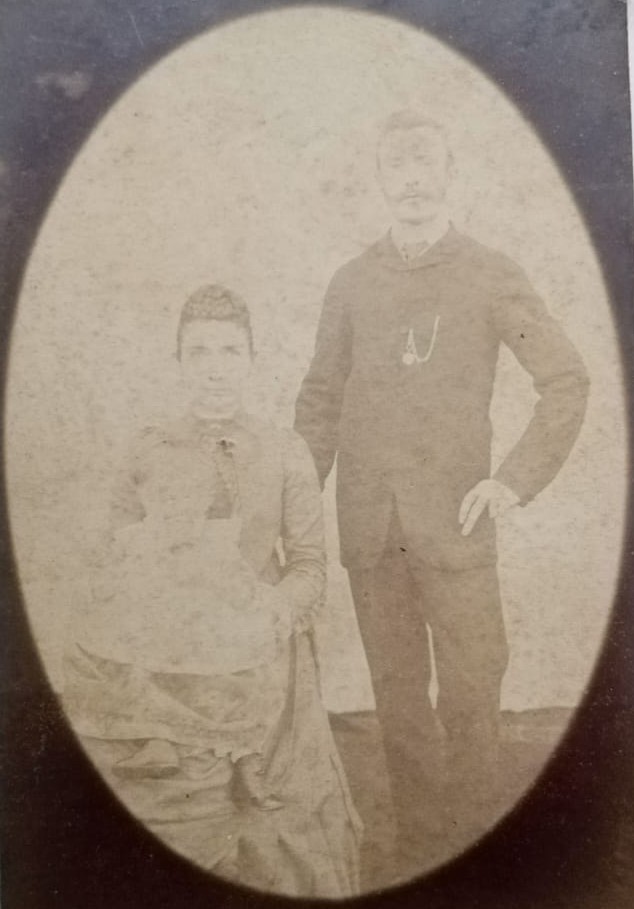 |
|
Mary Ann (Burn) Risley and William
Frederick Risley
photograph courtesy of Robert King
|
Mary Ann Burn on 12 August 1889 in
St John the Baptist, Harrismith, Orange Free State
William Frederick Risley is recorded as a bachelor, aged 31. He is a clerk,
resident in Harrismith. Mary Ann Burn is recorded as a spinster, aged 23,
resident in Addington, Durban. The marriage was performed by G. E.
Scratchley and witnessed by Richard Knight Lucas and Harry White.
Mary Ann was born in 1866, in Newcastle upon Tyne, Northumberland, England
and baptised on 18 April 1866 in Newcastle upon Tyne, the daughter of John
Gray Burn and Barbara Maria Sibbet. In 1881 her occupation is recorded as
dressmaker. Mary Ann died on 1 November 1950 in Harrismith Hospital,
Harrismith, Orange Free State, aged 84. The cause of death is listed as peritonitis / heart
failure of duration a few days and diverticulitis,
old age of duration 1 week. She was buried in Harrismith cemetery.
Will: dated 4 November 1948
Orange
Free State Estate Files 1950 #1253 film 004087975 image 990
LAST WILL AND TESTAMENT
I, the undersigned, MARY ANN RISLEY (born Burn), Widow, of Vowe
Street, Harrismith, desiring to make my Last Will and Testament, hereby
revoke all wills, codicils or other testamentary acts heretofore made by
me, and declare this to be my last Will and Testament :-
1.
I bequeath the whole of my estate and effects, nothing excepted, to
my daughter ESME LOUISA RISLEY.
2.
I also nominate and appoint my said daughter, ESME LOUISA RISLEY as
Executrix of my Will and Administratrix of my Estate and I hereby
stipulate that the Master of the Supreme Court shall not require her to
provide any security for the due fulfilment of her duties.
3.
Lastly, I reserve to myself the right to make all such alterations
in, or additions to this my Will as I may deem fit, either at the foot
hereof or by a separate act, desiring all such alterations and additions
so made under my signature, to be considered part hereof.
SIGNED at HARRISMITH, this 4th day of NOVEMBER 1948.
(Sgd.) M.A. Risley
As Witnesses :-
1. (Sgd.) Beno Sammel
2. (Sgd.) M. van Reenan
Census & Addresses:
1871:
Tynemouth, Northumberland
1881:
Alexandra Place, Newcastle upon Tyne St Andrew, Northumberland
1950: 64 Vowe Street, Harrismith, Orange Free State (Orange
Free State Estate Files 1950 #1253 film 004087975 image 989)
Clerk. When still a young man,
William entered the service of Messrs. Parker, Wood and Co., and was
associated with that firm for 18 years, the last few years being as manager
of the Harrismith branch. In the early 1900's, William moved to the firm of
Randles, Bro. & Hudson, general merchants at Market Square, Harrismith
where he managed the large branch.
The
Orange River Colony p132 (Macmillan & Ferguson, 1905)
RANDLES, BRO. & HUDSON,
General Merchants, Market Square.
THE proximity
of Harrismith to Natal has long made it an important centre for the
establishment of depôts of some of the principal mercantile houses of
that Colony. Occupying a leading position among these is the extensive
branch of Messrs. Randles, Bro. & Hudson, (the great Durban firm of
general merchants,) which has very materially helped to sustain the
commercial activity of Harrismith during the last thirty years. The
firm's premises cover an area of two erven, and the stocks retained
therein are so numerous, that it is impossible, within the space at our
disposal, to give even the briefest description of any of them; so that
we can only refer in general terms to the products of science, art and
invention which they embody. It would be difficult to mention any
section of trade in which Messrs Randles, Bro. & Hudson do not
engage; and their goods represent the highest productions of almost
every department of industry and commerce. From many sources have the
wares come, from the many chimneyed cities of Europe and
America—clothing and groceries, drapery and domestic utensils, boots and
oilmen's stores, crockery, furniture, ironmongery, fancy goods, timber,
agricultural implements—in short, practically anything and everything
that the heart of man can desire or the mind of woman conceive for
creature comfort, for the adornment of the home or the person, or for
the cultivation of the land. The establishment thus affords many object
lessons in the ramifications of modern commerce and the multifarious
requirements of civilised life that cannot fail to be deeply interesting
and instructive. But it is needless to say, those who visit it—and they
are many—do not so for mere sight seeing and amusement; for it holds out
more powerful attractions—the attractions of low prices and high
qualities, compared with which all other aspects of the stock are a
negligeable quantity. Importing their goods direct from the
manufacturers in enormous shipments in order to meet the demands of
their numerous branches in Natal and the Transvaal, Messrs Randles, Bro.
& Hudson are able to sell at prices that are often the despair of
smaller firms. Besides the long and honourable record of the house in
question forms one of the most notable examples of South African
commercial achievement; so that it is not surprising to find that the
people of the Harrismith district accord to the local establishment such
a large and well deserved patronage. Its management was taken over a
short time ago by Mr. W. F. Risley, who for eighteen years was engaged
in a similar capacity with another large firm in town. Under this
gentlemans' skilful and enterprising administration it is no
exaggeration to say that a marked improvement has already been evinced
throughout its numerous departments, and the spirit of thorough courtesy
and competency is all prevalent. Where such a condition of affairs
exists, it may be taken for granted that there will be, as in the case
before us, a full accomplishment of those high commercial aims which
invariably spell prosperity, and which have secured for Messrs. Randles,
Bro. & Hudson a position among their contemporaries none the less
enviable because it is the consummation of earnest hope and
long-continued endeavour.
William was a twin brother to Frederick William Risley.
William emigrated to Natal aboard
the Natal Star, arriving in
Durban on 1 February 1867. He is recorded as aged 8, and surety was
stood by his father, William Risley, who had emigrated earlier, and his
uncle, Joseph Risley, both of Pietermaritzburg. Accompanying William on the
Natal Star were his mother, Emily,
and siblings Emily, Arthur, Alice, Fred H., John E., Clara and Joseph.
In 1873, William was a member of the St Peters choir in Pietermaritzburg.
11 August 1935, at Harrismith
Hospital, Harrismith, Orange Free State, South Africa, aged 77
The cause of death is listed as (a) influenza (b) pneumonia (c) heart
failure, of duration 1 week
Harrismith, Orange Free State, South
Africa
Harrismith Chronicle Saturday 17 August 1935:
OBITUARY
WILLIAM FREDERICK RISLEY
We regret to record the death of Mr.
William Frederick Risley, who died at the local Hospital on Saturday
after a long and painful sickbed.
Mr. Risley, who was born at Uxbridge in
England, in April, 1958, was one of twins, his brother being named
Frederick William.
He lived in England until he was seven
years old, and then came out to South Africa with his parents in the
"Natal Star", an old sailing vessel, arriving here in February, 1867,
after a voyage which was notable for its many vicissitudes. Their
arrival at Durban coincided with the opening of the first lighthouse at
the Bluff, and the town as a result was "en Fete". After staying in
Durban for a couple of years they moved to Maritzburg, and Mr. Risley's
brother related how one the most interesting sights of those days was
the strings of ox wagons coming down to the coast from the interior.
They often attained a length of 40 miles, and were packed closely from
the Maritzburg Market Square to "World's View", where the new
broadcasting station is now situated.
When still a young man, Mr.
Risley entered the service of Messrs. Parker, Wood and Co., and was
associated with that firm for 45 years, the last few years being as
manager of the local branch.
With his twin brother and Mr.
George Law, Mr. Risley was a foundation pupil of Hilton College at
Maritzburg, the three of them enrolling the first morning the school
opened.
In Harrismith Mr. Risley was
known to everyone of the older citizens, and during his long stay here,
his quiet, unassuming and honest nature, endeared him to a very large
circle of friends, all of whom will mourn his death. He was a Christian
in the very best sense of the word, and one whose life can be taken as a
model by the younger people of Harrismith.
dated 13 May 1906
Orange
Free State Estate Files 1935 #26995 film 004047221 images 530-1
BE IT HEREBY MADE KNOWN
THAT on this the Thirteenth day of May Nineteen Hundred and Six
appeared before us undersigned witnesses WILLIAM FREDERICK RISLEY of
Harrismith, Orange River Colony, Merchant, and MARY ANN RISLEY born Burn
his wife.
AND these Appearers, being in health of body, of sound disposing
mind, memory and understanding and capable of any act that required
thought judgment or reflection, declared their intention to make and
execute their last will and testament wherefore, hereby revoking and
annulling all wills, codicils and other testamentary acts heretofore
passed by them or either of them.
THE Appearers declared to nominate and appoint the survivor of them
to be the sole and universal heir of the first dying, all of his or her
estate, goods, effects, stock, inheritances, chattels, credits, and things
whatsoever and wheresoever the same may be, nothing excepted, which shall
be left at the death of the first dying of them, whether movable or
immovable, and whether the same be in possession, reversion, remainder or
expectancy.
THE Appearers declared to nominate and appoint the survivor of them
to be the Executor or Executrix of this their will, Administrator or
Administratrix of their estate and effects and guardians of their minor
children, hereby giving and granting unto each other reciprocally all such
powers as are required or allowed in law, and especially those of
assumption, substitution and surrogation.
THE Appearers declared to reserve to themselves jointly during
their joint lives, the power from time to time, and at all times hereafter
to make all such alterations in or additions to this will as they shall
think fit, either by a separate act or at the foot hereof, desiring that
all such alterations or additions so made, under their own signature,
shall be held as valid and effectual as if they had been inserted herein.
ALL which having been clearly and distinctly read over to the
Appearers, they declared that they fully understood the same and that it
contains their last will and testament, desiring that it may have effect
as such or as a codicil or otherwise in such manner as may be found to
consist with law.
THIS DONE and PASSED at Harrismith, Orange River Colony the day
month and year aforesaid in the presence of the subscribed witnesses.
Sgd.W.F.RISLEY
Sgd.M.A.RISLEY born Burn
SIGNED by both the said William Frederick Risley and Mary Ann
Risley (born Burn) in the presence of us both present at the same time who
at their request in the presence of both of them and in the presence of
each other have hereunto subscribed our names as attesting witnesses
Sgd.ALFRED E.MANN
Sgd.T.B.BREMER
1861: Blyth (West Side), Blyth,
Nottinghamshire
1909: Harrismith, Orange River Colony (Pietermaritzburg
Estate Files vol 37 #61 film 007866875 image 438)
1935: 60 Vowe Street, Harrismith, Orange Free State (Orange
Free State Estate Files 1935 #26995 film 004047221 image 529)
William Frederick Ward Risley
13 October 1896, in Harrismith,
Orange Free State
15 November 1896, in Harrismith,
Orange Free State
William Frederick Ward was baptised the son of William Frederick and Mary
Ann Risley. William is recorded as a clerk, of Harrismith. The sponsors of
the baptism were Thomas Frederick Andrews, William Frederick Risley and Mary
Ann Risley.
William
Frederick Risley
Mary Ann (Burns) Risley
Bank clerk
12 November 1924, at the General
Hospital, Pretoria, Transvaal, South Africa, aged 28
The cause of death is listed as a fractured skull - homicidal.
Harrismith, Orange Free State, South
Africa
1924: Queen Street, Pretoria, Transvaal
Winifred Alice (Risley) Hamilton
14 November 1890, in Harrismith,
Orange Free State
7 December 1890, in Harrismith,
Orange Free State
Winifred Alice was baptised the daughter of William Frederick and Mary Ann
Risley. William is recorded as a clerk, of Harrismith.
William
Frederick Risley
Mary Ann (Burns) Risley
John Matthew Hamilton on 23
September 1920 in St John the Baptist, Harrismith, Orange Free State, South
Africa
John Matthew Hamilton is recorded as a bachelor, aged 47. He is a farmer,
resident at Cedarmont, Standerton, Transvaal. Winifred Alice Risley is
recorded as a spinster, aged 29. She is a school teacher, resident in
Harrismith, O. F. S. The marriage was performed by William Austin, and
witnessed by William Frederick Risley and William Frederick Ward Risley.
John was born on 9 December 1872, in Carnwath, Lanarkshire, Scotland, the
daughter of Matthew Hamilton and Janet White. He was a farmer on the farm
"Garngour", in Standerton district in the Transvaal. John died on 15 July
1945, at Berea Nursing Home, Durban, Natal, South Africa, aged 72. The cause
of death is listed as arteriosclerosis
- asthenia, of
duration two weeks. He was buried at Harrismith cemetery, Harrismith, Orange
Free State, South Africa.
Will: dated 12 February 1943
Pietermaritzburg
Estate Files 1945 #1421 film 007869133 images 1940-7
LAST WILL AND TESTAMENT
THIS IS the Last Will and Testament of JOHN MATTHEW HAMILTON,
presently of Cedarmont, Standerton District.
1. I hereby revoke, cancel and annul all previous Wills, Codicils or
other testamentary writings heretofore made or executed by me, and declare
this to be my Last Will and Testament.
2. I hereby bequeath the sum of £500:0:0 (FIVE HUNDRED POUNDS) to my
sister-in-law, ESME RISLEY, presently of Harrismith, Orange Free State.
3. I hereby bequeath the sum of, £100:0:0 (ONE HUNDRED POUNDS) to
the STANDERTON HOSPITAL to endow a bed to be known as the JOHN MATTHEW
HAMILTON bed.
4. I bequeath the rest and residue of my Estate and Effects, movable
and immovable and wheresoever situate and whether in possession,
reversion, expectancy or contingency to my Administrators and Trustees
hereinafter named, with authority to them to receive such rest and residue
and to invest it
(a) On First Mortgage of immovable property situate in the Union of South
Africa; provided that my Administrators and Trustees may invest in a
mortgage other than a first mortgage upon any such immovable
property if they are registered in any Deeds Office or the Rands Townships
Office as the holders of all existing bonds over any such property; and/or
(b) In Government or Municipal Stock; and/or
(c) On Fixed Deposit in any of the Banks doing business in the Union of
South Africa; and/or
(d) In the Shares of such public companies as my Administrators and
Trustees in their discretion may deem desirable;
(e) any other class of investment which my Administrators and Trustees in
their discretion may deem fit;
with the power of changing from one form of investment to another, and oyt
of the income therefrom to pay to my wife, WINIFRED ALICE HAMILTON (born
Risley), the sum of £50:0:0 (FIFTY POUNDS) per month during her lifetime,
and to pay the rest of such income in equal shares to my children,
MARY JANE HAMILTON
GAVIN HAMILTON, and
ELIZABETH WHYTE HAMILTON,
or to their respective descendants by representation per stirpes, during
the lifetime of my aforesaid wife.
In the event of disagreement between the said Administrators and
Trustees as to any investments, the dispute between them to be settled by
Arbitration.
In the event of the aforesaid income not amounting to the sum of
£50:0:0 (FIFTY POUNDS) per month, then my Administrators and Trustees
shall have the right to make up from the rest and residue of my Estate,
such income to an amount of £50:0:0 (FIFTY POUNDS) per month.
5. On the death of my aforesaid wife, WINIFRED ALICE HAMILTON (born
Risley), the rest and residue of my Estate and Effects, movable and
immovable and wheresoever situate and whether in possession, reversion,
expectancy or contingency, shall be divided equally amongst my children,
MARY JANE HAMILTON
GAVIN HAMILTON
ELIZABETH WHYTE HAMILTON
or their respective descendants by representation per stirpes, provided
that the share of such rest and residue due to any child shall not be paid
over to him or her until he or she shall respectively attain the age of 30
years, and until my children respectively do attain the age of 30 years
his or her portion shall be held in trust in manner heretofore provided,
and he or she shall receive the income only on such share of the Capital
as may be due to him or her; provided further that my Administrators and
Trustees shall in their absolute discretion be entitled to pay to any or
each of my aforesaid children at any time a sum of money not exceeding
£5,000 (FIVE THOUSAND POUNDS) as a portion of the share of his or her
inheritance, conditionally that such payment does not minimise the payment
of £50:0:0 (FIFTY POUNDS) per month to my aforesaid wife.
The portion of income that accrues for the benefit of my daughter
ELIZABETH WHYTE HAMILTON shall not be paid to the Master of the Supreme
Court but shall be paid to my wife for the maintenance and education of my
daughter, ELIZABETH WHYTE HAMILTON.
6. In the event of any of my aforesaid children predeceasing me and
leaving no descendants, or predeceasing my said wife and having no
descendants then the portion of my Estate which would otherwise have
accrued to such predeceased child or children shall not be deemed to have
vested in such child or children but shall be dealt with in accordance
with the provisions of this my Will and the beneficiaries under this my
Will, subject to the aforesaid monthly payment of £50:0:0 (FIFTY POUNDS)
to my wife, shall be my remaining children or their respective descendants
by representation per stirpes.
7. I direct that no beneficiary of my Estate shall be called upon to
collate any property or any sum of money or any other gift given by me to
him or her for any purpose whatsoever during my lifetime.
8. I hereby nominate, constitute and appoint my wife, WINIFRED ALICE
HAMILTON (born Risley) and JAMES WADDINGTON LANGSTAFFE, Solicitor of
Johannesburg, or the survivor of them to be the Executors of this my Will,
Administrators of my Estate, property and effects, and Trustees upon the
special trust and confidence hereinbefore set forth, hereby giving and
granting to them all such powers and authorities as are required or
allowed in Law, and especially that of Assumption. I direct that my
Executors, Administrators and Trustees in any of these capacities while
both are acting together as such shall be exempt from furnishing any
security whatsoever either to the Master of the Supreme Court or any other
official for the due and faithful administration of my Estate.
9. My Administrators and Trustees shall be paid a Commission of 5%
(Five per centum) on the income of the trust as compensation for their
services and the fact that one of my Administrators and Trustees is an
Attorney, Notary and Conveyancer shall in no way debar him or his firm
from having and receiving the usual charge and costs relating to any legal
work that may be performed by him or his firm.
10. I direct that any bequest accruing to any of my female
beneficiaries (including my aforesaid daughters) shall be such female
beneficiary's sole and absolute property, free from the jus mariti and
from all interference, assistance or control of their respective husbands,
in the event of their marrying. Any such bequest shall not form part of
the estate of any husband of any of the said female beneficiaries or of
the joint estate of any of the said female beneficiaries and their
respective husbands, and in the event of the insolvency of any of the
respective husbands such bequest or any property acquired therewith or
with the income or proceeds thereof shall not form part of such husband's
estate or the joint estate of such husband and any of the said female
beneficiaries.
11. I reserve to myself the right at any time hereafter to make all
such alterations in or additions to this my Will as I shall think fit,
either by a separate act or at the foot hereof, desiring that all such
alterations or additions so made under my signature shall be held as valid
and effectual as if they had been inserted herein.
IN WITNESS WHEREOF I have hereunto set my hand at JOHANNESBURG,
this 12th day of FEBRUARY, in the year of our Lord One Thousand Nine
Hundred and Fortythree in the presence of the subscribing witnesses.
SIGNED and DECLARED by the Testator, the said JOHN MATTHEW HAMILTON
as and for his Last Will and Testament in the presence of us, who in his
presence, and in the presence of each other, all being present at the same
time have hereunto set our hands.
J.M. HAMILTON.
AS WITNESSES:
1. H. MAXWELL.
2. M. MORRAGH.
Census & Addresses:
1881:
Carwath, Lanarkshire, Scotland
1920: "Garngour", Cedarmont Station, Standerton district,
Transvaal (Pietermaritzburg
Estate Files 1945 #1421 film 007869133 image 1961)
1943: Cedarmont, Standerton district, Transvaal (Pietermaritzburg
Estate Files 1945 #1421 film 007869133 image 1940)
1945: 2450 Marine Drive, Brighton Beach, Durban, Natal (Natal
Civil Records Deaths Durban 1945 DGS 007751188 image 2714)
School Teacher
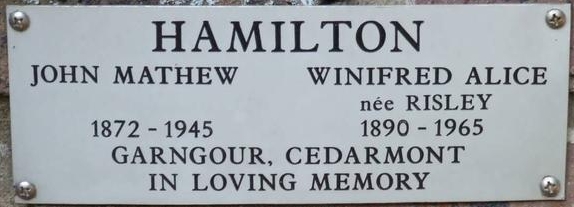 |
|
Memorial plaque to John Matthew Hamilton
and Winifred Alice (Risley) Hamilton
|
29 July 1966, in Durban, Natal, South
Africa, aged 75
The cause of death is listed as carcinoma of the pancreas, of duration 8
months, and intestinal haemorrhage, of duration 8 hours.
A memorial plaque to John and
Winifred is found in the Wall of Remembrance, Church of St Francis of
Assisi, Val, Mpumalanga, South Africa
1920: Harrismith, Orange Free State (Pietermaritzburg
Estate Files 1945 #1421 film 007869133 image 1961)
Return to Chris Gosnell's Home Page
If you have any comments, additions or modifications to the information on this page, please feel free to email me.
Created and maintained by: chris@ocotilloroad.com