The Shaw Family
Abigail Shaw
John Shaw
Thamar
(Lewes) Shaw
Abigail's will was dated 11 February
1689/90 (OS/NS). It is held at the Essex Record Office (Reference: D/ACW
21/54). The will is interesting in that Abigail makes a number of small
bequests ("to buy mourning") to family members, enabling us to solidify
information about the family:
In the name of
God Amen ...I Abigail Shaw of Colchester in the County of Essex Spinster
being of a sickly and weakly constitution of Body, but of a Sound
disposing Mind and memory (Let thanks and praises be given to Almighty
God for the same) And knowing the uncertainty of this life here on earth
and being disposed to settle things in order before my departure hence I
do make constitute ordain and declare this my last will and Testament...
My body I commit to the Earth to be directly buried by my Executors
hereafter named, in such manner as is herein after expressed, in hope of
a joyful Resurrection at the last day and Revoking hereby all former
wills by me at any time heretofore made. Ans as to the the Disposition
of my Estate my God has given me I dispose thereof as followeth And now
touching the method and manner of my funeral My devise and will is that
my body be wrapped up in woollen according to Law and then deposited in
a ?? of not greater value than forty shillings And to be decently
buried (in the day-time) In the Chancell of the Parish Church of the
Holy Trinity in the Towne of Colchester aforesaid As near to my Mother
and other my Relations there interred as reasonable may be. ... Item I
give and bequeath unto My Ever honoured father Sir john Shaw Knight, one
of his Majesty's Serjeant at Law The King's Picture sett in Gold and the
sum of ten pounds of Lawful English money To buy himself mourning. Item
I give and bequeath unto my Brother John Shaw Esquire the sum of five
pounds of lawful English money To buy mourning for himself. And I give
and bequeath the like sum of five pounds unto his wife my sister Mrs
Anne Shaw To buy mourning for herself. And I do also give and bequeath
my side-saddle my furniture unto her my sd sister Mrs Anne Shaw.
Item I give and bequeath unto my Brother Mr Jeremiah Shaw my silver
??box ?? Silver Medal. Item I give and bequeath unto my Brother Mr
Jeremiah Shaw the sum of five pounds of lawful English money to buy
mourning for himself. And I give and bequeath the like sum of five
pounds unto Mrs Anne Shaw my sd Brother Jeremiah's Wife To buy mourning
for herself. And I give ??? unto her my sd Sister Mrs Anne Shaw my white
Ringed Mantle and Redd round Mantle as a remembrance of me. Item I give
and bequeath unto my Brother Mr Joseph Thurston the sum of five pounds
of lawful English money To buy mourning for himself and I give and
bequeath the like sum of five pounds unto his wife my Sister Mrs Mary
Thurston To buy mourning for herself. Item I give and bequeath unto my
Brother Mr Robert Moore the sum of five pounds of lawful English money
To buy himself mourning, And I do give and bequeath the sums of of five
pounds unto his wife my sd Sister Mrs Penelope Moore To buy mourning for
herself. And I do also give unto her my Sister Moore My Booke of
Receipts as a Remembrance of me. Item I give and bequeath unto my Cousin
Gabriel Shaw, son of said Brother Jeremiah Shaw the sum of one hundred
pounds of lawful English money To be paid unto him when he shall attain
his full age of one and twenty years. And I do hereby futher give
bequeath and allow the sum of five pounds a year Towards the Schooling
and Education of him my sd Cousin Gabriel Shaw to commence from the time
of my decease until he the sd Gabriel shall accomplish his sd age of one
and twenty years and not longer. And in case my sd Brother Jeremiah Shaw
shall Educate and bring up his sd sonne Gabriel to ?? and make him a
Scholar So that he be capable of ??? and ??? into the university of
Cambridge. And then and in such case I yet further give and bequeath
unot him my said Cousin Gabriel Shaw the sum of Twenty pounds of like
lawful money of England To buy him Bookes, a Gowne and other necessaries
of the sd university. Item I give and bequeath unto my Cousin Joseph
Thurston the sum of five shillings and Sr Henry Appleton's Gold Rings.
Item I give unto my Cousin Thomas Thurston the sum of five shillings.
Item I give and bequeath unto my Cousin Mary Thurston one pound-worth
Coins and a Shepherdess in a frame and a Wedgewood ??? and a ??- work
baskett. Item I give and bequeath unto my Cousin William Moore the sum
of five shillings. Item I give and bequeath the like sum of five
shillings unto my Cousin John Moore. Item I give and bequeath unto my
God daughter my Cousin Mary Moore one pair of Bugle-Candlesticks with
Silver ?? and a Bugle-Baskett and a Bugle-Sweets-Bagg, as a remembrance
of me. Item I give and bequeath unto my sd Father's Servants Namely ???
John Wright Mary Pargiffer & Ellen Bowley (if they or any of them be
then living with my sd father) the sum of twenty shillings apiece. Item
I give and bequeath unto every one of my sd Brother John Shaw's Menial
Servants respectively that shall be living with him at the time of my
decease one shilling apiece. Item I give and bequeath unto ??? one of my
sd Brother Jeremiah Shaw's Menial Servants respectively that shall be
living with him at the time of my decease one shilling apiece.
... Item I give and bequeath the like sum of Twenty shillings to be
distributed (by my Brother Mr Thomas Shaw Minister of Greenstead within
the liberties of the Towne of Colchester aforesaid) To and amongst such
poor people of the parish as come to his Church to hear Divine Service.
...Item I give and bequeath unto my Cousin Thomas Aylett now an
Apprentice in Colchester The sum of forty shillings of lawful English
money. But my Minde and will is that the sd forty shillings shall be
left in the hands and custody of my Kinswoman Mrs Abigail Brasier In
trust for him the sd Thomas Aylett and at the Expiration of his sd
Apprenticeshipp or such other convenient time as my sd Cousin Brasier
shall think expedient for him. Item I give and bequeath unto my Cousin
John Aylett the sum of Twenty shillings of lawful English money But my
minde and will is that the sd Twenty shillings shall likewise be left in
the hands and custody of my sd Cousin Brasier In trust for him until She
shall think it ?? expedient for him.
Charles Shaw
1 December 1660, in St Leonard,
Colchester, Essex, England
John Shaw
Thamar
(Lewes) Shaw
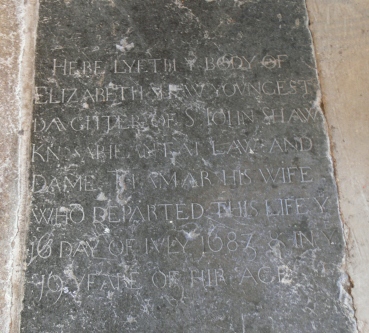
Elizabeth Shaw
 |
|
Memorial to Elizabeth Shaw
in Holy Trinity, Colchester, Essex
photo from Michael Peel
|
1663/4
John Shaw
Thamar
(Lewes) Shaw
16 July 1683
Holy Trinity, Colchester, Essex,
England
The memorial to Elizabeth reads:
Here lyeth y body of
Elizabeth Shaw youngest
daughter of S John Shaw
Kn sarjeant at law and
Dame Thamar his wife
who departed this life y
16 day of July 1683 & in y
19 yeare of hir age
- Age at death from
memorial inscription
- Memorial inscription
- Photograph of memorial
from Michael Peel
- Photograph of memorial
from Michael Peel
Elizabeth (_____) Shaw
Gabriel Shaw
29 December 1749, in St Michael,
Kirby le Soken, Essex, England
A note in the burial register describes Elizth Shaw as "Wife of Gabriel
esq."
-
note in burial register for Elizabeth in Kirby le Soken parish records
transcribed at FreeReg;
mentioned in marriage settlement of daughter Elizabeth at Essex
Archives
Online D/DHt/T111/4
- Kirby le Soken parish
records transcribed at FreeReg
Elizabeth (Shaw) King
Gabriel Shaw
Elizabeth (_____)
Shaw
John
King on 16 December 1725 in Great Holland, Essex, England
Jon. King is recorded as single, resident of Colchester. Elizb. Shaw is
recorded as single, resident in Kirby. It is noted that the marriage was "by
license at Frinton"
Elizabeth's marriage settlement concerned a messuage called "Crispes", in
Frinton.
20 January 1730
Marriage Settlement
GABRIAL SHAW, of Kirby, esq. and Elizabeth his wife
(2) John King, of Thorp, gentleman and Elizabeth his wife. (3) Robert Price,
of Colchester, esq. on marriage of John King and Elizabeth only daughter of
Gabriel Shaw
Messuage called 'Crispes', etc., Frinton
Crisps, variously estimated at 16, 18 and 20 acres, had been held in the
Shaw family since 1710 and was sold by Shaw King in 1798. The day before
this marriage settlement was signed, a lease agreement for the property was
signed by Gabriel Shaw, of Kirby, from Robert Price, of Colchester.
Gabriel Shaw
Jeremy Shaw
Sarah
(Barbar) Shaw
Elizabeth _____
J.P. for Essex.
Gabriel owned the estate
Mereland in Kirby le Soken, Essex, which he inherited from his grandfather,
Sir John Shaw. Gabriel is specifically named in the will of his aunt,
Abigail Shaw, in 1689 and bequeathed the sum of £100 as well as £5 a year
for his education until reaching the age 21 (which means he must have been
under the age of 21 in 1689, and so born after 1667).
Gabriel, born to Jeremiah's first wife, Sarah (Barbar) Shaw, must have been
born before 11 February 1689/90 (OS/NS), which is the date of the will of
Jeremiah's sister, Abigail Shaw, which refers to "Mrs Anne Shaw my Brother
Jeremiah's Wife".
8 April 1751, in St Michael, Kirby
le Soken, Essex, England
A note in the burial register describes him as "Gabriel Shaw Esq. J.P."
Hannah Shaw
26 November 1658, in St Leonard,
Colchester, Essex, England
John Shaw
Thamar
(Lewes) Shaw
Jeremiah Shaw
10 January 1665/6 (OS/NS), in
Colchester St Leonard, Essex, England
John Shaw
Thamar
(Lewes) Shaw
Royal Grammar School of
Colchester. Jeremy was admitted on 9 January 1671/2 (OS/NS).
Sarah
Barbar
Anne (Hamond) Nicholson. Anne
was the daughter of Mr. Hamond of Oxfordshire and widow of John Nicholson
This second marriage must have occurred before 11 February 1689/90 (OS/NS),
which is the date of the will of Jeremiah's sister, Abigail Shaw, which
refers to "Mrs Anne Shaw my Brother Jeremiah's Wife".
J.P. for Essex
Jeremiah was of Kirby le Soken,
Essex. In 1710 he bought the freehold Crisps, in Frinton, Essex, which is
estimated at 16 to 20 acres, from Joseph Thurston, his nephew, a Colchester
woolen-draper..
Jeremy Shaw
Jeremiah
Shaw
Anne (Hamond, Nicholson) Shaw
Jeremy died without children
John Shaw
Mary
Lufkin
Politician
John Shaw, a royalist, was elected mayor of Colchester in 1647, in the first
direct election for the position, but his election was annulled under
pressure from a troop of parliamentarian horse, and the following year,
after the Siege
of Colchester, John, along with Robert Buxton and Thomas Laurence,
were removed as aldermen. In 1660, he was restored to his position as
alderman, while his son, also John Shaw, became recorder.
John Shaw
Sir John Shaw
1616/7
John Shaw
Mary
(Lufkin) Shaw
St
Catharine's College, Cambridge, admitted on 9 January 1667/8 (OS/NS)
Alumni cantabrigienses part 1 vol 4 p52
(John Venn and J. A. Venn, 1927):
SHAWE, JOHN. Matric. pens. from ST
CATHARINE'S, Easter 1639. Of Colchester. S. and h. of John,
of Colchester, gent. Adm. at Lincoln's Inn, Oct.21, 1640. Called to the
Bar, 1647. Recorder of Colchester. M.P. for Colchester, 1659, 1660-79.
Knighted, Sept. 24, 1661. Serjeant-at-law, 1677. King's Serjeant, 1683.
Married Thamar, dau. of Samuel Lewis, of Roydon, Suffolk. Died 1690.
Father of John (1665), Samuel (1667-8) and Thomas (1667-8). (Morant,
I. i. 483; A.B. Beaven.)
Thamar
Lewes in May 1643
Description of the marriage settlement held at Essex
Record
office D/DR T28/2:
Marriage settlement
(i) John Shaw, senior of Colchester, gentleman; (ii) Thomas Talcott of
Colchester, gentleman and William Blomefeild, senior of Little Stoneham,
Suffolk, gent.; (iii) John Shaw, junior of Lincoln's Inn, Middlesex,
gentleman (son and heir of John Shaw, senior) and Thamar Lewes (daughter
and heir of Samuel Lewes late of Raydon, Suffolk), gentleman, deceased.
Farm, lands, tenements and marshes called Goldanger alias Faltie alias
Pawtie (containing 170a.) in occupation of Thomas Huggins and William
Yellopp; messuage and 3 crofts of land called Pryers; salt marsh called
Pryers Marsh alias the Outmarsh (20a.); croft called Edencroft (3a.) in
occupation of John Reade; crofts called Ravens Croft (14a.); salt marsh
called Ravens Marsh with 2 parcels of land (10a.) in occupation of William
Garrard; common pasture for 25 sheep a year in Stockwell marshes and the
salt marshes; messuage in north part of Pitcroft Lane and a croft of land
called Cobbs Croft (2 and a half acres) in occupation of John Carlett with
common pasture for 30 sheep a year in the Common Marsh in Goldhanger;
messuage called Hunts and a croft of land (1 and a half acres) on west of
Hunts in occupation of Margaret Knight widow, all in Goldhanger and Great
and Little Totham. Messuage and crofts of land called Shottesland and 2
meadows (10a.) adjoining in occupation of Thomas Lawrence; field called
Brettland (5a.); parcel of meadow called Bennettes alias Lamberts near
Symines Brome; crofts of land called Green croft and Hobbs Loyte, in
occupation of [blank] Hutt; messuage called Nuges in occupation of Thomas
Huggins; land called Cokes alias Cookes (9a.); tenement and 'Wareland'
called Helders alias Holders (5a.), two parcels of land, one called
Parsonsmoore and the other Holders Meade (2 and a half acres), parcel of
land called Wheat Croft alias Wettfeild (6a.) adjacent to Holders, meadow
at Garnisheade called Bowsers Hope (1a.), meadow called Bridgeleys Mead
alias Bridge Meade (2a.), parcel of land called Bedleys Leigh, all in
occupation of [blank] Hutt, all in Langford and Ulting. Messuage and
garden in occupation of John Shaw, senior in All Saints, Colchester;
messuage and gate called the Burgate in occupation of Robert Gurney,
maltster, 2 tenements in Southgate Street in occupation of Leonard Crispe
and Christopher Barnard, in St. Botolph, Colchester. Messuage and land
(16a.) called Teles, croft of land called Hubbards Croft (2a.) in
occupation of [blank] Coleman in Great Totham. Messuages and lands called
Sturmares alias Sturmures and Paynes in occupation of [blank] Berrisford,
crofts of land called Spice Crabtrees, formerly Wellousland and Under
Houton in occupation of Thomas Barker, all in Witham. Customary tenement
and land (30a.) called Parmes, surrendered by John Shaw, senior, copyhold
of the manor of LittleTotham with Goldhanger.
Property in Goldhanger, Little Totham, Langford and Ulting to the use of
John Shaw junior and, after his death, to Thamar Lewes for life; the
remainder to their heirs or, in default of issue, to the heirs of John
Shaw, senior
Property in All Saints, and St. Botolph, Colchester, and Witham to the use
of John Shaw, junior for life with remainder to heirs of John Shaw, senior
Lawyer and politician.
John was elected M.P. for Colchester in 1659, 1660 and 1661. In 1660 became
Recorder
of Colchester, an important legal position in the borough government. John
was knighted at Whitehall on 24 September 1661 (The Knights of England vol 2 p233 (William
Shaw, 1906)). John is noted to have been a controlling influence in the
Restoration corporation, and a supporter of the established church.
Opposition to his party grew during the 1670s. 'Scandalous' verses against
Shaw and alderman William Moore circulated in 1673, and at the elections of
1676 the opposition, led by the aldermen Ralph Creffield, Nathaniel
Laurence, and Thomas Green, all nonconformist sympathizers, succeeded in
having Shaw removed as recorder. John began legal action against the town,
claiming arrears for wages due to him both as a member of parliament and as
recorder which resulted in Colchester paying him £356 compensation before he
resigned the office of recorder to the Duke of Albemarle on 12 November
1677. John was appointed Serjeant-at-law
on 11 October 1677 (A political index to the histories of Great Britain
and Ireland Vol 1 p437 (1788)) and King's Serjeant on 22
November 1683 (ibid.
p438). Turbulent politics continued in the town with opponents being
accused of being covert dissenters and new rules being introduced that town
officers had to be communicants of the Church of England. In 1688, the Privy
Council stepped in and replaced the mayor and much of the council, including
the recorder who was replaced, in May 1688, by Sir John Shaw.
A political opponent of John's the Rev. E. Hickeringill describes John's
political choices with some venom in the Tanner MSS printed in The history and antiquities of Colchester castle
p122 (1882):
This Proteus was a Councellor before he was a
Captayne against Charles I, then a Committee-man, &c. And in all these
nauseous vicissitudes the chamelion was of the colour that was nearest
him, being sometime for the King, then for the Rump, then for Oliver, then
for Queen Dick then for the Committee of slavery and the keepers of the
liberties of England, and then for the King again at last.
A biography of John focusing on his parliamentary career is found on the The
History of Parliament website and published in The History of Parliament: the House of Commons
1660-1690 (ed. B.D. Henning, 1983):
SHAW, John
(c.1617-90), of Colchester, Essex.
Family
and Education
b. c.1617, 1st s. of John Shaw of Colchester by Mary, da.of Thomas
Lufkyn of Ardleigh, Essex. educ. St. Catharine’s, Camb. 1639; L. Inn
1640, called 1647. m. by 1648, Thamar (d. 13 Jan. 1682), da. and h. of
Samuel Lewis of Roydon, Suff., 4s. (2 d.v.p.) 6da. suc. fa. 1661; kntd.
24 Sept. 1661.
Offices Held
Commr. for new model ordinance, Essex 1645, assessment, Essex 1645-9,
1657, Jan. 1660-80, 1689, Colchester 1663-80, 1689-90, Suff. 1677-9;
recorder, Colchester 1655, 1658-77, May-Sept. 1688, commr. for militia,
Essex 1659, Mar. 1660, j.p. Mar. 1660-d., commr. for corporations
1662-3; conservator, Bedford level 1665-70, 1675-6; commr. for
recusants, Essex 1675.
Serjeant-at-law 1677, King’s serjeant 1685-9.
Biography
Shaw’s father, a royalist sympathizer, was removed from the Colchester
corporation after the siege in the second Civil War. But Shaw himself
served on the county committee from 1645 till the execution of Charles
I. As recorder in 1655, however, he was described as ‘the chief of the
malignant interest in this place’, and was also displaced. Nevertheless,
he sat for Colchester in Richard Cromwell’s Parliament.
Shaw was re-elected in 1660, and became a moderately active Member of
the Convention. He spoke on four occasions and was appointed to 21
committees, taking the chair in three. On 8 June he acted as teller
against limiting the number of exceptions to the indemnity bill to
twenty. He was ordered to take special care of the bill for settling a
minister in Harwich. As chairman of the committee on the bills to
regulate woollen manufactures, he proposed a proclamation against the
export of wool and fullers’ earth. He spoke in favour of amending the
bill for local commissioners of accounts, and on 15 Aug. reported from
the committee to confirm the authority of the Dutch Bay Hall in
Colchester. After the recess he read a letter from the mayor complaining
of the confiscation of several wagonloads of cloth for non-payment of
alnage, which the House referred to the Privy Council. On 23 Nov. he was
appointed to the committee to draw up the excise clauses for the bill
abolishing the court of wards, and on the following day he reported the
bill to prevent the export of wool. Although he was added to the
committee to bring in the bill for modified episcopacy, he acted as
teller against it. Shortly before the dissolution, he spoke in favour of
Admiral Lawson’s claim to the pension granted to him by the Rump.
Shaw was again moderately active as representative of Colchester in the
Cavalier Parliament. He was certainly appointed to fourteen committees
before the autumn recess in 1661, including those for the uniformity
bill and for the bill to prevent danger from schismatics, and probably
to most of the 150 committees to which ‘Sir John Shaw’ was named after
his knighthood in September, such as the committees on the bills for
executing those under attainder and for settling the militia. He
probably helped to consider a proviso to the schismatics bill in 1662,
served on the committees for the corporations bill in 1663, for the
conventicles bills in 1663-4, and to inquire into their defects in 1670.
His only recorded speech On 31 oct. 1673 was a protest against the
conduct of soldiers in Colchester during the third Dutch war, and he was
doubtless appointed to the committees to prepare an address against a
standing army, to consider a bill to prevent illegal exactions, and one
for better assurance of ancient fines and recoveries. He received the
government whip and was listed (in anticipation) among the officials in
1675. Sir Richard Wiseman advised that the King should ‘be pleased to
see Sir John Shaw’s business done out of hand, [or] I shall lose my
credit with him’. He was made a serjeant in the following year, but
hopes that he would develop into a government speaker were not
fulfilled. He was by now at odds with the corporation over their failure
to suppress conventicles, while they held him responsible for unfair
land-tax assessments. An attempt in 1676 to dismiss him as recorder
failed, but it presumably prompted him to follow the example of Thomas
King and sue the corporation for £238 6s. as wages for sixteen years’
parliamentary service. Meanwhile on 3 Mar. 1677 his colleague Sir
Harbottle Grimston moved to bring in a bill to invalidate such claims,
with particular reference to Colchester. It was said that to free
constituencies from this liability would be a greater encouragement to
them to pay the land-tax. Grimston was warmly thanked for his efforts,
but the bill did not proceed to a second reading. In November 1677 he
resigned his recordership to the Duke of Albemarle (Christopher Monck)
and accepted £356 13s. in payment for his arrears both as recorder and
M.P. He was marked ‘thrice vile’ by Shaftesbury, and in 1678 was
included in both lists of court supporters.
Shaw continued to be active against dissenters. In 1684 he complained to
Albemarle of lack of cooperation by the municipal authorities in
prosecuting conventicles, which were ‘as frequent and numerous as ever’.
About the same time he was mentioned as a prospective candidate for
Essex, which the Whigs believed ‘would do no good at all’. As a j.p. he
assented to all three questions on the repeal of the Test Act and Penal
Laws, and James II’s agents reported in 1688 that he was the choice of
both Colchester and Maldon. His four months’ spell as recorder in 1688
ended when he was replaced under the new charter, and he is not known to
have stood for Parliament again. He was described at one time as ‘one of
the greatest killcows [bullies] at drinking in the nation’. He died in
1690, aged 73, according to his gravestone in Trinity Church,
Colchester. No other member of his family entered Parliament.
Ref Volumes: 1660-1690
Authors: M. W. Helms / Gillian Hampson
|
|
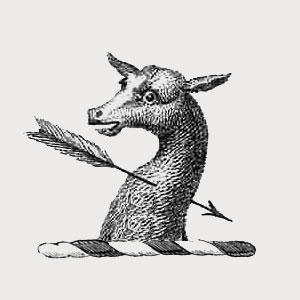
Crest of Sir John Shaw, of Colchester
|
Arms: Or, a chevron wavy between 3
eagles displayed sable; on an escutcheon of pretence
Crest: A hind's head proper,
transfixed by an arrow gules barbed argent.
1690, aged 73
The chancel at Holy Trinity Church,
Colchester, Essex, England
The history and description of Colchester Vol 2
p24 (1803):
On grave stones in
the chancel.
M. S. Johannes Shaw Miles pro Rege Serviens ad legem, villae Colcestriae a
Memoria, Ubi ut communi Utilitati et Paci publicæ serviatur, curavit nemo
inter successores felicius, Dum publicis Regni Comitiis agens (quo officia
diu est sunctus) Regis & Regni Com'odum indivisum habuit. Tandem,
valedicto prius mundo, cum ætatem hominis pertransissit animam Deo, unde
venit, tradidit. Quicquid erat mortale sub hoc marmore deponitur. Fide
Christiana reviviscere immortale et æternum. Anno ætatis 73, et salutis
1690.
"Miles" in this epitaph translates
as Knight.
The next two gravestones listed in The history and description of Colchester
provide some difficulty reconciling with the first one of John Shaw above.
They read:
2. Here lyeth the body of the lady Thamar Shaw,
wife to sir John Shaw knight, serjeant at law, who died Jan. 13, Anno Dmi
1681.
3 Here lyeth the body of sir John Shaw knight, serjernt at law, who dyed
Jan. 13, Anno Domi 1681.
Philip Morant in The history and antiquities of the
most ancient town and borough of Colchester (1748) reprinted
by
J. Fenno in 1789 p143 attempts to solve this conundrum by concoting a
second Sir John Shaw, also a knight and also a serjeant-at-law, and
inserting him as the son on the first Sir John Shaw and the father of John
Shaw Esq. who married Anne Broom, and having him born in 1648 and dying in
1681. Morant's explanation does not work not just because it is extremely
unlikely that the young son got the same awards as his father, but also we
know that John Shaw Esq. married Anne Broom in 1677 aged about 28 (London marriage licenses 1521-1869 p1212),
so born 1648/9, and Sir John Shaw married Thamar Lewis in 1643. Clearly John
Shaw Esq. is directly the son of the first (and actually only) Sir John
Shaw, serjeant-at-law, and Morant's extra generation is incorrect.
My attempt to explain these two gravestones, is that the first obviously
refers to Thamar Lewis who married Sir John Shaw, and that she
died on 13 January 1681. i.e. the implied parenthesis should read "Here
lyeth the body of the lady Thamar Shaw, (wife to sir John Shaw knight,
serjeant at law), who died Jan. 13, Anno Dmi 1681." rather than "Here lyeth
the body of the lady Thamar Shaw, (wife to sir John Shaw knight, serjeant at
law, who died Jan. 13, Anno Dmi 1681.").
The next gravestone is much more troublesome, and I believe that it is
simply an error, either in the inscription or in the transcription of the
inscription (I have not had the opportunity to examine the stones myself).
Quite possibly there is a John Shaw buried there, perhaps Sir John's father,
and the information on Thamar's stone was inadvertently copied. It's not a
great explanation, I know, and I am very willing to listen to a better one.
We know that Sir John Shaw, serjeant-at-law, lived on past 1681 - in 1683 he
was promoted to King's Serjeant, and in 1688 he was re-elected as recorder
of Colchester.
John lived on an estate known as Shaw's, on which the manor house Hollytrees
was later built. He also owned the estate Mereland in Kirby le Soken, Essex.
Colchester worthies. a biographical index of
Colchester p47 (Benham, Charles E.)
SHAWE, SIR JOHN. A prominent royalist during Cromwell's Government. Lived
in the parish of All Saints. He was brought up to the law, and at
the Restoration was made Recorder of Colchester, a post which he resigned
Nov. 12, 1677. He was three times M.P. for the town, and died 1690, aged
73. Buried in Trinity Church.
The life of the right honourable Francis North, Baron
of Guilford p88 (Roger North, 1819):
But once in the circuit, being invited with the rest of the counsel, to
dine at Colchester with the recorder Sir John Shaw, who was well known to
be one of the greatest kill-cows at drinking in the nation; he with the
rest of his brethren, by methods too well known, got very drunk.
John Shaw
1648
John Shaw
Thamar
(Lewes) Shaw
Jesus
College, Cambridge, admitted on 9 January 1667/8 (OS/NS)
Alumni cantabrigienses part 1 vol 4 p52
(John Venn and J. A. Venn, 1927):
SHAW, JOHN. Adm. Fell.-Com at JESUS,
June 6, 1665. Of Colchester. S. and h. of Sir John (1639), Knt.B. 1648.
Matric. 1665. Married three wives. Died Jan 13, 1681. Brother of Samuel
(1667-8) and Thomas (1667-8). (Morant,
I. i. 118, 183)
(Note: Fell-Com stands for Fellow Commoner, the first of three ranks in
which students were matriculated, above pensioners and sizars. They paid
double the tuition and enjoyed more privileges than pensioners, such as
commoning with Fellows)
Anne Brome in 1677 at St
Magnus-the-Martyr with St Margaret, New Fish Street, London, England
(marriage settlement date 10-11 August 1677, license issued 27 August 1677).
London marriage licenses 1521-1869 p1212
Shaw,
John, of Colchester, Essex, esq., bachelor, about 28, and Mrs. Anne
Brome, of Tuppenden, Kent, spinster, about 16, her parents dead, consent
of her guardian—at St Magnus-the-Martyr, or St. Margaret, New Fish
Street, London. 27 Aug. 1677. V.
(Note: "V." indicates Registry of the Vicar-General of Canterbury)
Anne was born about 1660/1, the daughter of Thomas Brome, serjeant at law,
and Margaret. Thomas was resident at Tubbendens, situated about a mile
northeast of Farnborough, Kent.
Description of the marriage settlement held at Essex
Record
office D/DR T28/3 dated 10-11 August 1677:
Marriage settlement
(i) Sir John Shaw of Colchester, knight., wife Thamar, and John Shaw, esq.
(son and heir of Sir John Shaw); to (ii) Elizabeth Broome of Tuppendent,
Kent, widow and Joseph Hull of Lincoln's Inn, Middlesex, esquire; (iii)
Anne Broome (second daughter of Thomas Broome, late Sergeant at Law,
deceased.)
Farm called Shrubb Farm with lands called Lakings alias Shawes in Lexden;
farm in occupation of [blank] Taller and wood (10a.) in occupation of Sir
John Shaw in Alresford; messuage and land and marsh ground (12a.) in
occupation or [blank] Harris, in West Mersea and Peldon; messuage and land
(16a.) called Teles and Hubbert Croft. in occupation of [blank] Deadman in
Great Totham; 2 messuages and lands in occupation of [blank] Baxter,
[blank] Hull and [blank] Pledger in Witham; inn called the 'Angell' in
occupation of [blank] Boykett in Ipswich, Suffolk; messuage and lands in
occupation of Sir John Shaw in Colchester; 2 woods called Fowlers Wood and
Neither Wood in occupation of Sir John Shaw in Stanway; farm in occupation
of [blank] Harbart, farm and lands in occupation of [blank] Hutcheson
called Vantie alias Faltie; Ravenscrofts, Raven Marshes, Pipers and Pipers
Marsh, 2 farms in occupation of [blank] Francis, all in Goldhanger; farm
in occupation of [blank] Rand, Tan House in occupation of [blank]
Richmond, both in Langford; freehold messuage and the 'Oade House' in
occupation of [blank] Love in Creeting St.Mary, Suffolk.
£1,500 paid to Sir John Shaw and his son John as marriage portion of Anne
Broome.
Recites intended marriage of John Shaw and Anne Broome.
Property in Lexden, farm in occupation of [blank] Taller and wood in
Alresford, property in West Mersea and Peldon, Great Totham,Witham and
Ipswich, to the use of John Shaw during his life and, after his death, to
Anne Broome; the remainder to their heirs. The other property (except the
woods in Stanway) to the use of Dame Thamar Shaw for life; the remainder
to John Shaw and his heirs or, in default of such issue, to heirs of Sir
John Shaw The woods in Stanway to the use of John Shaw and, after his
death, to Elizabeth Broome and Joseph Hull for 100 years
- John Shaw (1680 - 1715)
- Anne Shaw
- Thomas Shaw (1682 - ? ). Died before 8 October 1715 (SEAX D/DR T28/8).
Penelope (Derham) Keble
Penelope was baptised on 4 September 1650, the daughter of Sir Thomas
Derham, Bart. and Elizabeth Gargrave. She married, firstly, Thomas Keble,
of Newton Hall, on 5 June 1677 in West Dereham, Norfolk. She was buried in
Holy Trinity, Colchester on 4 July 1699.
Jane (Alden) Lessingham in
1703 (marriage settlement dated 8-9 June 1703)
Description of the marriage settlement held at Essex
Record
office D/DR T28/4 dated 8-9 June 1703:
Marriage Settlement (Lease and Release)
(i) John Shaw of Colchester, esquire; (ii) Jane Lessingham of London,
widow; to (iii) Richard Backwell of London, gentleman and Allen Banckes,
citizen of London, leather seller
Mansion house and land (containing 5a.) nearby, both in All Saints,
Colchester; parcel of meadow (2a.) in St. James, Colchester, all belonging
to John Shaw.; moiety of messuage and farm called Layer House and land
(160a.) formerly in occupation of Philip Richmond, now of John Ballee in
Peldon and Abberton; parcels of land (14a.) and parcels of meadow (7a.) in
occupationof Roger Winke in Creeting St.Mary and Creeting St. Olaves,
Suffolk; messuage in occupation of [blank] Digby, copyhold of manor of
Peet Hall in Peldon and West Mersea
Recites intended marriage of John Shaw and Jane Lessingham.
Property to use of John Shaw for 99 years or life and to Richard Backwell
and Allen Banckes in trust; after death of John Shaw, to Jane Lessingham
and, after her death, to their heirs. Copyhold property to be surrendered
by John Shaw to the use of himself during his life and, after his death,
to Jane Lessingham and then to their heirs.
Jane died in 1716 (her will was dated 5 April 1716, and was proved 11 August
1716). The will mentions "John.Alden, brother to Jane S., lately decd" and
we know that Jane Lessingham is described as a widow when she married John
Shaw, so I deduce that Jane was originally an Alden, and her first husband
was a Lessingham.
Description of Jane's will held at Essex
Record
office D/DR T28/10 dated 5 April 1716:
[Proved: 11 Aug.1716] Devises to Allen Banks (nephew to Jane S.) and,
after his death, to Jane Banks (daughter of Allen B.and goddaughter of
Jane S.)
Messuage in occ.of Geo.Mussells, merchant, in Ayloffe Street, Goodmans
Fields (co.Middx.)
Devises to John Turner (kinsman and exec.to Jane S.) in trust for sale
Lands and tenements in Essex and Suffolk, recently purchased by Jane S.;
copyhold lands and tenements in Essex and Suffolk; messuage (where Jane S.
then lives) in Devonshire St., St.Andrew, Holborn (co.Middx)
Bequeaths to Jane Newman (kinsman to Jane S.) and after her death,to John
Turner (brother of Jane N.)
2 pews in St.George's Chapel in St.Andrew, Holborn
Bequeaths to Jane Turner (dau.of Tho.Turner,kinsman to Jane S.)and to Jane
(dau.of Sarah, the daughter of John.Alden, brother to Jane S., lately
decd.)
£100 each out of the estate, to be paid to each upon reaching the age of
21 or upon marriage; the interest to be paid to them until then.
Devises to Mary Stockwell (kinswoman to Jane S.) and after her death to
Edm.and Jas.Stockwell (brothers to Mary S.)
Annuity of £10
Bequeaths £10 each to the 2 sons of Eliz.Curtis (cousin to Jane S.) £10
each to [blank] (dau. of `Cousin Laughton' by her 2nd husband) and Barnaby
Backwell (godson to Jane S.), 5 to Mary Stockwell. £20 to Jerem.Daniel
(cousin to Jane S.) of Colchester, linendraper
Minor bequests to niece Alice (w.of Allen Banks) and to jane Banks.
John was originally of Colchester,
but later moved to St Andrew, Holborn, Middlesex. D/DR
T28/5, dated 25 April 1705, refers to him as "John Shaw, senior of
St.Andrew, Holborn (co.Middx.), esquire" and D/DR
T28/6, dated 10 June 1709, refers
to him as "John S. late of Colchester and then of St.Andrew, Holborn,
deceased". D/DR
T28/9, dated 1 December 1715,
refers to "Jane Shaw of London, widow" and her will states her residence to
be "Devonshire St., St.Andrew, Holborn (co.Middx)"
April 1708
5 April 1708, in Holy Trinity,
Colchester, Essex, England
dated 18 August 1706
Mary (Shaw) Thurston
1645/6
John Shaw
Thamar
(Lewes) Shaw
Joseph
Thurston
- Joseph Thurston ( ? - 1714)
- Thomas Thurston
- Mary Thurston
27 June 1720, aged 74
The chancel at Holy Trinity Church,
Colchester, Essex, England
The
history and description of Colchester vol 2 p25 (1803):
On grave stones in
the chancel.
1. M. S. Johannes Shaw Miles
...
7. Mrs. Mary Thurston, wife of Joseph Thurston, and daughter of sir john
Shaw. "She lived 30 years a widow, was a very tender and affectionate
mother of her children, and of exemplary piety, virtue, and charity in her
life and conversation." She died June 27, 1720, aged 74.
8. Joseph Thurston, son of Edmund and Aquila, died June 22, 1690, aged 54.
left issue surviving, Joseph, Thomas, and Mary.
dated 11 November 1714, with
three codicils. Proved 9 July 1720.
Fragmenta Genealogica vol 8 p39 (Frederick
A. Crisp, 1902):
"I MARY
THURSTON the elder of Colchester in the County of Essex, widow." To be
buried in the parish Church of Holy Trinity in Colchester near to my
late husband Mr Joseph Thurston. Unto my daughter Mary, the wife of John
Essington, esquire, £200. To every one of my grand-children £200, i.e. Mary and Ann Thurston, Joseph
and Thomas Thurston, at age of 18. My daughter-in-law Mrs Mary Thurston,
widow and relict of my late son Joseph Thurston, esquire, £20. To my
son-in-law John Essington £20. To his daughter Mrs Margaret Essington
£10. £20 to "20 poor families in Colchester that do not receive
Collection." Residue to my daughter Mrs Mary Essington my sole
executrix. Witnesses: Martha Gifford, Mary Gifford, Hope Gifford. Dated
11 November 1714.
First codicil.—"I, Mary Thurston the elder, late of Colchester,
now of London, widow" do make some alterations and additions to my will
of 11 November 1714. To my grand-child Joseph Thurston an additional
£200. To my grand-child Mary Essington £200. £10 to the Corporation for
the poor of Colchester. All moneys and properties willed to my daughter
Mary Essington to be paid to John Comyns, Sergt-at-law, in trust for
her, "wherewith her husband shall in no wise intermeddle," and the
interest to be paid to her alone. Dated 9 April 1716. Witnesses: Char:
Crumpe, Anna Furly, Edwd Smith.
Second codicil.—To every one of my grand-children the further sum
of £100. Witnesses: Char: Crumpe, Thomas Wright, Ann Furly. Dated 3
April 1718.
Third codicil.—Legacies to my grand-children not to be paid till
they attain the age of 21. I revoke the legacy of £20 to my
daughter-in-law. Witnesses: Anna Furly, Will: Church, Hen: Skyring.
Dated 18 November 1719.
Proved (with three codicils) 9 July 1720 by Mary Essington, wife
of John Essington, esquire, daughter, sole executor.
P.C.C. 166
Shaller.
Penelope (Shaw) Moore
1648/9
John Shaw
Thamar
(Lewes) Shaw
Robert
Moore
14 February 1709, aged 60
St Botolph, Colchester, Essex,
England
The
History and Description of Colchester vol 2 p46 (Benjamin
Strutt, 1803):
St. BOTOLPH's
Upon two flat stones in the
church yard.
2. Robert Moore, died June 22, 1725, aged 76. Mary Moore, died March 18,
1670, aged 25. Mary Moore, mother of the said Robert, died October 28,
1675, aged 75. William Moore, esq; sometime mayor, her husband, died Dec,
30, 1697, aged 80. Penelope Moore, died Feb. 14, 1709, aged 60. Samuel
Moore (son of Robert snd Penelope) died May 16, 1724, aged 28.
-
Age at death
- Le Neve's pedigrees of the knights made by King
Charles II., King James II., King William III. and Queen Mary, King
William alone, and Queen Anne p146 (Peter Le Neve, 1873)
- The will of Penelope's
sister, Abigail Shaw (Essex
Record Office D/ACW 21/54) contains this bequest on page 3 "I give
and bequeath unto my brother Mr Robert Moore the sum of five pounds of
lawful English money To buy himself mourning, And I do give and bequeath
the sums of of five pounds unto his wife my Sister Mrs Penelope Moore To
buy mourning for herself. And I do also give unto her my Sister Moore My
Booke of Receipts as a Remembrance of me."
- The History and Description of Colchester
vol 2 p46 (Benjamin Strutt, 1803); Philip Morant in The
history and antiquities of the most ancient town and borough of
Colchester (1748) reprinted
by
J. Fenno in 1789 p143 states in that Penelope died in 1699 but is
probably confusing her with Penelope (Dereham, Keble) Shaw who married
John Shaw and was buried in Holy Trinity, Colchester on 4 July 1699 (and
distinguished in the burial register as Mrs Shaw).
- The History and Description of Colchester
vol 2 p46 (Benjamin Strutt, 1803)
Samuel Shaw
John Shaw
Thamar
(Lewes) Shaw
Joseph
Thurston
Jesus
College, Cambridge, admitted on 9 January 1667/8 (OS/NS)
Alumni cantabrigienses part 1 vol 4 p53
(John Venn and J. A. Venn, 1927):
SHAW, SAMUEL. Adm. pens. at JESUS,
Jan. 9, 1667-8. 2nd s. of Sir John (1639), Knt., of Colchester and of
Lincoln's Inn. Matric. 1667-8. Adm. at Lincoln's Inn, Nov 27, 1669. Died
Apr. 16, 1677. Brother of John (1665) and Thomas (1667-8). (Morant,
I. i. 118.)
Lawyer. Samuel was admitted to
Lincoln's Inn on 27 November 1669 (Alumni cantabrigienses part 1 vol 4 p53)
and called to the bar on 30 October 1676 "haveing been admitted and civilly
behaved himselfe seven yeares in the said Society" (The Records of the Honorable Society of Lincoln's Inn:
1660-1775 p108).
16 April 1677
The chancel at Holy Trinity Church,
Colchester, Essex, England
The
history and description of Colchester vol 2 p25 (1803):
On grave stones in
the chancel.
1. M. S. Johannes Shaw Miles
...
4. Samuel Shaw, esq; second son of sir John, who died April 16, 1677.
.
Thamar Shaw
John Shaw
Thamar
(Lewes) Shaw
11 March 1686/7 (OS/NS)
The chancel at Holy Trinity Church,
Colchester, Essex, England
The
history and description of Colchester vol 2 p25 (1803):
On grave stones in
the chancel.
1. M. S. Johannes Shaw Miles
...
5. Thamar, his eldest daughter died unmarried, March 11, 1686-7
Thomas Shaw
1651/2
John Shaw
Thamar
(Lewes) Shaw
Joseph
Thurston
Jesus
College, Cambridge, admitted pensioner on 9 January 1667/8 (OS/NS),
and graduating B.A. in 1671/2 and M.A. in 1675.
Alumni cantabrigienses part 1 vol 4 p54
(John Venn and J. A. Venn, 1927):
SHAW, THOMAS. Adm. pens. at JESUS,
Jan. 9, 1667-8. 3rd s. of Sir John (1639), Knt., of Colchester. Matric.
1667-8; Scholar, 1671; B.A. 1671-2; M.A. 1675. R. of Greenstead by
Colchester, 1676-92. R. of Gt Holland, 1678-92. Died May 3, 1692, aged 40.
Will, P.C.C. Brother of John (1665) and Samuel (1667-8). (A. Gray.)
Clergyman. Thomas was rector of
Greenstead, near Colchester, from 1676, and Great Holland, Essex from 1678,
holding both offices until his death in 1692.
3 May 1692, aged 40
Greenstead, Colchester, Essex,
England
The
history and description of Colchester vol 2 p74 (Benjamin
Strutt, 1803):
On a grave-stones in the church.
Mr. Thomas Shaw, A. M. Rector of this parish, and third son
of Sir Jn. Shaw, knt. died May 3, 1692. aet. 49.
.
- Aged 40 at death in 1692
from Philip Morant in The history and
antiquities of the most ancient town and borough of Colchester
(1748) reprinted
by
J. Fenno in 1789 p143; The history and description of Colchester
vol 2 p74 (1803) has Thomas's age at the same death date as 49,
transcribed from the gravestone, but this age at death would put his
birth before that of his brother John who we know was the first son, and
Thomas was the third. The age of 40 at death described by Morant fits
Thomas much better into the sibling sequence, as well as making his age
at entrance to Cambridge University more natural.
- The history and description of Colchester
vol 2 p74 (1803); Le Neve's pedigrees of the knights made by King
Charles II., King James II., King William III. and Queen Mary, King
William alone, and Queen Anne p146 (Peter Le Neve, 1873)
- Alumni cantabrigienses part 1 vol 4 p54
(John Venn and J. A. Venn, 1927)
- Alumni cantabrigienses part 1 vol 4 p54
(John Venn and J. A. Venn, 1927); The history and description of Colchester
vol 2 p74 (1803); Philip Morant in The
history and antiquities of the most ancient town and borough of
Colchester (1748) reprinted
by
J. Fenno in 1789 p143
- The history and description of Colchester
vol 2 p74 (1803)
- The history and description of Colchester
vol 2 p74 (1803)
Return to Chris Gosnell's Home Page
If you have any comments, additions or modifications to the information on this page, please feel free to email me.
Created and maintained by: chris@ocotilloroad.com