Robertian Dynasty
Beatrix
Robert I
(these are children of
Robert I, but their mother is not documented)
Beatrix has been stated to be the daughter of Heribert
I, count of Vermandois, based on a passage in
Historia
Francorum Senonensiss in Monumenta
Germaniæ Historica SS 9 p366 (ed. G. H. Pertz, 1851)
Habebat
enim idem Robertus sororem istius Herberti in conjugio; de qua ortus
est Hugo Magnus.
This roughly translates as:
For the same
Robert had the sister of this Herbert in marriage; from whom Hugh the
Great was born.
This relationship is doubted by modern historians, not least because it
would make Beatrix the sister of Heribert
II who is known to have married a daughter of Robert I, i.e. his own
niece or step-niece. See The
Henry Project: The Ancestors of King Henry II of England (Béatrix) for
commentary on the debate.
Beatrix is named and documented as the mother of Hugh the Great in one of
Hugh's charters, dated 931, in which he donates some of the land inherited
from his mother to the church.
Hugonis Magni Charta in Recueil
des historiens des Gaules et de la France vol 9 p719 (1874)
[An.
931.] Hugo Rector Abbatiæ sancti Martini. De tantis
omnipotentis Domini promissionibus bene securi, pro amore ejusdem
omnipotentis Dei atque sancti Martini egregii Confessons in eleemosyna
domni et genitoris nostri Rotberti quondam Regis ac genitricis nostræ
domnæ Beatricis, atque nostra, omniumque parentum nostrorum, alodum
juris nostri, quem ex materna hæreditate jure et legaliter, necnon
quieto ordine possidere videmur, Castellionum nomine, cum Ecclesiis,
id est Spantiacum et Pometura atque Sauciacum, situai in pago
Biturigensi, cum omnibus rebus ad ipsum alodum pertinentibus in ipso
pago sitis
This roughly translates as:
[Year 931.]
Hugh Rector of the Abbey of St. Martin. Of the great promises of the
Almighty Lord, well assured, for the love of the same Almighty God and
of the excellent Saint Martin, we confess in charity our lord and parent
Robert, formerly King, and our mother, the lady Beatrice, and ourselves,
and all our parents, the freehold land of our right, which we seem to
possess by right and legal right, and also in quiet order, from our
maternal inheritance, by the name of Castellion, with the churches, that
is, Spantiacum and Pometura and Sauciacum, situated in the village of
Biturigensi, with all the things pertaining to the freehold land in that
village.
Hugh the Great
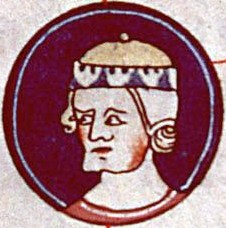 |
Hugh the Great, as depicted in the
illuminated manuscript Arbor genealogiae
regum Francorum : les Robertiens by Bernardus Guidonis
from the 14th century, now held in the Bibliothèque
municipale de Besançon MS 854 folio 8 |
Robert I
Beatrix
Hugh names his mother and father in a charter, dated 26 March 931, donating
some of the land inherited from his mother to the abbey of St. Martin of
Tours.
Hugonis Magni Charta in Recueil
des historiens des Gaules et de la France vol 9 p719 (1874)
[An.
931.] Hugo Rector Abbatiæ sancti Martini. De tantis
omnipotentis Domini promissionibus bene securi, pro amore ejusdem
omnipotentis Dei atque sancti Martini egregii Confessons in eleemosyna
domni et genitoris nostri Rotberti quondam Regis ac genitricis nostræ
domnæ Beatricis, atque nostra, omniumque parentum nostrorum, alodum
juris nostri, quem ex materna hæreditate jure et legaliter, necnon
quieto ordine possidere videmur, Castellionum nomine, cum Ecclesiis,
id est Spantiacum et Pometura atque Sauciacum, situai in pago
Biturigensi, cum omnibus rebus ad ipsum alodum pertinentibus in ipso
pago sitis
This roughly translates as:
[Year 931.] Hugh Rector of the Abbey of St.
Martin. Of the great promises of the Almighty Lord, well assured, for the
love of the same Almighty God and of the excellent Saint Martin, we
confess in charity our lord and parent Robert, formerly King, and our
mother, the lady Beatrice, and ourselves, and all our parents, the
freehold land of our right, which we seem to possess by right and legal
right, and also in quiet order, from our maternal inheritance, by the name
of Castellion, with the churches, that is, Spantiacum and Pometura and
Sauciacum, situated in the village of Biturigensi, with all the things
pertaining to the freehold land in that village.
the daughter of Roger,
count of Maine, and his wife Rothilde,
who was the daughter of Charles the Bald
Rothilde is named as Hugh's mother-in-law and the aunt of Charles the Simple
when her abbey was ytaken away by Charles the Bald in 922.
Les annales de Flodoard p8 (ed. Philippe
Lauer, 1905)
praedictum
Haganonem, cui rex abbatiam Rothildis, amitae suae, socrus autem
Hugonis, dederat, nomine Calam
This roughly translates as:
the
aforementioned Hagano, to whom the King had given the abbey of
Rothilde—the king’s aunt and mother-in-law of Hugh —named Chelles.
Eadhild
the daughter of Edward the Elder, king
of England in 926
Les annales de Flodoard p36 (ed. Philippe
Lauer, 1905)
Annus DCCCCXXVI … Hugo, filius Rotberti, filiam Eadwardi regis
Anglorum, sororem conjugis Karoli, duxit uxorem5.
5. Ethile ou Eadhild, fille d’Edouard Ier l’Ancien,
et sœur d’Athelstan (Louis d’Outre-Mer, pp. 8 et 304). Par ce
mariage, Hugues le Grand s’assurait la neutralité d’Athelstan, dont on
pouvait craindre une intervention en faveur de Charles le Simple. II
devenait le beau-frère de Charles le Simple, dont la femme, Ogive
(Eadgyfu) était aussi fille d’Edouard l’Ancien. Cf. W. G. Searle, Anglo-saxon
bishops, kings and nobles (Cambridge, 1899, in-8o),
p. 346.
This roughly translates as:
In the
year 926 … Hugh, son of Robert, married the daughter of Edward, king of
England, sister of Charles's wife5.
5. Ethile or Eadhild, daughter of Edward the Elder and sister of
Æthelstan (Louis d'Outremer, pp. 8 and 304). Through this
marriage, Hugh the Great secured the neutrality of Æthelstan, whose
intervention in favor of Charles the Simple was a potential concern. He
also became the brother-in-law of Charles the Simple, whose wife, Ogive
(Eadgyfu), was also a daughter of Edward the Elder.
Hedwig
of Saxony in 937
Flodoard put the marriage in 938 so, taking into account, the charter dated
September 937, the marriage was likely in 937.
Hedwig is named as Hugh's wife in a charter, dated 14 September 937,
confirming a donation to the abbey of Saint-Martin of Tours.
Hugonis Magni Charta in Recueil
des historiens des Gaules et de la France vol 9 p721 (1874)
…
concedimus præfato seniori patrique nostro domno Hugoni, necnon
amabillimæ et multùm dilectæ conjugi suæ Haduidi usu et ordine
fructuario illius ipsius res quas idem sancto Martino
This roughly translates as:
… we grant to
the aforementioned lord and our father, Lord Hugh, as well as to his
most amiable and much beloved wife, Hedwig, for their use and the
enjoyment of the fruits thereof, those very properties which he himself
[gave] to Saint Martin.
Les annales de Flodoard p69 (ed. Philippe
Lauer, 1905)
Anno
DCCCXXXVIII … Hugo princeps, filius Rotberti, sororem
Othonis regis Transrhenensis, filiam Heinrici, ducit uxorem.
This roughly translates as:
In the year 938
… Prince Hugh, the son of Robert, took to wife the sister of Otto, king
across the Rhine, and daughter of Heinrich.
Hugh also had a son, Heribert, whose mother was a concubine named Raingarda
Duke of France and Burgundy,
count of Paris and Orléans
Hugh inherited the titles of count of Paris and count of Orléans on his
father's death in 923. He was made duke of France (or duke of the Franks - "Dux
Francorum") by king Louis IV upon his return from England in 936. This
made Hugh "the second after the King" in the realm. He was also granted the
duchy of Burgundy by king Lothair following the death of the previous duke,
Giselbert, in 956, but only held it
briefly before his own death.
Hugh the Great was the most powerful man in 10th-century France who never
wore the crown—by choice. As the kingmaker of the late Carolingian era, he
preferred the security of being a dominant duke over the instability of
being a weak king. Hugh was born into the Robertian dynasty, the son of king
Robert I of France and married powerfully, becoming the son-in-law of king
Edward the Elder of England (through his second wife) and king Henry the
Fowler of Germany (through his third wife, Hedwig of Saxony). Upon his
father’s death and the later death of his brother-in-law king Raoul, Hugh
held enough military and political leverage to take the throne himself.
Instead, he chose to restore the Carolingian line, bringing Louis IV back
from exile in England. Hugh's strategy was to remain the power behind the
throne. He took the title duke of the Franks, which essentially made him
second only to the king. Hugh's career was marked by a constant struggle
with the monarchy - he frequently rebelled against the kings he helped
install when they tried to assert independence, he expanded his territories
across the Seine and Loire valleys, centering his power in Paris and Orléans
and he controlled the wealthiest abbeys in France, notably Saint-Martin of
Tours and Saint-Denis. Hugh was fiercely protective of his family's
interests. A defining moment of his career occurred when king Charles the
Simple seized the abbey of Chelles from Hugh's mother-in-law, Rothilde, to
give it to a favorite named Hagano. Hugh’s outrage over this slight helped
fuel the massive revolt that eventually led to the end of Charles the
Simple’s effective reign. Hugh died in 956 at his stronghold in Dourdan and
was buried in the Basilica of Saint-Denis. While he never took the title of
king, he laid the territorial and political foundation for his son, Hugh
Capet, to be elected king of the Franks in 987. This transition ended
Carolingian rule forever and established the Capetian Dynasty, which would
rule France for centuries.
Four of Hugh's charters, gifting land to various churches, are printed in Hugonis Magni Charta in Recueil
des historiens des Gaules et de la France vol 9 pp719-24
(1874)
The ecclesiastical history of England and Normandy by
Ordericus Vitalis vol 1 p138 (trans. Thomas Forester, 1853)
At this time
Hugh the Great, of Orleans, duke of France, raised himself above all the
nobles of France by his riches and power. He married the daughter of the
emperor Otho, by whom he had three sons, Hugh, Otho, and Henry, and a
daughter of the name of Emma, who married Richard the elder, duke of
Normandy, but died without children.2
2 … Hugh the Great, duke of France and Burgundy,
count of Paris and Orleans, appears on the political scene from 922 to
956, the period of his death. By his third wife, Hadwide or Hedwiges,
sister, and not daughter, of the Emperor Otto I., he had, besides the
children here mentioned, an elder daughter named Beatrice.
The ecclesiastical history of England and Normandy by
Ordericus Vitalis vol 2 pp300-3 (trans. Thomas Forester,
1853)
While
however, Richard, the young duke, was detained for nearly three years in
exile, and the king of France supposed that Normandy was entirely his
own, he had some apprehension of Hugh the Great, duke of Orleans,
rendering aid to the Normans, and he therefore ceded to him Exmes,
Bayeux and all the district of the Cotentin as far as Mont St.
Michel-in-peril-of-the-sea, giving him strict orders to reduce the
rebellious Normans with a strong force, and get possession of their
fortified places. The ambitious marquis received these commands with
great satisfaction, and, at once breaking the treaties which he had
previously entered into, invaded Normandy with a powerful army. Hugh
himself established himself with his household at Gacé, while his troops
overspread the whole province. Herluin, the duke’s chancellor, and Ralph
de Tracy, were quartered at Ouche, and lodged in the convent of St
Evroult the confessor. Both were men of piety and lived in the fear of
God. The simple monks rejoiced to entertain such distinguished men, and
rendered them all hospitable attentions in their power with the utmost
kindness. Conducting them without reserve through their chapels,
oratories, and secret recesses, they showed them, to their loss, the
shrines and relics of the saints which they contained. The strangers
examined with great reverence these objects preserved with so much
secrecy, and on their departure offered their prayers and gifts; but
they returned shortly afterwards, like the Chaldeans to Jerusalem, and
cruelly carried off the holy vessels of the church, and all its valuable
treasures.
Hugh the Great sat down before Exmes with his array, but the
garrison made a brave resistance and prevented his further advance. At
the same time, the king of France entering the country of Evreux with a
strong force spread fire and rapine through all Normandy. Bernard the
Dane being apprized of these incursions, and receiving sure accounts of
the devastation of the country, was in great dismay at his inability to
withstand the attacks of such powerful princes, with only his Norman
levies. In consequence, having keenly surveyed the state of affairs, his
crafty genius devised the means of extricating himself and the people he
governed from the difficulties in which they were placed. He therefore
met the king with the air of a suppliant and thus addressed him: “What
are you doing, my lord the king? Your undertaking is impious and
unbefitting your rank. All this Normandy, which you are ravaging, is
your own. Rouen and the other cities, with the villages and strong
places, throw open their gates at your command, and the whole
population, both rich and poor, submits to you, and having no other lord
respect and love you. Who can have given you the disastrous counsel to
ravage your own property with the sword of the destroyer, and to butcher
a people devoted to you? He must be a wicked traitor who has persuaded
you to devastate your own states with fire and sword.” The king’s heart
was softened by this specious language, so that he dismissed his army
and entered Rouen with Bernard. Bernard gave him a brilliant reception,
surrounded with the citizens full of joy, and having prepared for him a
magnificent banquet entertained him for several days with great respect.
However, as the king was sitting one day after dinner in the great hall,
conversing cheerfully with those about him on affairs of state, the
crafty Barnard addressed them in ambiguous terms: “We have,” he said, “O
Norman lords, great cause for joy, and let us render thanks to God for
it, as we ought. Hitherto we have obeyed a duke of the race of Rollo;
now, by God’s will, we are the subjects of a great king of the race of
the emperor Charlemagne. To this time we have been ducal, now we are
royal, and, what is more, imperial.” All the company applauding this
discourse, and deceiving the French by flattering words, Bernard again
entreated silence, and thus proceeded while there was general attention:
“I acknowledge the shrewdness of the French in many affairs, but there
is one thing my lord the king has done which I cannot approve, for I
perceive in it his own disadvantage and great dishonour. We all know
that Hugh the Great is a traitor, and the son of a traitor; and yet the
king has aggrandized him, as I think, to his own great injuiy, by giving
him the districts of Exmes and the Cotentin, with many thousand men
bearing arms. Some pestilent adviser has taken advantage of his master’s
simplicity, and, to speak the truth, has plunged a dagger into his heart
by persuading his lord to strengthen his enemy against himself. I wonder
much, my lord the king, that you have so entirely forgotten the past. It
is plain to all the world, for such crimes cannot be committed in
private, that Robert,1 Hugh’s father, was a traitor, and
having rebelled against your father Charles, and breaking his oath of
allegiance usurped the crown and deservedly fell in battle. Hugh was a
party to these designs, and disturbed France for seven years while you
were an exile with your uncle Athelstan in England.2 Is it
not clear as the light to any sensible person that he is guilty of high
treason who wickedly suggests to the king that stripping himself of his
own estates, he should lessen his own dominions to augment the strength
of an enemy who will turn it against yourself. Let no one have a share
in the duchy of Normandy, but the king of France be the sole ruler of
the Normans who pay him their willing obedience.”
On hearing this, the king became anxious about the gift he had
voluntarily made to Hugh, without any application on his part, and asked
to be advised what he should do in the affair. The crafty Dane replied
that the king ought without hesitation to annul his engagements, and
give a positive command to Hugh to raise the siege of Exmes; and if he
should rebelliously resist the order, they should fall upon him with
their united forces. Bernard selected two knights for this embassy, and
the king dictated to them the imperious orders they were to carry to
Hugh. Thereupon, the envoys made all haste to the camp of Hugh, and
reported to him faithfully the king’s message: “Your presumption,” they
said, “is intolerable in invading the dominions of your lord the king of
France, and besieging the castle of Exmes, which has been a royal seat
from ancient times. Hear now his commands in this matter; and on the
fealty you owe him, obey them without delay. Raise the siege before
sunset, and give account of your rash enterprise to the king at Laon,
with the advice and judgment of his peers, when he shall appoint a time.
Otherwise, prepare yourself and your people for battle, for the king
your lord, if he finds you here, will attack you with the forces of
France and Normandy before the week is passed.”
This message violently enraged Hugh the Great, and rousing him to
the highest pitch of resentment, he exclaimed to his attendants: “This
weak king must be demented to send me such a message while I am
supporting him with all my power. I never coveted the possession of
Normandy, or demanded any part of it from him; but he made me the
voluntary offer of the whole country on this side of the Seine, as far
as the sea, and required my assistance to subdue these indomitable
pirates. Does he not manifest his folly to all the world when he
threatens to fight me at the very time I am obeying his orders. The man
who serves an unjust master is much to be pitied, and he who submits to
one who is at once faithless and weak is a fool himself. Let us make a
hasty retreat; but see that you devastate the whole country, ruin the
churches, burn the houses, level the ovens and mills, drive off the
flocks and herds of cattle, and carry away with you, never to return,
every sort of plunder, and, loaded with booty, leave those miscreants to
themselves.”
Receiving such orders, the troops dispersed themselves like bands
of robbers throughout the province, and taking the country-people by
surprise, while they thought themselves safe under the duke’s
protection, executed his orders without mercy.
1 Robert, duke of France, second of the name, was son
of Robert the Strong, king of France, June 24, 922—June 15, 923.
2 Louis d’Outre-Mer, who was born in 920, resided at
the court of his uncle Athelstan nearly thirteen years, from the
captivity of King Charles, his father, in 923 to 936, when he was
crowned at Laon.
pp338-40
(trans. Thomas Forester, 1853)
Before a year
was expired, Charles the Simple gave battle to Robert at the city of
Soissons, in which battle Robert the pretender to the throne of the
Franks was slain. While, however, Charles was retiring victorious from
the carnage of the battle, Herbert, the most abandoned of traitors, met
him and, under cover of pretended amity, induced him to accept his
proffered hospitality in the castle of Peronne, where having thus
deceitfully inveigled him, he detained him prisoner: for Robert had
married Herbert’s sister,4 from which union sprung Hugh the
Great. In this strait Charles, with the advice and consent of Hugh the
Great, son of the said Robert, and his nobles of France, raised to the
throne Rodolph, the illustrious son of Richard, duke of Burgundy, whom
he had held at the baptismal font.
… King Rodolph dying on the eighteenth of the calends of February [15th
January], he was buried in the church of St. Columb the Virgin. On his
death, Hugh the Great with the Franks applied to Duke William, surnamed
Longsword,3 to undertake a mission to Ogive, wife of Charles
the Simple, and bring back his son Lewis, who had taken refuge with his
uncle the king of England for fear of Herbert and Hugh. William,
therefore, proceeding to England, and having given hostages, under the
sanction of an oath, to the mother of the young prince, returned with
him to France.
Thereupon, Lewis, son of Charles the Simple, was anointed king at
Laon on the eighteenth of the calends of July [19th June]. Two years
afterwards, on the sixteenth of the calends of March [14th February], at
the time of cockcrowing till the dawn of day, there was the appearance
of armies dyed in blood over all the face of the heavens. The month
following, on the ninth of the calends of April [25th March], the Huns,
who were still pagans, began to ravage France, Burgandy, and Aquitain
with fire and sword. After this, the Frank nobles, and especially Hugh
the Great, revolted against King Lewis.5 The same year a
severe famine prevailed throughout all the kingdom of the Franks, so
that a muid of wheat was sold for twenty-four pence. Not long afterwards
King Lewis, son of Charles the Simple, was, by contrivance of Hugh the
Great, treacherously made a prisoner by the Normans in the city of
Bayeux, where many of the Franks were massacred by the people. After
this, on Tuesday in the month of May, it rained blood upon the labourers
at work in the fields. The same year, in the month of September, King
Lewis having spent his whole life in straits and mortifications, came to
his end and was burid at Rheims, in the cathedral of St. Remi.
The month following, the second of the ides [12th] of November,
his son Lothaire, then a boy, was crowned at Rheims, and Hugh the Great
was made duke of France.3 Two years afterwards, in the month
of August, Hugh the Great laid siege to the city of Poitiers, but
without success; for while he was engaged in the siege, on a certain day
the thunder of the Lord crashed terribly, and the duke’s tent was rent
by a whirlwind from top to bottom, so that both he and his army were
struck with horror, and being in fear for their lives, took to flight,
and abandoned the siege.
4 Beatrix, second daughter of Herbert, count de
Vermandois.
3 Ordericus, following the error or misrepresentation
of his predecessor, Dudon, substitutes here Duke William Long-sword for
William, archbishop of Sens.
5 This league, formed in 938, seized Rheims in 940,
and compelled Lewis d’Outre-Mer to take refuge with Charles Constantine,
prince of Vienne. He returned by Aquitain, and reached Poitiers the 5th
of January, 942.
3 Hugh the Great had been confirmed as long before as
943 in the dignity of duke of France. If there was a fresh confirmation
after the coronation of Lothaire, it was a mere form. He died at Dourdan
the 16th of June, 956, and his son, Hugh Capet, was invested in 960 with
the duchy of France, the counties of Paris and Orleans, and the abbeys
held by his father.
The Encyclopaedia Britannica 11th edition vol
13 pp857-8 (ed. Hugh Chisholm, 1911)
HUGH,
called THE GREAT (d. 956), duke of the
Franks and count of Paris, son of King Robert I. of France (d. 923) and
nephew of King Odo or Eudes (d. 898), was one of the founders of the
power of the Capetian house in France. Hugh’s first wife was Eadhild, a
sister of the English king, Æthelstan. At the death of Raoul, duke of
Burgundy, in 936, Hugh was in possession of nearly all the region
between the Loire and the Seine, corresponding to the ancient Neustria,
with the exception of the territory ceded to the Normans in 911. He took
a very active part in bringing Louis IV. (d’Outremer) from England in
936, but in the same year Hugh married Hadwig, sister of the emperor
Otto the Great, and soon quarrelled with Louis. Hugh even paid homage to
Otto, and supported him in his struggle against Louis. When Louis fell
into the hands of the Normans in 945, he was handed over to Hugh, who
released him in 946 only on condition that he should surrender the
fortress of Laon. At the council of Ingelheim (948) Hugh was condemned,
under pain of excommunication, to make reparation to Louis. It was not,
however, until 950 that the powerful vassal became reconciled with his
suzerain and restored Laon. But new difficulties arose, and peace was
not finally concluded until 953. On the death of Louis IV. Hugh was one
of the first to recognize Lothair as his successor, and, at the
intervention of Queen Gerberga, was instrumental in having him crowned.
In recognition of this service Hugh was invested by the new king with
the duchies of Burgundy (his suzerainty over which had already been
nominally recognized by Louis IV.) and Aquitaine. But his expedition in
955 to take possession of Aquitaine was unsuccessful. In the same year,
however, Giselbert, duke of Burgundy, acknowledged himself his vassal
and betrothed his daughter to Hugh’s son Otto. At Giselbert’s death
(April 8, 956) Hugh became effective master of the duchy, but died soon
afterwards, on the 16th or 17th of June 956.
16 June 956, at Dourdan,
France
Historia
Francorum Senonensis in Monumenta
Germaniæ Historica SS 9 pp366-7 (ed. G. H. Pertz, 1851)
[956]
Secundo anno obiit Hugo Magnus dux Francorum apud Drodingam villam 16.
Kal. Iul., sepultusque est in basilica beati Dyonisii martiris
Parisius. Cui successerunt filii eius, Hugo videlicet, Otto et
Heinricus, nati ex filia Odonis regis. Hugo dux Francorum effectus est
et Otto dux Burgundionum. Defuncto Ottone duce Burgundionum, successit
Heinricus, frater eius.
This roughly translates as:
[956] In the
second year, Hugh the Great, Duke of the Franks, died at the village of
Dourdan on the 16th day before the Kalends of July [16 June], and was
buried in the basilica of the blessed martyr Denis of Paris. He was
succeeded by his sons—namely Hugh, Otto, and Henry—born of the daughter
of King Odo. Hugh was made Duke of the Franks and Otto Duke of the
Burgundians. When Otto, Duke of the Burgundians, died, Henry, his
brother, succeeded him.
The ecclesiastical history of England and Normandy by
Ordericus Vitalis vol 2 pp340-1 (trans. Thomas Forester,
1853)
The same
year died Gilbert, duke of Burgundy, leaving the Duchy to Otho, son of
Hugh the Great, who had married Gilbert’s daughter:5 two
years afterwards Hugh himself, duke of France, died on the sixteenth of
the calends of July [June 16], at Dourdan, and was buried in the church
of St. Denys the martyr, at Paris. He was succeeded by his sons, Hugh,
Otho, and Henry, born of the daughter of Otho, king of the Saxons. Hugh
became duke of the Franks, and Otho of the Burgundians, and on Otho’s
death, his brother Henry succeeded him as duke of Burgundy.1
5 Gilbert died on the 8th of April, 956, and his
son-in-law Otho, son of Hugh the Great, the 23rd of February, in 965,
according to Frodoard.
1 The dates of the succession of Hugh Capet and Otho
are alrendy given. Hudwide, or Hadwidge, their mother, second wife of
Hugh the Great, was sister, not daughter, of the Emperor Otho I., and
consequently daughter of Henry I. of Saxony, surnamed the Fowler, king
of Germany. Henry, duke of Burgundy, called the Great, succeeded his
brother Otho in 965, and died about 1002.
Basilica
of Saint-Denis, Paris, France
- Hugonis Magni Charta in Recueil
des historiens des Gaules et de la France vol 9 p719
(1874); Les annales de Flodoard SS 9 p36 (ed.
Philippe Lauer, 1905); The ecclesiastical history of England and Normandy
by Ordericus Vitalis vol 2 p338 (trans. Thomas Forester,
1853); The Encyclopaedia Britannica 11th edition vol
13 pp857-8 (ed. Hugh Chisholm, 1911); The
Henry Project: The Ancestors of King Henry II of England (Hugues "le
Grand")
- Hugonis Magni Charta in Recueil
des historiens des Gaules et de la France vol 9 p719
(1874); The
Henry Project: The Ancestors of King Henry II of England (Hugues "le
Grand")
- Les annales de Flodoard p8 (ed.
Philippe Lauer, 1905); The
Henry Project: The Ancestors of King Henry II of England (Hugues "le
Grand"); Medieval
Lands (HUGUES)
- Les annales de Flodoard SS 9 p36 (ed.
Philippe Lauer, 1905); The Encyclopaedia Britannica 11th edition vol
13 pp857-8 (ed. Hugh Chisholm, 1911); The
Henry Project: The Ancestors of King Henry II of England (Hugues "le
Grand"); Medieval
Lands (HUGUES)
- Hugonis Magni Charta in Recueil
des historiens des Gaules et de la France vol 9 p721
(1874); Les annales de Flodoard p69 (ed.
Philippe Lauer, 1905); The ecclesiastical history of England and Normandy
by Ordericus Vitalis vol 1 p138 (trans. Thomas Forester,
1853); The Encyclopaedia Britannica 11th edition vol
13 pp857-8 (ed. Hugh Chisholm, 1911); The
Henry Project: The Ancestors of King Henry II of England (Hugues "le
Grand"); Medieval
Lands (HUGUES)
- The ecclesiastical history of England and Normandy
by Ordericus Vitalis vol 1 p138 (trans. Thomas Forester,
1853); The
Henry Project: The Ancestors of King Henry II of England (Hugues "le
Grand"); Medieval
Lands (HUGUES); wikipedia
(Hugh the Great)
- Heribert from Gesta pontificum Autissiodorensium in Patrologiæ Latina vol 138 p271 (ed.
J.P Migne, 1855); The
Henry Project: The Ancestors of King Henry II of England (Hugues "le
Grand"); Medieval
Lands (HUGUES)
- The ecclesiastical history of England and Normandy
by Ordericus Vitalis vol 1 p138 (trans. Thomas Forester,
1853); The Encyclopaedia Britannica 11th edition vol
13 pp857-8 (ed. Hugh Chisholm, 1911); The
Henry Project: The Ancestors of King Henry II of England (Hugues "le
Grand"); Medieval
Lands (HUGUES); wikipedia
(Hugh the Great)
- The ecclesiastical history of England and Normandy
by Ordericus Vitalis vol 2 pp300-3 pp338-40
(trans. Thomas Forester, 1853); The Encyclopaedia Britannica 11th edition vol
13 pp857-8 (ed. Hugh Chisholm, 1911); The
Henry Project: The Ancestors of King Henry II of England (Hugues "le
Grand"); Medieval
Lands (HUGUES); wikipedia
(Hugh the Great)
- Historia Francorum Senonensis in Monumenta
Germaniæ Historica SS 9 pp366-7 (ed. G. H. Pertz, 1851);
The ecclesiastical history of England and Normandy
by Ordericus Vitalis vol 2 pp340-1 (trans. Thomas
Forester, 1853); The Encyclopaedia Britannica 11th edition vol
13 pp857-8 (ed. Hugh Chisholm, 1911); The
Henry Project: The Ancestors of King Henry II of England (Hugues "le
Grand"); Medieval
Lands (HUGUES)
- Historia Francorum Senonensis in Monumenta
Germaniæ Historica SS 9 pp366-7 (ed. G. H. Pertz, 1851);
The ecclesiastical history of England and Normandy
by Ordericus Vitalis vol 2 pp340-1 (trans. Thomas
Forester, 1853); The
Henry Project: The Ancestors of King Henry II of England (Hugues "le
Grand"); Medieval
Lands (HUGUES)
Robert the Strong
 |
Robert the Strong, as depicted in the
illuminated manuscript Généalogie des
rois de France by Bernardus Guidonis c. 1384, now held in
the Bibliothèque
municipale de Besançon MS 677 folio 139v |
Robert was marquis of Neustria, count of
Anjou, count of Blois, count of Auxerre and Nevers, count of Autin,
lay-abbot of Marmoutier
and lay-abbot of Saint-Martin de Tours
Regionis
Chronicon in Monumenta Germaniæ
Historica SS 1 p571 (ed. G. H. Pertz, 1826)
Anno
dominicae incarnationis 861. Carolus placitum habuit in Compendio,
ibique cum optimatum consilio Rodberto comiti ducatum inter Ligerim et
Sequanam adversum Brittones commendavit, quem cum ingenti industria
per aliquod tempus rexit.
This roughly translates as:
In the year of
our Lord's incarnation 861, Charles held a council in Compendium, and
there, with the best advice, he entrusted count Rodbert with the dukedom
between the Loire and the Seine against the Britons, which he ruled with
great industry for some time.
In 864, Robert was wounded in a battle with Vikings:
Annales Bertiniani p74 (1883)
[864]
Rodbertus comes Andegavensis adgrediens duos cuneos de Northmannis qui
in Ligeri fluvio residebant, unum quidem, exceptis paucis evadentibus,
interfecit, et altero maiore retro superveniente, vulneratur. Unde,
paucis suorum amissis, sibi secessu consuluit et post paucos dies
convaluit.
This roughly translates as:
[864] Rodbert,
count of Anjou, attacking two bands of Northmen who were residing on the
Loire River, killed one of them, except for a few who escaped, and was
wounded by the other, who was more numerous, as he came up behind.
Whereupon, having lost a few of his men, he consulted a retreat and
after a few days recovered.
The Encyclopaedia Britannica 11th edition vol
23 p402 (ed. Hugh Chisholm, 1911)
ROBERT
THE STRONG. (le Fort) (d. 866), count of Anjou and of Blois, is
said by Richerus to have been the son of a certain Witichin, but nothing
definite is known about his parentage or early life. Quickly attaining a
prominent position among the Frankish nobles, he appears as rector of
the abbey of Marmoutier in 852, and as one of Charles the Bald’s missi
dominici, in 853; but soon afterwards he was among those who
rebelled against Charles, and invited the king’s half-brother, Louis the
German, to invade West Francia. However, after the peace between Charles
and Louis in 860 Robert came to terms with his sovereign, who made him
count of Anjou and of Blois, and entrusted him with the defence of that
part of his kingdom which lay between the Seine and the Loire, a
district which had suffered greatly from the ravages of the Normans and
the Bretons. By his conduct in many stubborn fights with these foes,
Robert thoroughly earned his surname and gained the confidence of the
king, who gave him the counties of Nevers and Auxerre. He was killed in
battle at Brissarthe in October 866, leaving two sons, Odo, or Eudes,
and Robert, both of whom became kings of the Franks. Robert has been
compared to the Maccabees, and the fact that he was the ancestor of the
Capetian kings of France has invested him with historical importance.
See K. von Kalekstein, Robert der Tapfere (Berlin, 1871);
and E. Favre, Eudes, comte de Paris et roi de France (Paris,
1893).
A biography, in German, of Robert the Strong is Robert der Tapfere, Markgraf von Anjou: der Stammvater
des kapetingischen Hauses (Carl von Kalckstein, 1871).
 |
|
Depiction of the death of Robert the
Strong at the combat of Brissarthe.
|
866, at Brissarthe,
Neustria, in the Battle
of Brissarthe against Vikings and Bretons
Annales Bertiniani p84 (1883)
[866]
Nortmanni commixti Brittonibus, circiter quadringenti de Ligeri cum
caballis egressi, Cinomannis civitatem adeunt. Qua depraedata, in
regressu suo usque ad locum qui dicitur Brieserta veniunt; ubi
Rotbertum et Ramnulfum, Gozfridum quoque et Heriveum comites cum
valida manu armatorum, si Deus cum eis esset, offendunt. Et conserto
praelio, Rotbertus occiditur, Ramnulfus plagatus, cuius vulnere postea
mortuus est, fugatur; et Heriveo vulnerato, et aliis quibusdam
occisis, caeteri ad sua quique discedunt. Et quoniam Ramnulfus et
Rotbertus de praecedentium se vindicta, qui contra suum ordinem alter
abbatiam Sancti Hilarii, alter abbatiam Sancti Martini praesumpserat,
castigari noluerunt, in se ultionem experiri meruerunt.
This roughly translates as:
[866] The
Northmen, mixed with the Britons, set out from the Loire with about four
hundred horsemen, and approached the city of the Cinomans. Having
plundered it, they came on their way back to a place called Brissarthe;
where they encountered counts Robert and Ranulf, and also count Geoffrey
and Herive with a strong force of armed men, if God were with them. And
after a battle, Robert was killed, Ranulf was wounded, from whose wound
he later died, and was put to flight; and Herive, wounded and some
others killed, the rest departed to their own homes. And since Ranulf
and Robert did not wish to be punished for the revenge of their
predecessors, who, against their order, had presumptuously taken the
abbey of St. Hilary, the other the abbey of St. Martin, they deserved to
experience revenge on themselves.
Regionis
Chronicon in Monumenta Germaniæ
Historica SS 1 p578 (ed. G. H. Pertz, 1826)
Anno
dominicae incarnationis 867. Nordmanni oram Ligeris fluminis
occupantes, Namnetensem, Andegavensem, Pictavensem atque Turonicam
provinciam iterato crudeliter depopulari coeperunt; contra quos
Ruotbertus qui marcam tenebat, et Ramnulfus dux Aquitaniae, collecta
multitudine aciem dirigunt. Illi sentientes se ab exercitu insequi,
cum summa acceleratione ad classem repedare contendunt; sed cum
appropinquare insequentium multitudinem cernerent, cognoscentes se
effugere non posse, quandam villam ingrediuntur, ubi se, quantum hora
permisit, communiunt. Erat autem in eadem villa basilica pergrandis ex
lapide constructa, in qua maxima pars Nordmannorum introivit cum duce
eorum nomine Hastingo. Ruotbertus et Ramnulfus cum sociis super eos
irruunt, quoscumque extra basilicam reppererunt, absque mora
trucidant. Ad ecclesiam pervenientes, cum vidissent locum munitum, et
animadvertissent non modicam turbam paganorum intrinsecus latitantem,
parumper deliberantes, castra in circuitu statuunt, tentoria figunt,
ut in crastinum, exstructis aggeribus applicatisque machinis, hostes
totis viribus expugnarent; declinabat quippe iam sol ad occasum.
Ruotbertus nimio calore exaestuans, galeam et loricam deposuit, ut
aura collecta paulisper refrigeraretur; cumque unusquisque in
positione castrorum intenderet, repente Nordmanni a munitione
exiliunt, et cum ingenti clamore super Ruotbertum ac socios impetum
faciunt. Sed quamvis repentini et subitanei casus etiam fortissimos
viros in bello conturbare soleant, tamen arma quam citius corripiunt,
hostes viriliter excipiunt, et cedentes in basilicam redire
compellunt. Ruotbertus absque galea et lorica accurrens, cum incautius
dimicaret, et inimicos ultro insequeretur, interfectus est in introitu
ipsius ecclesiae; eius corpus iam exanime Nordmanni intrinsecus
trahunt. Porro Ramnulfus, cum eminus stans eventum rei specularetur, a
quodam Nordmanno per fenestram basilicae sagittae ictu graviter
vulneratus est, et a suis ex certamine eductus, vix triduo supervixit.
Tali infelici infortunio pugna commissa est et finita; exercitus
amisso capite errore pariter ac moerore repletus, solvit eadem hora
obsidionem, et ad propria revertitur; Nordmanni ovantes ad classem
dirigunt gressum.
This roughly translates as:
In the year of
our Lord's incarnation 867. The Northmen, occupying the banks of the
Loire river, began to cruelly depopulate Namur, Anjou, Pictou and the
province of Tours again; against whom Robert, who was marquis, and
Ranulf, duke of Aquitaine, gathered a multitude and directed their
battle. They, feeling that they were being pursued by the army, hastened
to return to the fleet with the utmost acceleration; but when they saw
the multitude of those pursuing them approaching, knowing that they
could not escape, they entered a certain village, where they communed as
much as the hour permitted. Now in that village there was a very large
basilica built of stone, into which the greater part of the Northmen
entered with their leader named Hastings. Robert and Ranulf with their
allies rushed upon them, and without delay slew whomever they found
outside the basilica. Arriving at the church, when they saw the
fortified place and noticed a considerable crowd of pagans hiding
inside, they deliberated for a while, pitched camp around it, pitched
tents, so that on the next day, having built ramparts and applied
engines, they would attack the enemy with all their might; for the sun
was already setting. Robert, burning with the excessive heat, took off
his helmet and breastplate, so that the collected air might cool him for
a while; and as each one was preparing for the position of the camp, the
Northmen suddenly leapt out of the fortifications, and with a great
shout made an attack on Robert and his companions. But although sudden
and unexpected accidents are wont to discomfit even the bravest men in
war, yet they quickly seized their weapons, manfully received the enemy,
and compelled them to retreat back into the basilica. Robert, running in
without helmet and breastplate, while he was fighting carelessly and
pursuing his enemies, was killed at the entrance of the church itself;
his body, now lifeless, was dragged inside by the Northmen. Furthermore,
Ranulf, while standing at a distance and watching the outcome of the
event, was seriously wounded by a Northman through the window of the
basilica with an arrow, and was carried out of the battle by his men,
barely surviving three days. With such an unfortunate misfortune the
battle was committed and ended; the army, having lost its leader, filled
with both error and sorrow, raised the siege at the same hour and
returned to its own; the Northmen, cheering, directed their march
towards the fleet.
Robert I
 |
Robert I, as depicted in the illuminated
manuscript Arbor genealogiae regum
Francorum : les Robertiens by Bernardus Guidonis from the
14th century, now held in the Bibliothèque
municipale de Besançon MS 854 folio 8 |
Robert the
Strong
Regionis
Chronicon in Monumenta Germaniæ
Historica SS 1 p578 (ed. G. H. Pertz, 1826)
867
… Non multo post interiecto tempore Hugo abba in locum Ruotberti
substitutus est, vir strenuus, humilis, iustus, pacificus et omni
morum honestate fundatus; siquidem Odo et Ruotbertus, filii Ruotberti,
adhuc parvuli erant, quando pater extinctus est, et idcirco non est
illis ducatus commissus.
This roughly translates as:
867 … Not long
after, Abbot Hugh was substituted in Robert's place, a man of great
energy, humility, justice, peace, and integrity of character; for Odo
and Robert, Robert's sons, were still young when their father died, and
therefore the duchy was not entrusted to them.
Beatrix
Beatrix is documented as the mother of Hugh the Great in one of Hugh's
charters, dated 931, in which he donates some of the land inherited from his
mother to the church.
Hugonis Magni Charta in Recueil
des historiens des Gaules et de la France vol 9 p719 (1874)
[An.
931.] Hugo Rector Abbatiæ sancti Martini. De tantis
omnipotentis Domini promissionibus bene securi, pro amore ejusdem
omnipotentis Dei atque sancti Martini egregii Confessons in eleemosyna
domni et genitoris nostri Rotberti quondam Regis ac genitricis nostræ
domnæ Beatricis, atque nostra, omniumque parentum nostrorum, alodum
juris nostri, quem ex materna hæreditate jure et legaliter, necnon
quieto ordine possidere videmur, Castellionum nomine, cum Ecclesiis,
id est Spantiacum et Pometura atque Sauciacum, situai in pago
Biturigensi, cum omnibus rebus ad ipsum alodum pertinentibus in ipso
pago sitis
This roughly translates as:
[Year 931.]
Hugh Rector of the Abbey of St. Martin. Of the great promises of the
Almighty Lord, well assured, for the love of the same Almighty God and
of the excellent Saint Martin, we confess in charity our lord and parent
Robert, formerly King, and our mother, the lady Beatrice, and ourselves,
and all our parents, the freehold land of our right, which we seem to
possess by right and legal right, and also in quiet order, from our
maternal inheritance, by the name of Castellion, with the churches, that
is, Spantiacum and Pometura and Sauciacum, situated in the village of
Biturigensi, with all the things pertaining to the freehold land in that
village.
A countess Adelæ is documented with count Robert in a charter of Charles the
Simple, dated 21 May 907. She has been the subject of unresolved debate as
to whether she is an earlier or later wife to Robert than Beatrix, or
perhaps Robert's daughter, presumably the otherwise unnamed daughter who
married Heribert II.
Caroli Simplicis Diplomata in Recueil
des historiens des Gaules et de la France vol 9 p505 (1874)
Unde
interventu quorumdam Principum viciniùs nobis assistentium, Frederunæ
videlicet conjugis carissimæ, necnon et dilectæ Gislæ Abbatissæ, atque
venerandi Comitis Roberti, et Adelæ Comitissæ, Altmari quinetiam atque
Erchengarii Comitum et Roberti nobis dilecti, humiliter expetiit ut ad
supplementum desolatæ Ecclesiæ Abbatiam S. Petri, Resback nomine
dictam
This roughly translates as:
Wherefore,
through the intervention of certain Princes who were near us, namely
Frederuna, our dearest wife, as well as the beloved Abbess Gisla, the
venerable Count Robert, and Countess Adele, the quintet of Altmar, the
Counts of Erchengary, and our beloved Robert, humbly requested that the
Abbey of St. Peter, called Resback, be built as a supplement to the
desolate Church.
(mother not documented)
Robert was crowned king of
France or king of the Franks at Reims on 29 June 922, reigning for less than
a year until his death on 15 June 923. When his elder brother, Eudes, became
king in 888, Robert was given many offices, including marquis of Neustria,
count of Paris, count of
Orléans, count
of Tours, abbot of Saint-Martin de Tours and lay-abbot of Marmoutier.
Flodoardi
annales in Monumenta Germaniæ Historica
SS 3 pp370-1 (ed. G. H. Pertz, 1839)
Anno 922
… Rotbertus igitur super Maternam fluvium Rodulfo filio Richardi,
genero suo, procedit obviam; quem sequens Karolus cum Lothariensibus,
Maternam transiit, et castrum Sparnaci direptum est ab Haganonis
complicibus. Rotbertus etiam, praefato Rodulfo cum Burgundionibus
veniente, fluvium transiens subter Sparnacum, non longius tribus
leugis ab exercitu Karoli castra metatus est; ubi una magis ebdomada
consederunt utrique, ad colloquium ceteri praeter Haganonem et Karolum
venientes.
Hugo interea filius Richardi ad Rotbertum veniens, ducentos
circiter ex his qui cum Haganone erant obvios habuit, in villas
episcopii Remensis abeuntes praedari; quibus captis, tribus tantum
occisis, equos cum armis abstulit et ad suos ignominia oneratos
remisit ceteros. Hinc Rotbertus apud Calmiciacum et Karolus circa
Remis castra metati sunt; ubi cum tribus continuis consedisset diebus,
una scilicet a civitate leuga, et nonnulli ex equis illorum caperentur
a civibus Remorum, una tantum die, dominica videlicet pentecostes,
contra urbem pugnarunt. Ubi nonnullis occisis ex Lothariensibus,
vulneratisque plurimis, nox praelium diremit. Audito denique, quod hi
qui cum Rotberto erant Laudunum captum haberent, et thesauros
Haganonis, qui inibi erant, dispertiti essent, et unum de fratribus
eius ibi comprehendissent, Karolus cum Haganone Laudunum contendit.
Lotharienses quidam regrediuntur ad sua; quidam cum Karolo pergunt.
Rotbertus super Axonam tentoria fixit. Karolus, abnegato sibi introitu
Lauduni, resedit super fluvium Saram, et Rotbertus castra metatus est
super Aleam. Et cum cotidie copiis Rotberti crescentibus, decrescerent
Karoli, clam tandem secedens cum Haganone trans Mosam proficiscitur.
Franci Rotbertum seniorem eligunt ipsique sese committunt. Rotbertus
itaque rex Remis apud sanctum Remigium ab episcopis et primatibus
regni constituitur. Heriveus Remorum archiepiscopus obiit tertia die
post consecrationem Rotberti regis, scilicet 6 Nonas Julii
This roughly translates as:
In the year 922
… Robert therefore went over the river Marne to meet Rudolf, the son of
Richard, his son-in-law; following him, Charles with the Lotharians
crossed the Marne, and the castle of Sparna was plundered by Haganon's
accomplices. Robert also, when the aforementioned Rudolph came with the
Burgundians, crossed the river below Sparna, and pitched his camp not
far from Charles' army; where they both stayed for about a week, the
others coming to the conference except Haganon and Charles.
Meanwhile, Hugh, the son of Richard, coming to Robert, met about
two hundred of those who were with Haganon, going to plunder the
villages of the bishopric of Reims; having captured them, having killed
only three, he took away their horses with their weapons and sent the
rest back to their own people, burdened with disgrace. From here Robert
and Charles pitched their camp near Reims; where, having camped for
three consecutive days, namely one league from the city, and some of
their horses were captured by the citizens of Reims, they fought against
the city on only one day, namely Pentecost Sunday. Where some of the
Lotharians were killed and many wounded, night broke up the battle.
Finally, hearing that those who were with Robert had captured Laudun,
and had scattered the treasures of Haganon, which were there, and had
arrested one of his brothers there, Charles rushed to Laudun with
Haganon. Some of the Lotharians returned to their own; some continued
with Charles. Robert pitched his tents on the Axon. Charles, having
denied himself access to Laudun, settled on the river Sara, and Robert
pitched his camp on Ale. And as Robert's forces grew daily, Charles's
diminished, he finally secretly withdrew with Haganon and set out across
the Meuse. The Franks chose Robert the Elder and they committed
themselves to him. Robert was therefore made king of Reims at Saint
Remigius by the bishops and primates of the kingdom. Heriveus,
Archbishop of Reims, died on the third day after the consecration of
king Robert, namely on the 6th Nones of July [2 July]
The Encyclopaedia Britannica 11th edition vol
23 p398 (ed. Hugh Chisholm, 1911)
ROBERT
I. (c 865-923), king of France, or king of the Franks, was
the younger son of Robert the Strong, count of Anjou, and the brother of
Odo, or Eudes, who became king of the western Franks in 888. Appointed
by Odo ruler of several counties, including the county of Paris, and
abbot in commendam of many abbeys, Robert also secured the
office of duke of the Franks, a military dignity of high importance. He
did not claim the crown of France when his brother died in 898; but
recognizing the supremacy of the Carolingian king, Charles III., the
Simple, he was confirmed in his offices and possessions, after which he
continued to defend northern France from the attacks of the Normans. The
peace between the king and his powerful vassal was not seriously
disturbed until about 921. The rule of Charles, and especially his
partiality for a certain Hagano, had aroused some irritation; and,
supported by many of the clergy and by some of the most powerful of the
Frankish nobles, Robert took up arms, drove Charles into Lorraine, and
was himself crowned king of the Franks at Reims on the 29th of June 922.
Collecting an army, Charles marched against the usurper, and on the 15th
of June 923, in a stubborn and sanguinary battle near Soissons, Robert
was killed, according to one tradition in single combat with his rival.
Robert left a son, Hugh the Great, duke of the Franks, and his grandson
was Hugh Capet, king of France.
See F. Lot, Les Derniers Carolingiens (Paris, 1891); and
E. Lavisse, Histoire de France, tome ii. (Paris, 1903).
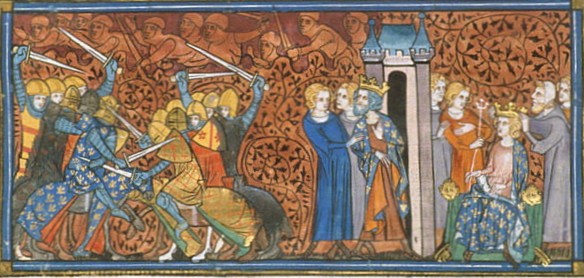 |
|
Depiction of (from left to right): the
Battle of Soissons, the imprisonment of Charles III and the
coronation of Rudolph, created between 1332 and 1350.
illustration in the Chroniques de
Saint-Denis manuscript (Royal 16 G VI f. 248) held at the
British Library, posted on wikipedia
|
15 June 923, in the Battle
of Soissons, near the abbey
of Saint-Médard de Soissons, Neustria
Flodoardi
annales in Monumenta Germaniæ Historica
SS 3 p371 (ed. G. H. Pertz, 1839)
Anno 923
Rotbertus in regnum Lothariense proficiscitur, locuturus cum Heinrico,
qui ei obviam venit in pagum Ribuarium super fluvium Ruram; ubi se
invicem paverunt, et pacta amicitia, datisque ab alterutro muneribus,
discesserunt. Ubi etiam quidam Lotharienses dederunt obsides, et
inducias a Rotberto acceperunt usque in Kalendas Octobris. … Karolus
cum suis Lothariensibus, inducias quas nuper a Rotberto acceperant
infringentibus, Mosam transiens, ad Atiniacum venit, et antequam
Rotbertus suos fideles adunare potuisset, super Axonam insperate, ubi
Rotbertum sub urbe Suessonica sedere compererat, adiit. Et in
crastinum, die dominica, hora iam sexta praeterita, Francis dehinc
illa die praelium non sperantibus, plurimis quoque prandentibus,
Karolus Axonam transiit, et super Rotbertum cum armatis Lothariensibus
venit. Rotbertus vero armatis his qui secum erant, contra processit;
commissoque praelio, multis ex utraque parte cadentibus, Rotbertus
quoque rex lanceis perfossus cecidit. Hi tamen, qui erant ex parte
Rotberti, Hugo scilicet ipsius filius, et Heribertus cum ceteris,
victoria potiti, Karolum cum Lothariensibus in fugam verterunt; sed ob
mortem regis sui Rotberti eos persequi destiterunt, campum vero
obtinuerunt spoliaque ab eis, maxime autem a rusticanis et ex
Suessonicae urbis suburbio confluentibus, direpta sunt.
This roughly translates as:
In the year
923, Robert set out for the kingdom of Lotharingia, to speak with Henry,
who came to meet him in the village of Ribuarium on the river Rura;
where they fed each other, and having agreed on friendship and given
gifts from each other, they departed. Where also some Lotharingians gave
hostages, and received a truce from Robert until the Kalends of October.
… Charles with his Lotharingians, breaking the truce which they had
recently received from Robert, crossed the Meuse, came to Atiniacum, and
before Robert could gather his faithful, he unexpectedly went over the
Axona, where he had found Robert sitting under the city of Soissons. And
on the following day, Sunday, already past the sixth hour, the French
not expecting battle that day, and many of them also having lunch,
Charles crossed the Axona, and came upon Robert with armed
Lotharingians. Robert, however, with those who were with him armed,
advanced against him; And when the battle was joined, many fell on both
sides, and King Robert also fell, pierced through with spears. However,
those who were on Robert's side, namely Hugh his son, and Herbert with
the others, having gained the victory, put Charles and the Lotharians to
flight; but because of the death of their king Robert, they ceased to
pursue them, but they gained the plain and plundered them, especially
from the peasants and those who had come from the suburbs of the city of
Soissons.
Historia
Francorum Senonensiss in Monumenta
Germaniæ Historica SS 9 p366 (ed. G. H. Pertz, 1851)
922.
Secundo anno post eius mortem Robertus princeps rebellavit contra
Karolum Simplicem, unctusque est in regem 3. Kal. Iulii. Et nondum
anno expleto 17. Kal. Iulii factum est bellum Suessionis civitate
inter Karolum Simplicem et ipsum Robertum, qui regnum Francorum
invaserat; ubi interfectus est ipse Robertus. —Karolo vero a cede
belli victore revertente, occurit illi Herbertus infidelium
nequissimus, et sub fictae pacis simulatione in castro quod Parrona
dicitur ut hospitandi gratia diverteret conpulit. Et sic eum dolo
captum retinuit. Habebat enim idem Robertus sororem istius Herberti in
conjugio; de qua ortus est Hugo Magnus.
This roughly translates as:
922. In the
second year after his death, prince Robert rebelled against Charles the
Simple, and was anointed king on the 3rd Kalends of July [29 June]. And
not yet completed was the year, on the 17th Kalends of July [15 June],
war broke out in the city of Soissons between Charles the Simple and
Robert himself, who had invaded the kingdom of the Franks; where Robert
himself was killed. —But as Charles was returning victorious from the
war, Herbert, the most wicked of infidels, met him, and under the
pretense of a false peace, he drove him away to the castle called
Parrona, in order to entertain him. And thus he captured him by deceit
and kept him. For the same Robert had the sister of this Herbert in
marriage; from whom Hugh the Great was born.
_____
Robert I
Heribert
II
Flodoard refers to the sons of Heribert being nephews of Hugh
the Great, who was a son of king Robert
I, showing that Heribert must have been married to Hugh's sister, who
was thus a daughter of Robert I, although her name is not known.
Flodoardi
annales in Monumenta Germaniæ Historica
SS 3 p390 (ed. G. H. Pertz, 1839)
Anno 943
… revertitur ad Compendium, ubi eum expectabat Hugo dux cum nepotibus
suis, Heriberti filiis, de quibus recipiendis frequens agitabatur
intentio.
This roughly translates as:
In the year 923
… [king Louis
d'Outremer] returned to Compendium, where Duke Hugh was waiting for him
with his nephews, the sons of Heribert, whose return was frequently
discussed.
p393
Anno 946
quidam motus inter filios Heriberti comitis agitantur pro hereditatum
distributione suarum. Qui tamen, Hugone principe avunculo ipsorum
mediante, pacantur, divisis sibi, prout eis competens visum est,
rebus.
This roughly translates as:
In the year 946
some
disturbances arose among the sons of count Heribert over the
distribution of their inheritances. However, through the mediation of
their uncle prince Hugh, they were pacified, dividing their property
among themselves as seemed best to them.
In 931, king
Rudolph besieged Heribert and his wife in a castle in Laon. Heribert
escaped the siege, leaving his wife in the castle which was captured by the
king.
Flodoardi
annales in Monumenta Germaniæ Historica
SS 3 p380 (ed. G. H. Pertz, 1839)
Anno 931
… sicque pergens Laudunum, obsidet inibi Heribertum, qui ibidem sese
concluserat cum suis. Nec diu persistens, locum petit egrediendi;
datoque sibi spatio, recedit, dimissa uxore sua in arce, quam infra
Laudunum ipse construxerat. Ad quam postea capiendam majoris laboris
et morae opus regi fuit
This roughly translates as:
In the year 931
… And so,
proceeding to Laudunum, [king Rudolph] besieged Heribert there, who had
shut himself up there with his men. Not long in remaining, he sought a
place to come out; and, having given himself space, he withdrew, leaving
his wife in the castle, which he himself had built below Laudunum. To
capture which afterwards required the king great labor and delay.
Return to Chris Gosnell's Home Page
If you have any comments, additions or modifications to the information on this page, please feel free to email me.
Created and maintained by: chris@ocotilloroad.com


